Warming climate lands on students' agenda
Regardless of what comes out of international climate change negotiations in Copenhagen next month,
By Stephanie Waddell on November 30, 2009
Regardless of what comes out of international climate change negotiations in Copenhagen next month, F.H. Collins Secondary School students were told Friday they can make a difference in their future environment.
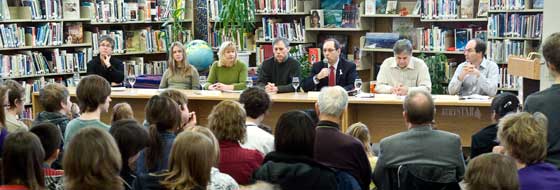
Students gathered in the school's library late Friday morning for a panel discussion on climate change.
It featured local environmentalists and politicians, including Yukon NDP Leader Elizabeth Hanson; Northern Climate Exchange director Lacia Kinnear; Environment Minister Elaine Taylor; John Streicker, a climate change scientist and the territory's Green Party candidate in the next federal election; Liberal Leader Arthur Mitchell; Yukon MP Larry Bagnell and economist Keith Halliday.
"It's incredibly big, but it shouldn't daunt us,” Streicker said of the issue to a packed library, noting the importance of encouraging the federal government to "do the right thing.”
Organized by Malkolm Boothroyd, a young environmentalist, the event was held to draw attention to the negotiations in Copenhagen set to begin next Monday.
Prime Minister Stephen Harper has been criticized by environmental organizations across the country for low targets on cutting greenhouse gases, committing to a 20 per cent cut below 2006 levels by 2020 and between 60 and 70 per cent below 2006 rates by 2050.
As Bagnell pointed out, climate change is affecting the North in major ways.
"Our highways are buckling,” he said, going on to point to other examples showing climate change puts infrastructure at risk.
Other environmental impacts were noted among the panelists, as were economic issues.
There's a strong consensus emerging, Halliday pointed out, that dealing with climate change won't be as simple as producing more environmentally-friendly vehicles and other such products.
The federal government is debating whether the country should have a 2.3 per cent or 2.1 per cent growth while the rest of the world watches and "boos,” an emotional Streicker told the students.
"We have to do a lot better,” he said.
On the territorial front, Taylor cited recent meetings she attended with Bagnell in Ottawa to meet the federal environment minister, the Yukon government's climate change action plan, and plans to attend the Copenhagen meetings, along with the two opposition environment critics, representatives of the Council of Yukon First Nations and other organizations.
"It comes down to our individual actions as well,” she said.
Boothroyd began his questioning by stating the targets Canada is proposing here would be only a three per cent cut of greenhouse gas emissions in 1990. He then questioned panelists on where those targets should be.
"Canada does not go far enough,” Taylor said, arguing again that everyone has to do their part in dealing with climate change.
The Yukon, she pointed out, is well below the targets outlined in the last international agreement on climate change negotiated in Kyoto in 1997.
"We need to continue to do our part,” she said, adding she supports more ambitious goals for both Canada and the U.S., which is proposing a 17 per cent decrease of 2006 emission levels by 2020.
Mitchell was quick to note part of the reason the Yukon has lower greenhouse gas emissions comes from the 1998 closure of the Faro mine.
"Three per cent is not in any way sufficient,” he said, noting both the economic and environmental costs which come from things like beetle infestation, forest fires and so on.
Hansen suggested an 80 per cent decrease by 2050.
"We have to go there with some creative ideas,” Bagnell said, after noting the importance of planning and negotiating in Copenhagen in good faith.
What's clear economically is that for any aggressive targets, there will have to be a significant price hike in fuel costs. That may come anyway as a number of oil theorists have stated their belief the world may be running out of cheap oil, Halliday said.
"We have to start getting ready now,” he said, pointing to Norway as an example of a country that has made moves in that direction on a number of fronts.
If things don't change, one student in the audience wondered, what impacts will that have on the planet? Kinnear, Bagnell and Streicker noted the possibilities of more forest fires, changes to migration patterns, droughts, less access to clean water and even the possibility of less oxygen as the situation puts plankton in the ocean at risk. Halliday was quick to point out that addressing climate change is something that's never been done before.
"We simply don't know,” he said. "There's enormous uncertainty about what the world might look like in 2040.”
Similarly, he said, responding to another question on whether these negotiations will have any impact, it's unknown whether these talks will end up being just another Kyoto situation where discussions end with few results years later.
Pointing to the resistance to a proposed carbon tax, Halliday went on to argue that while there's scientific and economic consensus on climate change, it seems as though government and voters aren't ready to act.
Referring to herself as an "eternal optimist”, Taylor suggested there is now a more heightened awareness of climate change than there was during the Kyoto climate change protocol negotiations in 1997.
More countries are also coming together to negotiate this time around and several organizations are taking an aggressive stand on climate change.
She also used the opportunity once again to cite a number of Yukon government initiatives such as taking Pelly Crossing off diesel power and connecting the community to the electrical grid.
"It really does matter what we do here at home,” she said.
Mitchell also argued the power of local involvement.
"You've got a huge power,” he told the students, suggesting that once they get to voting age to cast their ballots. "You have to hold politicians accountable.”
Following the panel session, students gathered outside the school for a climate change rally.
A fire was lit beneath an ice sculpture of Earth, symbolizing "the detrimental effects of climate change, and (to) demand serious action on climate change from the Canadian government,” it was noted in a statement released last Wednesday.
Comments (3)
Up 0 Down 0
Joel on Dec 2, 2009 at 8:51 am
So, now that the science of the "greenhouse effect" has been proven to be created by a few misguided scientists, what will happen?
I believe in climate change and also more and more believe it has to do with solar output more than carbon dioxide emissions...this is the true science of what is happening. I also believe in making the best use of every resource that we have.
People's ignorance on this subject actually is embarassing...and amazing I agree with francias on this one...
Up 0 Down 0
footprints on Dec 2, 2009 at 4:32 am
Future technological advances may very well allow us to extract a lot more of the oil from the remaining reserves than is possible with present technology. In any case, at some point energy expended extracting oil will exceed energy returned by oil = "No Oil".
"Peak Oil" is only a question of when, and even the most optimistic of experts claim the equation is over the hump without factoring in the possibilities of future technology, viable alternatives and/or adjustment of our lifestyles.
The sooner we break from fossil fuel dependence the better. And if it turns out that lowering Co2 concentrations in our atmosphere significantly reduces global warming then BONUS!
If you don't like what Big Biz/Gov is doing then start supporting the alternatives.
Up 0 Down 0
francias pillman on Nov 30, 2009 at 10:26 am
Peoples ignorance on this subject is embarrassing. If climate change was indeed human caused, the average person has absolutely nothing to do with it. Its just another scam to put the cost onto the working man. Why don't you big pros on the environment every talk about weather modification? China does all time. That absolutely can affect the weather in other parts of the world. Are you scared of the truth, or just enjoy being ignorant? We don't design the cars and products that pollute the environment, corporations do.I applaud harper on standing firm and sticking to his guns, because he knows the dire consequences of this disgusting scam called climate change. Believe what you want but if you just choose to see the issue from al gores eyes, you lose. And in all honesty you are a dangerous threat promoting an agenda you have no clue about, and seem to really not care.