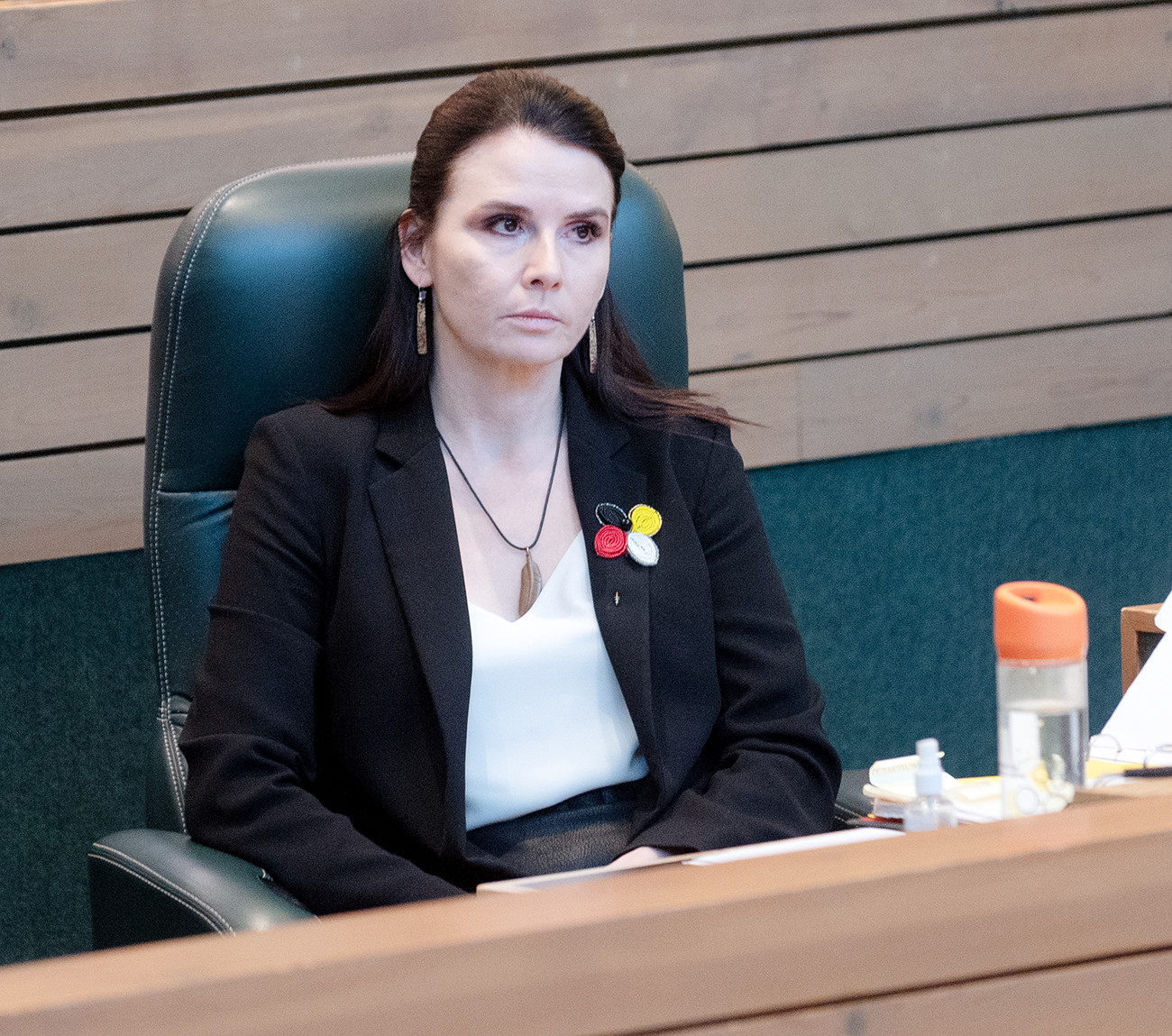
Photo by Whitehorse Star
Education Minister Jeanie McLean
Photo by Whitehorse Star
Education Minister Jeanie McLean
Preparations for the establishment of First Nation School Boards were unveiled Friday.
Preparations for the establishment of First Nation School Boards were unveiled Friday.
The intent is to have the new board up and running by the beginning of the next school year.
The First Nation School Board Framework was announced last June. It sets out the process for the creation of the board under the Education Act.
Five school councils have submitted resolutions to trigger a referendum on their school falling under the authority of a newly established First Nation School Board. The referenda will be held next month under the supervision of Elections Yukon.
One other First Nation has submitted a petition to have a referendum next month.
On Friday, Richard Provan, the director of policy and planning with the Department of Education, explained the opportunities for school councils to transition to school boards.
First Nations will have greater involvement in education in their communities as well as have opportunities to advance reconciliation, he said.
Provan said 10 First Nations signed on to the initiative to transition school councils to school boards.
Today is the deadline for school councils to submit a resolution to hold a referendum next month to determine if their community supports moving to a First Nation School Board.
School councils that do not submit resolutions by the end of today will have to wait a year before the next opportunity comes up, Provan explained.
“We all have a responsibility to ensure that our educational system is reflective of First Nations history, culture and languages,” Education Minister Jeanie McLean said in a statement.
“The First Nation School Board Framework Agreement provides a path to advance reconciliation and provides First Nation governments greater authority in the education of their citizens.
“A school board is an additional tool to support Yukon First Nations to meaningfully shape their children’s education and improve their educational outcomes,” the minister said.
The five school councils that submitted resolutions are:
• Chief Zzeh Gittlit School (Old Crow);
• Grey Mountain Primary School;
• Johnson Elementary School and Watson Lake Secondary School, which includes one referendum;
• Ross River School; and
• St. Elias Community School (Haines Junction).
Takhini Elementary School is filing a petition calling for a vote next month.
Voting will be held between Jan. 11 and Jan. 27, with results to be announced on Jan. 31.
Those 18 and older living in each school’s catchment area will be eligible to vote. Parents or guardians living outside the catchment area can still vote if they have a child attending the school in question.
A school board is made up of elected trustees who have the additional responsibilities of staffing, resources and curriculum used under the board’s authority.
Unlike school councils, which only participate in the selection of the principal, school boards select all school staff, including principals and teachers.
School board authority includes hiring, dismissal, discipline, transfer, promotion and demotion; subject to the act and any applicable collective agreement.
Melanie Bennett is the executive director of the First Nation directorate. She said the Yukon is an anomaly right now in moving to the school board model.
Fundamental to the board process will be collaboration and community involvement, she explained. Direction, she said, will come from the community level.
Bennett said having a board brings the ability to have local control over decision-making.
There will be a returning officer appointed by Elections Yukon to oversee the vote in each of the school districts, and the referendum officer will be responsible for establishing a voting venue.
The Education Act allows for First Nation school boards. The boards will remain under the act’s jurisdiction.
The Yukon government will remain responsible for providing the First Nation boards with funding and the general curriculum.
Bennett said provisions under the Education Act are all about promoting inclusivity.
The First Nations never wanted exclusivity, because it’s all about community, she said.
Bennett said the creation of First Nation school boards has been something they’ve wanted for many years.
It’s been almost 50 years since the release of the Together Today for Our Children Tomorrow, the document that provided the foundation for Aboriginal land claim agreements in the territory, she pointed out.
In order to encourage thoughtful and responsible discussion, website comments will not be visible until a moderator approves them. Please add comments judiciously and refrain from maligning any individual or institution. Read about our user comment and privacy policies.
Your name and email address are required before your comment is posted. Otherwise, your comment will not be posted.
Comments (10)
Up 6 Down 2
yukon56 on Dec 17, 2021 at 3:59 pm
Have the FN build and staff their own school, not that it makes any difference as it all comes out of our tax dollars.
Up 9 Down 14
Reply to 'Bonanzjoe'--Incredulous comments Bozojoe on Dec 15, 2021 at 4:45 pm
They already had schools for FN only---those schools were called 'Residential schools.' Ever heard of them? Do you think any white children went to residential school? Pull your head out of your _ _ _ and stop making thoughtless, ignorant comments. And for the record, all of the great elite programs like ACES, MAD, CHAOS, OPUS, should include FN. CHAOS is supposed to be for FN but ends up having a mix which is a good thing. The other elite programs should have FN quotas instead of just filling programs like MAD with privileged, caucasian students, most of whom are from lawyer, teacher, and educated government worker families. Don't believe me? Ask for their demographic. That's why we need integration, of everybody, with a focus on elevating FN students, not putting them in 'their own school.' Those experiential programs were originally created to help learners who were struggling--my how that's changed.
Up 23 Down 21
Matthew on Dec 14, 2021 at 4:01 am
Aren't they segregating themselves? They must think titles and money changes things.. exact opposite if you asked an elder 150 yrs ago.. they say titles and money changes you.. doesn't it ?
Up 28 Down 22
Reply to some schools on Dec 14, 2021 at 2:15 am
Please don't use fear of the unknown to dissuade voters. Please use facts in your argument.
All of the communities that are moving forward with this are within the Traditional Territory of a First Nation that has signed onto the First Nation School Board Framework Agreement. (10 of the 14 First Nations in the Yukon signed on.) So yes, the First Nation is clearly in support of this move.
In Whitehorse, Grey Mountain is most closely affiliated with Ta'an Kwach'an (Ta'an is one of the First Nations that signed), and Takhini Elementary does not have a close relationship with any one First Nation and represents a wide variety of Indigenous nations in its student population. Your example of Elijah Smith is an anomaly in Whitehorse, and this school is not going to referendum. And it is this close relationship with Kwanlin Dun that ensures that First Nations ways of knowing and doing are better represented in this school. No other school in Whitehorse has this kind of relationship.
Additionally, the funding formula will need to be negotiated with the soon-to-be elected First Nation School Board, so nothing is being hidden from you, it has not been negotiated yet. And this funding formula definitely will not be taking away from students within the current funding formula. This is not how it works. They can't just reallocate funding.
(And YFNED is a completely separate funding source not at all tied to the school system or YG, so it doesn't make sense in your argument.)
Please at the very least use facts. Change can be scary, but it can also be exciting. Educate yourself. Ask questions. Join the information sessions the YG and YFNED are hosting. Don't make assumptions. Don't use fear. This whole process has been well thought out and is long overdue.
Up 33 Down 16
Salt on Dec 13, 2021 at 9:41 pm
The socialists are eating the Yukon one bite at a time. FN’s are their perfect cats paw as the are essentially fully subsumed by government already.
Up 36 Down 15
Wondering on Dec 13, 2021 at 8:13 pm
Hey staff and administrators currently employed by Yukon Government department of Education, I wonder what this means for your jobs if a school board reserves all rights to hire, fire and demote. Might want to see how this little deal impacts your employment. I honestly think I would move my kids outta here if that came into my children’s school.
Up 42 Down 18
Why not? on Dec 13, 2021 at 7:17 pm
The French first language folks have their own school board, funding (lots of it, to the tune of each student getting their own laptop) so why not for the FN? I'm sure a First Nations School board would do a better job than the governments who have f#$$ed up education.
The arrogance of the French first language folks is quite startling. When you just make a huge, expensive, over budget school, segregated, and for such a small amount of students, you make the community hate you.
What I love about the FN board idea is that the education is inclusive to all learners, not just FN students, as it should be. These guys have a chance to show the Yukon that education can value culture, language and ALL learners, not just French first language ones.
Up 47 Down 10
Whitehorse resident on Dec 13, 2021 at 4:38 pm
I don’t understand. They are wanting all schools to come under the school board? I thought they wanted to make a FN school, not take over all the school councils. I love my school council they do amazing things.
I am all for building a school and having it run by their own school board like the French school, but leave the rest of the already-established, council-led schools alone please.
Up 35 Down 25
bonanzajoe on Dec 13, 2021 at 3:50 pm
Why not just have schools for FNs only. Wouldn't that solve a lot of problems?
Up 91 Down 14
Some Schools on Dec 13, 2021 at 3:36 pm
Some schools in Yukon (and in particular in Whitehorse) have had long-standing MOUs directly with the First Nation Governments which have the largest representation of students in the schools. These MOAs have allowed for the fostering of relationships directly between these First Nations and the schools and gives them immediate input into the decisions and directions of the schools. Elijah Smith Elementary School is an example of this. This has all been done without the added level of bureaucracy that a School Board may create. Before anyone infers that the school board system proposed is the only way to achieve reconciliation in education, they should check with the leadership of the local First Nation to see how they feel about their relationships with the school(s) in the area.
Also, has anyone been provided with the funding model for this Board? Will it be funded with some brand new pocket of money (quite a few people are already employed at YFNED), or is it going to be funded by taking a percentage of the amount per student provided to schools for their administration, decreasing the overall amount per student that is allotted in the Territory? I haven't heard any talk of a potential restructure and downsize of the Department of Education should all schools opt into this model, so am naturally curious about where the funding will come from.