Photo by Vince Fedoroff
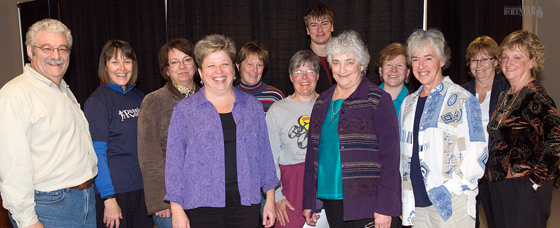
RETURNING OFFICERS READY FOR DUTY - Sue Edelman (fourth from left), the territory's chief returning officer, stand with some of her staff last Thursday at the Canada Elections Office in downtown Whitehorse.
Photo by Vince Fedoroff
RETURNING OFFICERS READY FOR DUTY - Sue Edelman (fourth from left), the territory's chief returning officer, stand with some of her staff last Thursday at the Canada Elections Office in downtown Whitehorse.
It's Thursday afternoon at the Elections Canada office in downtown Whitehorse.
It's Thursday afternoon at the Elections Canada office in downtown Whitehorse.
Sue Edelman, the territory's chief returning officer, sits behind a desk scattered with paper, binders and office materials as the "computer guy" spends a moment on her computer and another staffer comes in a bit later to say he's on his way up to Yukon College after just getting back from the Salvation Army.
At the Salvation Army shelter, clients were informed how to vote in the Oct. 14 federal election without a permanent address.
Up at the college, he was to make sure everything was set up for a teleconference to train election workers in communities around the territory.
"Not only do I believe in the political ...parties, but I also believe in the process. I think it's (the democratic voting process) extremely important," Edelman said of her reasons for taking on the task of overseeing the territory's portion of the federal election.
A cabinet minister under Pat Duncan's 2000-02 Liberal government, Edelman has served in a variety of roles for the party, and has also worked as a polling clerk, enumerator and other positions in past elections.
As the returning officer, Edelman is responsible for administering the election in the Yukon riding. Two years into her 10-year mandate, which came after a new competition process, this marks Edelman's first election in the role.
Returning officers, like Edelman, receive $21,000 for their work during the election. In between elections, when they are asked to do additional work (usually around 200 hours over the course of a year), they receive $44.51 per hour.
Though that could have been a daunting task, she noted she's been fortunate to benefit from many of the 500 staffers who have worked previous federal elections in the territory coming back for the 2008 vote.
"I've been blessed with people who've just come in and said, 'this is my desk, this is what I need,' and we figured out what we didn't have and off we went," she said. "It's wonderful. It just went like clockwork."
Work days of 12 hours, filled with what might seem like endless to-do lists and much-needed coffee aren't uncommon, but Edelman says she enjoys every minute of it, with each day bringing something new.
"It's really energizing. It's an adrenaline rush," she said. Every campaign she's been involved with, whether it be at the party level or as an election worker, has had that rush, she added.
"You can talk to any of the political junkies out there; this is what you live for," Edelman laughed.
That said, there are some days the adrenaline only goes so far. Then the "election diet" kicks in. It's a diet made up of convenient food like coffee, doughnuts and pizza designed to provide enough energy for workers to get through the work without having to really stop.
Somehow, she usually manages to lose some weight during an election, often forgetting to eat as she normally would.
It's been more than three weeks since Edelman made a home-cooked meal - something she normally loves to do - and she expects it will be at least another three weeks before she will.
She and other workers can't seem to leave their work at the office, even when they try.
"You go to sleep and you dream about it," she said. "So when I woke up this morning too early again, I , again, wrote down these things that hadn't really coalesced during the day because things were going so fast."
Throughout the campaign's six weeks, she must not only make sure polling stations are set up and Yukoners have opportunities for mail-in, special ballots and the like, but also ensure all eligible voters are fully aware of that information and how they can go about exercising their right to vote.
To that end, the Yukon office has two community relations officers dealing specifically with youth and aboriginal voters, encouraging them to get out and vote. Other communities around the country have such officers designated to deal with minority groups in those communities often under-represented in the vote.
"It's their job to go out and make sure those target groups have the information that they need to come and vote and be part of the process," Edelman said.
"We don't tell them how to vote; we don't care; we just want them to vote because there are certain groups that have been under-represented and have not voted in the numbers other groups have."
A large part of that work this time around for the community relations officers is also making sure voters are aware of the new identification requirements that have changed since the last election. That means voters have to show they have a street address.
This has created challenges in the Yukon's communities, where many people get their mail at a post office box rather than a street address and use that P.O. box address on documents like their driver's licence.
In those cases, voters are asked to get their name on the voting list as soon as possible to avoid complications on voting day. Without a street address, voters can't register themselves at the polls on election day, she said.
Documents such as property tax assessments and phone bills can be used since they show the legal address the service is going to even if the bill is sent to a P.O. box.
"We want to make sure you can vote," Edelman said.
After three weeks at the office and another three weeks to go, the returning officer said the office is still largely focused on the revision for the list of electors in the territory.
That's no easy feat, given the new changes for those with a P.O. box and also in the territory's capital city.
Although residents in Whitehorse often get their mail at their street address, new houses have been built in sections of Copper Ridge since federal voters last went to the polls in 2006.
"So we're sending people door-to-door and getting their names and their addresses in those areas put on the list," she said. "So teams of two do that and it's a Herculean effort."
Services like the Salvation Army are allowing those without permanent homes to use its street address for the election.
Edelman's days of late have normally started off early in the morning, getting those agents out the door to neighbourhoods around the city.
Those teams head out to a particular area of town and return to the office later to do hours of paperwork, then do it all again and once again in a different area in the city in the evening.
That part of the election process ended Friday, and those whose names haven't been added to the list will have to come into the Elections Canada office.
Voting cards have also been sent out to registered voters informing them where to cast their ballots, but Edelman is asking anyone who hasn't received one or have one that doesn't make sense to come into the office and speak to agents there.
Issues also arise around duplicated names, wrong addresses and names on the voters list of those who are deceased.
"If they come in here and talk to one of our agents then they can have that fixed," Edelman noted.
The other part of the returning officer's job is protecting the secret ballot system.
It's an onerous process and with good reason, she said.
"There's nothing more important than protecting the privacy and secrecy of the vote."
Every day, there's a slew of questions Edelman has to answer for Elections Canada about what the local office has done so far.
Protecting the secrecy of the ballot in the Yukon has meant having to merge the Keno and Stewart Crossing stations in Mayo because there are fewer than 100 voters in the two areas.
With seven votes from Keno and 22 in Stewart Crossing in the last election, it's virtually impossible to maintain the secrecy of a person's vote.
The residents of the two communities can vote by mail-in ballots the local office is sending out or go into Mayo on voting day or to the two Elections Canada satellite offices prior in Dawson and Watson Lake prior to the vote to cast their ballots.
While not everyone has been happy with that decision, Edelman said that although it's important to respect how thing have been done in the past, sometimes changes have to be made to ensure everyone's right to vote and to a secret ballot is met.
"We're being responsive to the fact there has to be a secret ballot," she said.
Between the agents, assistant returning officer, polling clerks and other staffers, the federal election will directly employ 500 Yukoners by the time the polls close on Oct. 14.
Another 40 polling clerks, who will be paid $226 for the day, are still needed on election day. Anyone interested can call the local Elections Canada office at 456-3086.
In order to encourage thoughtful and responsible discussion, website comments will not be visible until a moderator approves them. Please add comments judiciously and refrain from maligning any individual or institution. Read about our user comment and privacy policies.
Your name and email address are required before your comment is posted. Otherwise, your comment will not be posted.
Be the first to comment