Photo by Whitehorse Star
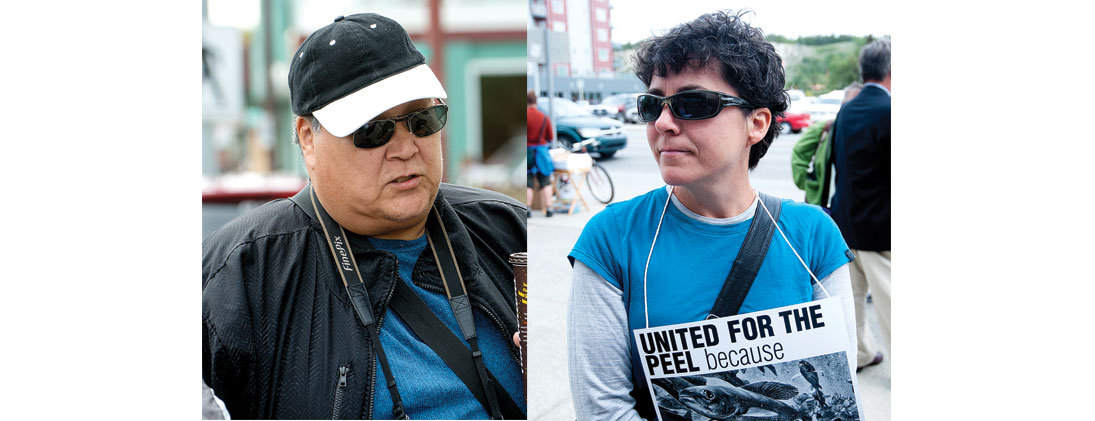
James Kawchuk and Roslyn Woodcock
Photo by Whitehorse Star
James Kawchuk and Roslyn Woodcock
Despite the crowd that gathered on the front steps of the Whitehorse courthouse Monday afternoon,
Despite the crowd that gathered on the front steps of the Whitehorse courthouse Monday afternoon, the only sounds for half an hour were cars whizzing by and the occasional horn honk of support.
More than 150 people sat on the steps and sidewalk, facing the road, to show support for the Peel River watershed as the trial began in Yukon Supreme Court Monday.
They wore white signs around their necks that read, “United for the Peel because” with black-and-white photos, including one of an elder drying fish and one of a moose.
Some closed their eyes and sat cross-legged, hands clasped or resting on their knees. A few wore “Protect the Peel” T-shirts.
Organizer Erica Heuer rang a gong every 10 minutes.
“I really wanted it to be not a political event but an event that brings people together and just capitalizes on internalizing people’s intention and connecting it to create an energy that can actually affect outcomes,” she said later.
“There have been studies done about how, if a group of people focus on a single point, they can reduce crime rates, they can affect outcomes of things, they can improve how the world is.”
The Canadian Parks and Wilderness Society (CPAWS) approached Heuer about hosting the vigil, which requested that all participants maintain “noble silence” that’s “powerful for focus, respect and intent.”
Nora Jim, a Tlingit woman, stood on the side of the road, holding up a copy of the 1973 document “Together Today for Our Children Tomorrow: A Statement of Grievances and an Approach to Settlement by the Yukon People” as cars passed by.
“What it all boils down to is we all have a tribal sovereignty,” said Jim. “The government cannot take that away.”
She and James Kawchuk, of the Carcross/Tagish First Nation, agreed that the Peel case is a chance to bring many issues to the forefront, including the lasting effects of residential schools, assimilation and respect for aboriginal sovereignty, as well as, of course, land claims.
“We have to sit down and rethink what land claims are really about,” said Kawchuk. “To us, it’s about looking after the land. We looked after the land for hundreds of thousands of years ... Everything we have on the land today is all provided for nothing from Mother Earth. We have to give back.”
Roslyn Woodcock also participated in the meditation.
“I wanted to make sure I was here just to show the community, the lawyers, the judges, that we care,” said Woodcock. “There are lots of people in the community that really care about it. Just so that they take it as seriously as they should.”
It’s not that she’s opposed to any or all development, she added, but that the government respects the discussion about development.
“There was a whole process,” she said, referring to the years of consultation and research by the Peel Watershed Planning Commission. “There was actual feedback and now it’s being completely ignored. That’s incredible.”
The commission recommended in 2011 that 80 per cent of the watershed be protected from development, and 20 per cent be opened up to oil, gas and mineral exploration.
The Yukon government has since opted to protect 29 per cent of the region.
The First Nation of Na-Cho Nyak Dun and the Tr’ondek Hwech’in, as well as the Yukon Conservation Society and CPAWS’ Yukon chapter, have sued the government over the plan.
Heuer saw the silent vigil as a way for people to recharge after listening to lawyers dig into case law, past rulings and excerpts of the Umbrella Final Agreement (UFA) between the Yukon First Nations and the territorial and federal governments.
“People are sitting in there who love this real land and these real mountains and these real rivers and this is what they’re listening to. So it’s an opportunity to come back out and reconnect with the place and with the intentions that have nothing to do with articles in the UFA,” she said.
In order to encourage thoughtful and responsible discussion, website comments will not be visible until a moderator approves them. Please add comments judiciously and refrain from maligning any individual or institution. Read about our user comment and privacy policies.
Your name and email address are required before your comment is posted. Otherwise, your comment will not be posted.
Comments (1)
Up 3 Down 6
Angela Demit on Jul 8, 2014 at 11:53 pm
My Great-great grandparents once walked this pristine lands. Preserving everything in it (animals, plants, water, air and people) so each new generation can enjoy what they preserved and looked after. This our Legacy to protect, preserve and sustain our Mother Earth so we can leave something for our children, grandchildren and for generations to come. No Developement in the Pelly, it is priceless. Leave it pure, pristine and clean.