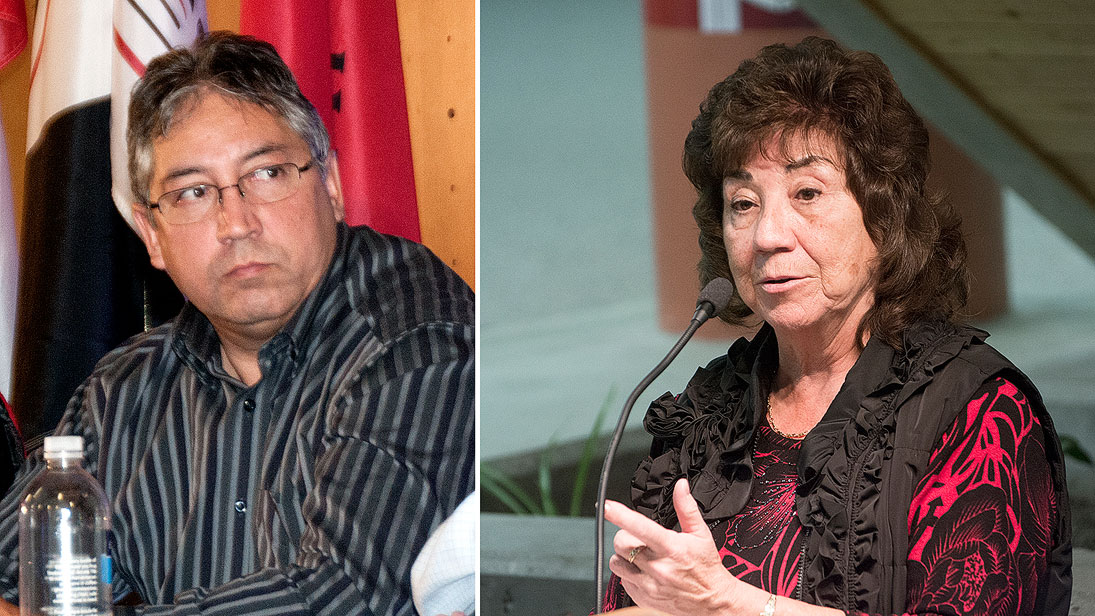
Photo by Whitehorse Star
Eric Fairclough, and Ruth Massie
Photo by Whitehorse Star
Eric Fairclough, and Ruth Massie
Changes to the Yukon’s environmental regime threaten the land and create potentially harmful economic uncertainty, say First Nations leaders.
Changes to the Yukon’s environmental regime threaten the land and create potentially harmful economic uncertainty, say First Nations leaders.
Following a meeting Monday morning with Aboriginal Affairs Minister Bernard Valcourt, several Yukon chiefs stated in a release that the “Harper government is upsetting the delicate balance between development and environmental protection through dramatic changes to a federal law....”
That law is the Yukon Environmental and Socio-economic Assessment Act (YESAA).
Bill S-6, before the House of Commons for second reading this week, allows a federal minister to impose policy direction on the assessment board — or delegate that authority to a territorial minister — and institutes end-to-end assessment timelines.
First Nations leaders are concerned the amendments “water down” the legislation and “leave the process open to political interference.”
Yukon First Nations and the Council of Yukon First Nations (CYFN) were invited to Ottawa by Valcourt for a last-minute meeting, “only to receive a stern rebuke” from him, the release states.
“The minister shut us down by telling us we are ‘not real governments’ and therefore he does not need to make us active participants in changing legislation that arises from our treaties,” Eric Fairclough, chief of the Little Salmon-Carmacks First Nation, said during a press conference held this morning in Ottawa.
“This flies in the face of recent court decisions that have affirmed the duty to consult First Nations. It is an insult and a signal to First Nations everywhere that our views don’t count,” said the former NDP cabinet minister and Liberal MLA.
“A strategy for northern development has to be more than photo-ops for the Franklin expedition,” Fairclough added.
Valcourt’s office did not respond to questions from the Star before press time this afternoon.
Ruth Massie, the CYFN’s grand chief, outlined how the new amendments could impact First Nations and all Yukoners.
“Frankly, our concern is that complex projects will be rushed through the approval process without proper assessment if these changes go through,” she said.
“These amendments threaten Yukon’s environment and will create uncertainty and scare off investment and jobs, which will put Yukon’s economy at risk.”
The proposed Casino mining project — a deposit of copper, gold, molybdinum and silver located 300 kilometres northwest of Whitehorse — would be the largest mine ever developed in the Yukon, and one of the biggest in Canada.
Casino is currently going through the environmental assessment process.
“We need to be sure that projects of this scale receive thorough and independent assessments,” the release states.
At least two mining companies operating in the Yukon have sent letters to Valcourt warning that regulatory reforms without meaningful consultation could create tension and uncertainty, the release added.
“We urge the minister and the Harper government to find a solution which honours the spirit and intent of First Nations final agreements,” Fairclough said.
Valcourt let it slip Monday that the Yukon government put forward at least two of the four controversial planks of Bill S-6.
These have to do with imposing binding policy direction from above onto the executive committee of the Yukon Environmental and Socio-economic Assessment Board (YESAB).
The two other contentious amendments — related to tighter timelines as well as project renewals or expansions that would no longer trigger fresh assessments — were apparently suggested by the federal government.
Larry Bagnell, the Yukon’s federal Liberal candidate for the 2015 election, said changing YESAA “doesn’t make any sense.”
He highlighted the years spent hammering out legislation in the late 1990s and early 2000s by “three equal governments,” as well the five-year legislative review.
“I’ve always said that land claims and assessments are a relationship, not a contract,” he told the Star today.
“Throwing this whole wrench into the relationship ... provides for all sorts of uncertainty in the economy.”
He added that most First Nations along with their development corporations want to work with resource companies, “but you have to have co-operation.”
Casino Mining Corp.’s project, if it goes ahead as planned, would employ 1,000 people during four years of construction and 600 during 23-plus years of operation.
It could add another $274 million, or more than 10 per cent, to the Yukon’s gross domestic product every year, president Paul West-Sells has said.
He has also stated the regulatory process is exhaustive and costly, suggesting it could use some streamlining.
The company has paid out an estimated $18 million so far in its review by YESAB.
“By the time we are done, it will probably be $25 million,” he told a mining conference last month.
The two First Nations that the corporation is in discussions with are not the issue; it’s the unwillingness of the two regulatory bodies – YESAB and the Yukon Water Board — to work in parallel that the companies are having a problem with, West-Sells added.
See letter.
In order to encourage thoughtful and responsible discussion, website comments will not be visible until a moderator approves them. Please add comments judiciously and refrain from maligning any individual or institution. Read about our user comment and privacy policies.
Your name and email address are required before your comment is posted. Otherwise, your comment will not be posted.
Comments (2)
Up 14 Down 11
Jackie on Dec 4, 2014 at 7:38 am
The Minister is so wrong that he should be embarrassed. The self-governing Yukon First Nations are no longer bands under the Indian Act. They have broad powers to make laws that apply to their citizens wherever they live in the Yukon and apply to everyone on their settlement lands. These laws are enforced in the Territorial Court (until they establish their own courts). These laws displace laws made by the territorial government. The Yukon First Nations may make taxation laws and, at present, they receive the income tax of all people living on their settlement lands as well as the GST. Etc. Yah, right - they aren't governments. Why is Valcourt the AANDC Minister? Clearly he does not know anything about Yukon First Nations or he is deliberately provoking them. Either way his conduct is shameful.
Up 50 Down 26
Lost in the Yukon on Dec 3, 2014 at 3:00 pm
This is shameful ... the Federal Minister should be called upon to resign.