Photo by Vince Fedoroff
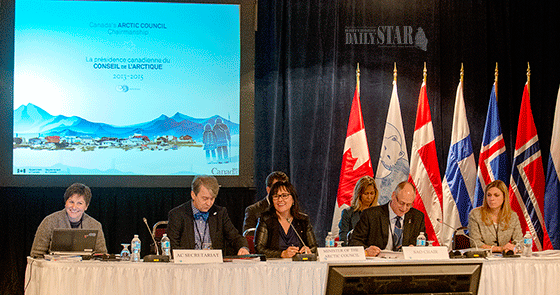
MEETING BEGINS – Environment Minister Leona Aglukkaq (centre foreground) is seen during the opening of the Arctic Council this morning in Whitehorse.
Photo by Vince Fedoroff
MEETING BEGINS – Environment Minister Leona Aglukkaq (centre foreground) is seen during the opening of the Arctic Council this morning in Whitehorse.
Arctic Council senior officials are meeting for the first time under Canada's chairmanship this week in Whitehorse.
Arctic Council senior officials are meeting for the first time under Canada's chairmanship this week in Whitehorse.
Environment Minister Leona Aglukkaq, Canada's chair of the council, was on hand to open the meetings this morning.
She took the opportunity to tout Canada's recently signed trade agreement with the European Union.
"The Canada-Europe Trade Agreement is the biggest trade deal Canada has ever made,” Aglukkaq told Arctic Council officials at the Yukon Convention Centre.
"This agreement will create thousands of jobs for Canadians and give Canadians business access to half a billion new customers,” she said,
Bridging back to the council, Aglukkaq highlighted the trade agreement's benefit to the North.
"The Canada-Europe trade agreement will provide another excellent platform for us with our European partners to maximize the potential of the circumpolar business forum, and this will benefit the entire circumpolar region,” she said.
Aglukkaq highlighted three key priorities for Canada as the chair of the council. They include the establishment of the circumpolar business forum – an initiative co-led by Iceland, Russia and Finland.
"I am very committed to this initiative. The forum will help enable businesses to seize opportunities to create prosperity for northern communities,” the minister said.
She then moved on to highlight ongoing work on oil pollution prevention in Arctic waters.
"It is an important opportunity for the council to show Arctic leadership,” she said.
"Effective action to prevent oil pollution is critical to protecting the Arctic marine environment and an excellent complement to the new agreement on oil pollution preparedness and response that was signed by Arctic states in May,” Aglukkaq told council officials.
The chair also highlighted the council's work to promote awareness of northerners' traditional way of life.
"As a northerner, as an Innu, I recognize the value of traditional way for life for communities across the circumpolar region and I believe that council's work can make a difference,” Aglukkaq said.
In closing her remarks, Aglukkaq said she'd been monitoring the council's progress on its 80-odd projects.
"As you guide the work of the council over the next two years, I encourage you to consider how the council can achieve real results on specific priorities and on the implementation of the recommendations approved by the ministers,” she said.
"I wish you a productive meeting today, and I look forward to hearing the results of your discussions at dinner this evening,” she said.
Premier Darrell Pasloski said in a release this morning the government is anticipating a "very good meeting” this week.
"Having circumpolar officials and observers meet here is a natural fit as Arctic Council delegates make decisions that affect the North,” he said.
"The theme of Canada's Arctic Council chairmanship is Development for the People of the North,” Pasloski noted in the release.
"Issues also being discussed are responsible Arctic resource development, safe shipping and sustainable circumpolar communities.
"Northern premiers support this focus and are committed to working together to ensure our issues are addressed at this important forum.”
In addition to the closed-door meetings planned to close Wednesday, the council has sponsored a public event at the Yukon Beringia Interpretive Centre on the conservation of
Arctic plants and animals. The event is scheduled to begin at 7 p.m. Wednesday.
The Arctic Council was established in 1996 to promote collaboration and co-operation on northern issues.
It's focused particularly on the environment and sustainable development. The council comprises eight member nations including Canada, Denmark (including Greenland and the
Faroe Islands), Finland, Iceland, Norway, Russia, Sweden, and the United States.
Aglukkaq was named Canada's chair of the Arctic Council last August.
This is Canada's second chairmanship of the council, having served as the council's first chair from 1996 to 1998.
The council also met in Whitehorse during that two-year leadership.
In order to encourage thoughtful and responsible discussion, website comments will not be visible until a moderator approves them. Please add comments judiciously and refrain from maligning any individual or institution. Read about our user comment and privacy policies.
Your name and email address are required before your comment is posted. Otherwise, your comment will not be posted.
Comments (1)
Up 2 Down 0
as if on Oct 22, 2013 at 4:33 am
I am sure they know what they are doing, heck Canada couldn't even negotiate a deal for European nations to accept our furs...