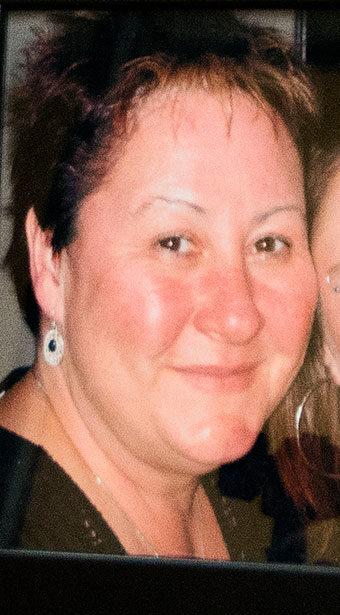
Photo by Whitehorse Star
Teresa Scheunert
Photo by Whitehorse Star
Teresa Scheunert
The forensic toxicologist who performed the post-mortem analysis on Teresa Scheunert testified Thursday she likely died from the combined effects of at least two narcotics.
The forensic toxicologist who performed the post-mortem analysis on Teresa Scheunert testified Thursday she likely died from the combined effects of at least two narcotics.
Walter Martz testified via video before the coroner's inquest investigating Scheunert's death.
Scheunert died at age 47 on June 21, 2012 after two weeks at the Watson Lake hospital, where she also worked as a nurse.
She had been admitted to hospital for pain management on June 7 after sustaining a back injury during a CPR training course in Whitehorse in April 2012.
Toxicological findings
Martz noted that he received samples of Scheunert's blood, urine, and the contents of her stomach on July 5, 2012.
The autopsy was completed four days following her death.
He testified that a number of medications were detected during the general drug screen, including naproxen, oxycotin, fentanyl, amitriptyline, and cyclobenzaprine, also known by the brand name flexeril.
Martz was concerned about the combined effects of the drugs, not the levels of any individual medication detected in Scheunert's blood.
Under questioning by counsel for the presiding B.C. coroner, Martz briefly explained each drug and the pertinence of the levels discovered in Scheunert's blood samples.
Naproxen, which Martz described as a pain medication you can buy in the supermarket, was found within its intended "therapeutic range.”
"I had no concerns about this level,” he said.
Martz noted that the level of oxycotin detected was a "significant concentration” signifying an "effective” dose of the narcotic.
However, he did express surprise that such a level had been detected, given that the doctor's orders show Scheunert should have stopped taking oxycotin on June 18, more than 48 hours before her death.
The toxicologist testified that the drug shouldn't have been detectable after 12 hours, and suggested the only explanation is that Scheunert had an undocumented dosage of oxycotin sometime closer to the time she died.
A "pretty high” dose of fentanyl, another narcotic, was also detected in Scheunert's blood samples, Martz noted.
The toxicological testing detected a fentanyl level of 0.051 mg/L in Scheunert's blood.
Such a level has been associated with both lethal and non-lethal doses. However, Martz noted that it shouldn't be considered an accurate indication of the blood concentration level while she was alive.
He explained that fentanyl can hide in the fat tissues. When Scheunert died, it would have seeped into her bloodstream, elevating the levels later detected.
In consideration of that, Martz determined she did not die of an overdose of fentanyl alone.
Moving on to the remaining detected medications, Martz noted he wasn't concerned about the amitriptyline, as it was also detected at a therapeutic level, although at the upper end of the scale.
He went on to comment that the levels of flexeril were "unremarkable,” although higher than he would have expected to detect in Scheunert's blood if she were alive, as blood levels of flexeril also have the potential to increase after death.
Symptomatic snoring
Martz concluded that the effect of the two narcotics, oxycotin and fentanyl, in combination with the amitriptyline and flexeril, was likely enough to affect Scheunert's ability to breathe normally and ultimately cause her death.
He added that another narcotic, dilaudid, could also have been present in her system given her last documented doses, although at a level undetectable by the general drug screen.
All of the drugs detected in Scheunert's blood have the potential to affect the central nervous system, particularly the automatic response to breathe, according to Martz and other experts who have testified before the inquest.
Martz suggested Scheunert's snoring, which was noted by nurses on the morning she died, was a signal she was in respiratory distress.
To back up his assertion, he referenced a World Health Organization report on opioids that notes the period before a person dies from opiod overdose is sometimes associated with snoring.
The inquest has heard that Scheunert was a long-time, loud snorer, and the nurses noted observing Scheunert snoring numerous times throughout her hospital stay.
A number of nurses, including Tracey Nolan, who testified Thursday, have said they never observed any indication that Scheunert was suffering from any level of respiratory distress or generally from an overdose of narcotic medications.
Conclusion challenged
Dr. Thomas Perry, an internist and pharmacology expert, disagreed with Martz's conclusion that Scheunert likely died from a toxic combination of drugs.
He suggested given the time of her death and the time of her last doses of amitriptyline and flexeril that the enhancing effect of the two drugs would have been past its peak.
With regard to the detected fentanyl level, Perry said it was "irrelevant” and "misleading.”
He suggested that because fentanyl can hide in the fats, is documented to seep into the blood from the fats after death, and that the autopsy was completed four days after Scheunert died that the detected levels could be up to 10 times higher than they would have been when she was alive.
Martz argued that the figure – 10 times – is not definite.
Regarding the suggestion that her snoring indicated breathing issues, Perry noted that her oxygen saturation appeared to be normal throughout her hospital stay. Vitals were not taken the two days before her death, including after her fentanyl dose was doubled on June 20.
While he agreed the drugs do have the potential to inhibit breathing and to enhance the effect of the others, he doesn't believe there is sufficient evidence to suggest that's what happened to Scheunert.
Suggesting Scheunert died from a toxic cocktail of drugs might be the "easiest answer” he said, but it's not necessarily the right one.
Unanswered questions
Perry raised a number of questions that remain unanswered, including the cause of Scheunert's back pain.
The pain he suggested is conceivably relevant to her death and wasn't investigated by the autopsy.
He raised the possibility that she might have had an undiagnosed infection near her spine.
Perry did note that fluid was discovered in Scheunert's lungs during the autopsy and questioned why that might be, although counsel for the coroner later noted that pulmonary edema, as the fluid build-up is called, is a common finding in deaths related to drug overdose.
Perry also questioned why Scheunert had such an elevated heart rate.
The jury has previously heard testimony that Scheunert's heart rate was not a concern for her health care workers who chalked it up to the fact that she was often in pain and that people have different "normal” rhythms.
The average heart rate is reportedly between 60 and 90 beats per minute. Scheunert's heart rate was recorded to have reached the mid 120s at some points.
Drug choices analyzed
The inquest also heard some testimony Thursday from Julie Greenall, a pharmacist and project leader with the Institute for Safe Medication Practices Canada.
Greenall's testimony was scheduled to continue today, but yesterday, she was questioned about some of the drugs Scheunert had been prescribed during her hospital stay.
Scheunert had been prescribed 40 mg a day of flexeril – a high dose, according to Greenall, who testified that the maximum dose in the U.S. is 30 mg a day, but 60 mg a day in Canada.
Perry noted that while it's a common practice to prescribe amitriptyline and flexeril together, he doesn't see the benefit to using both medications, as they are chemically quite similar. He also indicated he personally wouldn't prescribe flexeril.
Regarding the fentanyl patches, Greenall explained that they can't be relied upon to manage pain in the first 24 hours of the initial application, but the drug does begin releasing right away.
Commenting on the morphine Scheunert was initially given on June 7, a dose of 10 mg., Greenall said the dosage isn't uncommon for a first dose considering her pain levels, but did testify that a more common dose is between two and five mg.
The hydromorphone, or dilaudid, is a very potent drug, said Greenall, noting that a two-mg dose of dilaudid is equivalent to 10 mg of morphine. Scheunert was prescribed between two and four mg of dilaudid, as needed.
When asked whether narcotics, such as dilaudid, oxycotin, and fentynal are good for managing nerve pain, suspected to be the cause of Scheunert's back pain, Greenall noted it's one of the more difficult types of pain to treat.
Whether adding opioids, or narcotics, is the answer is always a question, she said.
Greenall commented that ideally, as few narcotics should be prescribed as possible, with the goal being to manage the pain to allow a patient better functionality, but perhaps not to eliminate it.
With acute pain, or pain from an injury, the goal should be to provide relief, while attempting to make a diagnosis, she suggested.
She noted that it becomes complicated when mixing various drugs because they interact differently, and suggested it might have been best to keep Scheunert on one type of opioid.
For instance, before Scheunert was admitted to hospital, she had been taking endocet, a short-acting form of oxycodone.
Greenall suggested Scheunert could have been moved to a long-acting form of the drug, oxycotin, and kept on a prescription for endocet for periods of sudden acute pain.
Since endocet and oxycotin are essentially the same drug, it would have been easier to monitor, she suggested.
Greenall continued her testimony today.
The inquest is also expected to hear from the forensic pathologist who originally declared mixed-drug toxicity as the cause of Scheunert's death.
In order to encourage thoughtful and responsible discussion, website comments will not be visible until a moderator approves them. Please add comments judiciously and refrain from maligning any individual or institution. Read about our user comment and privacy policies.
Your name and email address are required before your comment is posted. Otherwise, your comment will not be posted.
Be the first to comment