‘This will resonate across Canada'
The Yukon has come a long way in protecting against carbon monoxide poisoning, but there's still a long way to go.
By Stephanie Waddell on May 2, 2013
The Yukon has come a long way in protecting against carbon monoxide poisoning, but there's still a long way to go.
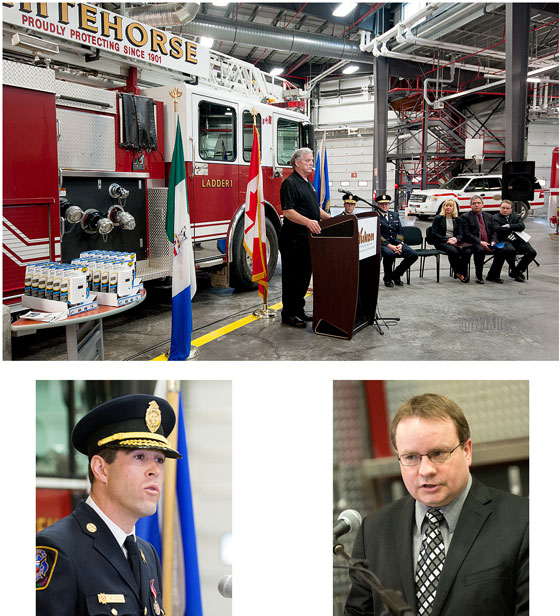
That was the consensus coming out of a news conference this morning where city and territorial officials were joined by John Gignac, co-executive director of the Hawkins-Gignac Foundation for CO Education.
The group assembled to celebrate the Oil-Fired Appliance Safety Statutory Amendment Act, which was expected to receive royal assent this afternoon in the legislature.
Under the proposed legislation, the Yukon will become the first jurisdiction in the country to require carbon monoxide detectors in all homes with fuel-burning appliances and/or attached garages.
Other changes will require:
• only qualified oil-burner mechanics to apply for and hold a permit to install or modify an oil-fired appliance;
• the creation of a public registry of trade-qualified oil-burner mechanics; and
• the adoption of the National Fire Code of Canada, and have trade qualifications.
"This is much bigger for us,” Gignac said, adding the legislation will save lives in the territory. "This will resonate across Canada.”
As officials praised the work that has gone into creating the legislation as well as increased training opportunities for those looking to become oil burner mechanics, they also reflected on the tragedy that brought on the changes.
On January 2012, five people, including the Rusk family and a friend boarding there, died in their rented Porter Creek house from carbon monoxide poisoning.
The home – since demolished – didn't have a carbon monoxide alarm. As well, there were significant problems with the heating system, leading to an ice blockage in the chimney.
"Today comes with mixed emotion,” Community Services Minister Elaine Taylor said.
She and the other speakers said the deaths in Porter Creek affected everyone in the Yukon.
She went on to thank all those who were involved in the working group which helped draft the legislation.
She also recognized the citizens, businesses and industry throughout the territory which also took part in the meetings held last year on the suggested legislation.
Scott Kent, the minister responsible for the Yukon Housing Corp., said the legislation will help improve home safety in the territory.
He also noted Yukon Housing is taking the lead on the public education front, informing residents on what they need to do to keep their homes safe.
Kent also noted that while many in the communities expressed concerns about a lack of servicing options for their heating systems, there are now 15 oil burner mechanic apprentices registered in the territory.
Kent noted the role home owners and tenants have to play too in making sure their systems are operating, having them serviced regularly and knowing what to do if there is a problem with the system.
Meanwhile, Mayor Dan Curtis reflected on the challenges facing the Yukon, with its spread-out population.
He went on to praise the government for bringing training opportunities to the territory, while recognizing the ongoing challenges being faced.
He also noted the city's willingness to help in whatever way to keep residents safe.
And it appears residents have taken action too since the tragedy of 2012, as Whitehorse Fire Chief Clive Sparks relayed.
Firefighters have responded to more calls over carbon monoxide detectors sounding.
Just a few weeks ago, the department was called to a home where the alarm had gone off, prompting the family to get out of the house and the fire department to get to the scene.
It was found a car engine in the garage hadn't been shut off, and the CO levels became high.
"The detectors do work,” Sparks said, stating he's looking forward to the legislation being passed so the education to residents can continue.
As Yukon Fire Marshal Dennis Berry said as the first speaker: "We learn from our experience and we try to make things better.”
The Fire Marshal's Office is set to contribute another 200 carbon monoxide alarms and 200 smoke alarms throughout the territory to those who may not otherwise have access to them.
This is in addition to earlier contributions from both the fire marshal's office and Hawkins-Gignac Foundation.
In Whitehorse, they will be made available through the Whitehorse Food Bank and the Department of Social Services.
In the communities, they will be provided through rural fire departments and community health centres.
Comments (4)
Up 0 Down 0
Groucho d'North on May 3, 2013 at 9:12 am
It still appears to me that government is trying to bury a turd. Let's review shall we?
The industry was performing shoddy work which was being approved by the government inspectors who did not apply diligence in making new installations conform to the building code standard of the day.
Over time and years of neglect, the furnaces have gotten worse because many people don't fix anything until it stops working. In this case sub-zero temperatures are the primary motivator, otherwise it would remain ignored.
A smoke or CO detector only advises when things have gone dramatically wrong. So now there is a law that says every home must have one. Well and good, an important safety feature that really does save lives; they are like life-jackets in a canoe, only valuable when something goes terribly wrong.
I would like to see some "First in Canada” creativity in fixing all those faulty furnaces out there to deal with the root of the problem. That and hold inspections to some level of accountability.
Up 0 Down 0
Jackie Ward on May 3, 2013 at 5:14 am
This should of been done years ago. It took the deaths of 5 people to wake up the government which is very sad. It's not like this was just known recently. It's been known for years. Now we have everyone parading around like they are some kind of saviors.
Up 0 Down 0
Arn Anderson on May 3, 2013 at 5:13 am
Common sense and responsibilty lies with the homeowner. Now living in Alberta where everything is natural gas supplied, my furnace and hot water tank is gas ran. Being new to this, I bought a CO detector, simple, some people need some insight into such matters instead of running out and buying soda pop and iphones.
Up 0 Down 0
Max Mack on May 2, 2013 at 6:20 pm
A long way to go?? What more do you expect to do? Require homeowners to have annual inspections, signed off by (of course) "certified" oil burner mechanics? Forced annual inspections on woodstoves, chimneys, etc?
Gotta have a way to pay for all those shiny new oil burner mechanic apprentices, I guess.