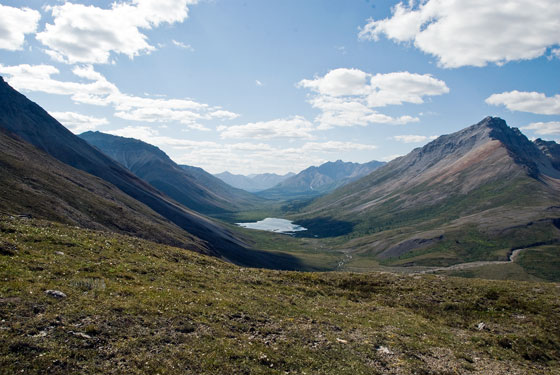
Photo by Whitehorse Star
PEEL COUNTRY – The Yukon government released its proposal Tuesday for a land use plan for the Peel River watershed. The premier is calling it fair and balanced; the Yukon Conservation Society has tagged it a whitewash.
Photo by Whitehorse Star
PEEL COUNTRY – The Yukon government released its proposal Tuesday for a land use plan for the Peel River watershed. The premier is calling it fair and balanced; the Yukon Conservation Society has tagged it a whitewash.
The Yukon government's new approach to land use planning in the Peel River Watershed will provide balance, says Premier Darrell Pasloski.
The Yukon government's new approach to land use planning in the Peel River Watershed will provide balance, says Premier Darrell Pasloski.
Pasloski unveiled the government's long-awaited vision Tuesday afternoon.
He appeared at a news conference alongside Energy, Mines and Resources Minister Brad Cathers, Environment Minister Currie Dixon and Tourism and Culture Minister Mike Nixon.
"We have repeatedly made it clear that we think that the plan proposed by the former Peel planning commission should be modified, and that the final plan can be more fair and balanced,” Pasloski told reporters.
"Since last fall, staff of several departments have put a tremendous amount of time into developing a range of potential modifications.
"The result is an innovative approach that we believe would be a more effective way of protecting existing users and values, including the environment and wilderness beauty, while allowing for potential new activity in this vast area.”
The premier and the ministers took turns assuring the public they and their staff have come up with the tools to ensure the highest level of environmental protection while allowing for development opportunities in the region.
They took turns inviting Yukoners to give thoughtful consideration of their four planning concepts and provide their feedback on the new planning proposal over the next four months of public consultation.
Karen Baltgailis of the Yukon Conservation Society is calling the new planning initiative a whitewash, or "greenwash,” which runs completely opposite to the direction in the final land use plan recommended by the Peel River Planning Commission.
Where the planning commission recommended no road access nor surface access to 80 per cent of the area, the government's proposal allows for full access while promising to manage access and development with the utmost of care, she pointed out this morning.
Baltgailis said while the government uses language like protected areas and restricted use wilderness area, ultimately, it goes nowhere in meeting the goals of true wilderness protection as envisioned in the commission's land use plan.
Under the Protected Area designation, she points out, there would be no new mineral claims allowed.
Road access, however, and other surface access to existing claims would be permitted in protected areas and throughout the entire planning region, she said.
Baltgailis said the government's Restricted Use Wilderness River Corridor designation promises to protect the wilderness character of river corridors and viewscapes, but does not restrict roads nor bridges.
To hear the premier say the government's proposal provides for wilderness protection over 74 per cent of the planning area is "disturbing,” she said.
"It was incredibly misleading,” Baltgailis said.
"And the fact they paint so much of those concepts as green is such a clear attempt to pretend this is something that it is not.
"They are not taking the final plan and tweaking it or modifying it; they are proposing something completely new and it appears that amounts to rejection of the final plan.”
Under the final plan presented in July 2011, the planning commission recommended roads and surface access be prohibited in 80 per cent of the area.
Mike Kokiw of the Yukon Chamber of Mines said this morning since most of the chamber's membership is still in the field, the chamber hasn't had time to assess and develop a position on the new planning proposal.
The chamber continues to support a fair and balanced approach to the management of the Peel that considers all values, including wilderness protection, cultural values and economic development opportunities, he said.
Kokiw said the chamber hopes to formulate a position prior to the annual Yukon Geoscience Forum held in late November.
Senior land use planner Jim Bell of the Department of Energy, Mines and Resources provided a briefing of the government's proposal following the official announcement by Pasloski and his ministers.
Yukoners, Bell explained, will have four months to digest and comment on the proposal as outlined in the four planning concepts available online or through contacting government offices.
Cathers indicated the final land use plan recommended by the planning commission in July 2011 will also be available as part of the package being sent out for consultation, as the government is legally bound to include it.
The government, however, has been clear that modifications to the final recommended plan are needed, the minister pointed out, while noting 97 per cent of the Peel watershed is Yukon government Crown land.
Asked whether he is afraid the government's proposal would prompt legal action from the First Nations wanting 100 per cent protection of the Peel, Cathers said his government is doing everything by the book.
"The Yukon government is confident we have followed all our legal obligations under the Umbrella Final Agreement (the blueprint for aboriginal land claim settlement in the Yukon),” the minister said.
Bell explained that following the public consultation period, which includes consultation with the First Nations, there will be an additional month of consultation with the First Nations specifically before a final land use plan is developed.
There are four different planning options included in the government's proposal. None, however, are set in stone, and it may be that the final land use plan will include components from one or more of the four options, he said.
For instance, Bell pointed out, the amount of land designated as protected area varies from 14 to 36 per cent in the four options, while the restricted use wilderness area designation varies from 32 per cent to 51 per cent.
The area designated as integrated management allowing for a greater flexibility in development opportunities remains a constant 26 per cent through the four options, Bell pointed out.
He said management initiatives to increase sensitivity to environmental concerns may include requiring a permit for basic exploration work, or a reclamation security deposit for work not normally subject to a security deposit.
There may be umbrella restrictions on the amount of development activity that can occur at the same time in a single land use planning unit, Bell said.
Emphasis, he added, will be placed on protecting river corridors, corridors which will potentially measure three to 10 kilometres in width, with an aim to restricting visual obstructions and noise levels, he said.
Roads, he said, would be private and gated, and would have to be reclaimed at the end of a project.
Bell said the management tools envisioned would help address conflicts and provide a better balance for the region.
"This is a shift in thinking,” Bell said. "And the government believes the shift in planning better reflects a balanced plan that recognized the diverse interests in the Peel watershed.”
• Protected Area – Under the protected area designation, existing rights would be upheld, including the right to work mineral claims along with access to those claims by air or road, according to the government's proposal.
The area would be withdrawn from new land uses. A protected area could also be elevated to a special management area, which prohibits surface access as outlined in the commission's final recommended plan.
• Restricted Use Wilderness Area – Under the designation, existing rights would be recognized, surface access would be permitted, as would new land uses, with a varying degree of management conditions depending on the sensitivity of the area.
• Wilderness River Corridor – New land uses would be prohibited, and existing rights and access would be permitted under specific conditions aimed at maintaining the integrity of the corridor.
• Integrated Management Area – Allows for existing and new land uses.
The four options included in the government's proposals break down as such:
• Option A – Protected area 14 per cent; Restricted use wilderness area, 51 per cent; Wilderness river corridor, nine per cent; Integrated management area, 26 per cent.
• Option B – Protected area 21 per cent; Restricted use wilderness area, 44 per cent; Wilderness river corridor, nine per cent; Integrated management area, 26 per cent.
• Option C – Protected area 33 per cent; Restricted use wilderness area, 34 per cent; Wilderness river corridor, seven per cent; Integrated management area, 26 per cent.
• Option D – Protected area 36 per cent; Restricted use wilderness area, 32 per cent; Wilderness river corridor, six per cent; Integrated management area, 26 per cent.
See related coverage
In order to encourage thoughtful and responsible discussion, website comments will not be visible until a moderator approves them. Please add comments judiciously and refrain from maligning any individual or institution. Read about our user comment and privacy policies.
Your name and email address are required before your comment is posted. Otherwise, your comment will not be posted.
Comments (7)
Up 0 Down 0
flyingfur on Oct 26, 2012 at 7:51 am
Protection? Allowing all of the past/current claims in those "protected" areas is not protection folks...by anyone's definition other than the Yukon Party's.
Up 0 Down 0
Stan Rogers on Oct 25, 2012 at 8:58 am
We committed to seeking a final plan for the Peel that protects the environment and respects all sectors of the economy," he said.
"And we've repeatedly made it clear we think the plan proposed by the former Peel Planning Commission should be modified and that the final plan can — and should — be more fair and balanced."
What Premier Darrell Pasloski is really saying when respecting all sectors of the economy is that the mining sector contributed heavily to the Yukon Party election campaign and their interests will be given the highest level of protection.
And when he says we would go bankrupt if we bought all the mining claims staked in the Peel watershed he is really saying the Yukon Party will go bankrupt if they no longer pander to the mining industry.
Its shameful and what it really means is that people who want to protect the Peel Watershed should have paid for the protection by contributing to the Yukon Party. This type of thing has to stop! We need election campaign contribution reform because the status quo is shady.
Most Yukoners recognize the long term benefit of protecting special wilderness areas. Most people wanted protection for the Peel during the last territorial election as does the Peel Planning Commission and First Nation governments. Unfortunately this government is not listening because they took in campaign contributions from the mining industry and have shamefully put mining interests above Yukoners who voted in the last election.
If we do not stop this the Peel drainage will be controlled by Chinese government interests which will buy and control mining companies in the Peel River drainage- thanks to the Yukon Party, this will be the inevitable legacy of a party which does not listen to Yukon residents. Please think hard about it Brad and Darrell. You are giving away a very special area and the resources there will end up in a foreign government's control.
Up 0 Down 0
Atom on Oct 25, 2012 at 8:14 am
Balance is the point at which something can tip either way....There is no way to get the old Yukon back, tip. Too many people here now to save anything. It's pick your side and be prepared to have the Yukon Party allow whatever interest is paying the most unfettered access.
That is the Yukon reality and it is so Yukon.
Up 0 Down 0
Joel on Oct 25, 2012 at 6:51 am
Not like the undesirables (as you call them) are not already here. Yukon is a safe haven due to its remote nature. If we were to try to decide who was desirable or not, the world or Yukon will be a very bad place...
And to believe that we can only protect or destroy everything is a farce. There can always be balance, we just have to find it.
Open your minds and great things CAN happen. I am interested to see how this all turns out....
Up 0 Down 0
isabel marant soldes on Oct 24, 2012 at 10:16 pm
and looks like you have been bamboozled, the "Sony facility monitor dj headphones"a. k. a. MDR-V700DJ
[url=http://isabelmarantsoldes.webnode.fr]isabel marant soldes[/url]
isabel marant soldes
Up 0 Down 0
June Jackson on Oct 24, 2012 at 9:51 am
More BS coming out of this government.. I don't believe them about anything.. there can't be mining and development of the Peel AND save our watershed. I don't want to be sold down the river on this..
The case for protecting the Peel Watershed
http://en.wikipedia.org/wiki/Peel_Watershed
Petition Ottawa and turn the entire watershed into a Park..and ask them to protect it from the Paslowski government.
Up 0 Down 0
Just wndering.. on Oct 24, 2012 at 7:45 am
What about the hundreds of "undesirables" that will be atracted to the Yukon now that they've opened up a huge new area to be explored?? I really do not want the whole mining industry coming to Whitheorse.. Problems will be: rougher downtown area, more drugs on the street, more violence, more gas guzzling/polluting vehicles... We do not need one of the last untouched area's in Canada turning into another Fort Mac!!