'They're trying to blame all homeowners for surface water'
Something must be done before winter to deal with water pooling around the foundations of homes in Copper Ridge, says a Zircon Lane homeowner.
By Jason Unrau on August 18, 2009
Something must be done before winter to deal with water pooling around the foundations of homes in Copper Ridge, says a Zircon Lane homeowner.
In May, Charlie Hoeller discovered water in the basement of his property and believed the source to be a broken water main.
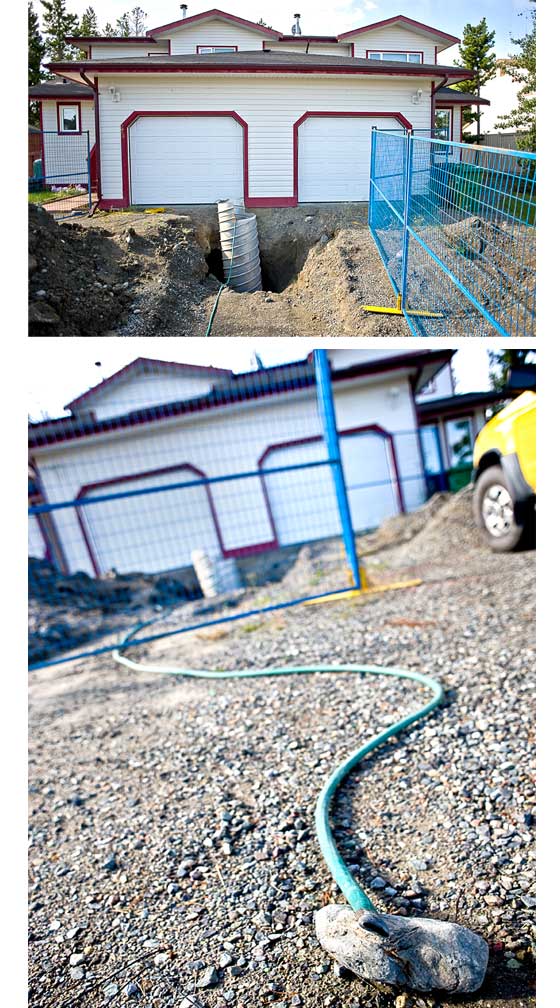
But after a vertical culvert and sump pump were installed at the front of the house, and the water line to the property shut off, water continued to pool around the foundation and leak into the basement.
"(The government) does have some plans to try and alter the ground water situation ... one is building an intercept trench and diverting the water around the houses," Hoeller told the Star this morning of possible ideas tossed around at a meeting among the city, government and Zircon Lane homeowners last Thursday.
"But the problem is we're in August now, and as winter is quickly arriving there's at least two homes with foundations sitting in water. Before winter comes, we need to get the water out."
The issue of possible rising water endangering homes in the area first surfaced in 2001, when groundwater ruined the foundation of a home at 10 Zircon Ln.
The Yukon government, which began developing the Copper Ridge lots in the 1990s, eventually bought out the owners.
Now it appears the problem is seeping up the street (Hoeller is at 27 Zircon Ln. and his neighbour at 25 Zircon is in a similar pinch), and despite a recently completed study, the government is unable to pinpoint a precise cause.
"There's a number of causes coming into play," Kevin McDonnell, acting infrastructure manager for the Department of Community Services, said today.
"There's high precipitation, it's a fairly low area there ... (so) it's a combination of issues, including how water is managed in and around houses."
McDonnell estimates more than a dozen homes are affected.
In the meantime, government officials are asking residents to ensure their eaves trough spills are directing water away from the home and that snow is kept away from the foundations during the winter.
However, Hoeller is skeptical of the directive and feels it could actually exacerbate the problem.
"They're trying to blame all home owners for surface water," he said.
"So we have to remove snow from around the house and point the drain pipes away. Depending on the (property's) easement, you could be pouring it into the neighbour's yard."
To ensure that the problem is not a hairline crack in the water line to Hoeller's property, it remains shut.
Dave MacDonald, who lives at 25 Zircon Ln., has graciously run his garden hose into his neighbour's home.
While Hoeller said he's spent upwards of $15,000 "tearing up drywall," installing the culvert and "mopping up the water," MacDonald told the Star that dealing with the flooding in his basement has probably cost $20,000 to date.
Both would like to see the problem fixed before winter, homeowners compensated, and ultimately, former market value restored to previous levels.
"That's very much the issue. While things have been moving along, we need to be sure that (government) keeps moving and we see some action before freeze-up," said MacDonald.
"In the meantime, we're going to excavate around our foundation, there's damage in the basement that we've got to fix and we're waiting on the what the city and government can do with the water itself," said MacDonald.
"But we have to do all three of those things to rebuild the confidence in the area."
However, Hoeller is not as optimistic, and worries if another winter passes, his property could be damaged beyond repair.
"During Thursday's meeting, we talked about frost jacking, it's the same as frost heaving," said Hoeller.
"And once you get water down around the footing, it can start pushing the house around ... our slab has cracked in a number of places already."
Be the first to comment