Photo by Vince Fedoroff
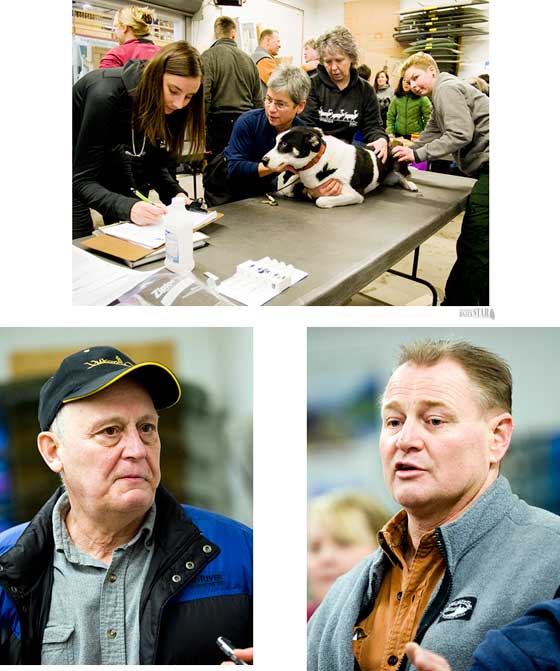
Top: GETTNG THE ONCE-OVER – Veterinary student Michelle Brown, far left, and Yukon Quest veterinarians and volunteers perform the pre-Quest vet check Tuesday morning. Bottom: AL HALLMAN and MIKE KENNY
Photo by Vince Fedoroff
Top: GETTNG THE ONCE-OVER – Veterinary student Michelle Brown, far left, and Yukon Quest veterinarians and volunteers perform the pre-Quest vet check Tuesday morning. Bottom: AL HALLMAN and MIKE KENNY
Al Hallman has been coming to the Yukon every February for 16 years to see some of the world's best endurance athletes run one of the world's longest foot races.
Al Hallman has been coming to the Yukon every February for 16 years to see some of the world's best endurance athletes run one of the world's longest foot races.
"I used to think race horses were the world's best athletes,” the Payson, Ariz. native says of his passion for the Yukon Quest.
"But once I started working with the sled dogs, my opinion changed. They are definitely the world's best athletes, without a doubt. It's a real pleasure to work with them.
"There are few places in the world that you can see this type of athlete and this many.”
As he says this one of the athletes in question, Zig of Didier Moggia's 14-dog Yukon Quest team, is being lifted onto a folding table set up in the garage of Northerm Windows.
"Really look for body conditioning,” Hallman says to the young vets as they prepare to examine Zig. "For those of you who haven't been around racing before, you're going to be blown away by the conditioning.”
A half-dozen veterinarians and veterinary students crowd around the dog, checking its teeth, gums, joints, muscle tone, heart rate, lung function, temperature and weight.
One volunteer vet passes a sensor around the dog's shoulders, checking for the microchip which every Quest dog must have planted under its skin.
Dogs are also subject to random drug tests for anti-inflamatories and stimulants, both of which are forbidden by Quest rules.
"We've had people who have had, maybe not knowingly, had drugs in the system and we've had to take them out of the race,” Quest board member Mike Kenny says of the doping tests. "It's not common, but it does happen.”
"We're not going to find a whole lot today,” Hallman, the head vet for the race, says of what he expects from the mandatory vet check.
"We're looking at great athletes here; it's just like the start of the Olympics where you have pre-event physicals. These athletes are ready to go. Right now, we're just getting used to these guys.”
For fourth-year veterinary student Michelle Brown, the Quest offers an opportunity to see a quantity and quality of dogs she doesn't normally see in the classroom.
"I decided to come back and volunteer because as a vet student, it's a great way to see a lot of normal dogs, listen to a lot of normal dog hearts and do a lot of physical exams and also to learn more about sports medicine. It's something that back in Ontario we don't see a lot of at school.”
And just like Hallman, Brown also comes for the other humans.
"I love the people in general,” she says of why she chose to return to the Yukon after a short internship at Alpine Veterinary last spring. "Everyone was so welcoming and friendly, it was hard to leave.”
"I've got friends all over the world that I wouldn't have if it wasn't for this race,” Hallman says. "In Alaska and the Yukon, I just really enjoy the people of the North anywhere I go.
"I learn more on this race every year from being around this quality of people than I do on any continuing education conference I go on,” he says.
Pointing to the young veterinary students crowded around another dog, he adds: "You know the truth is, I learn more from them than they do from me.”
This year, researchers from Cornell University are hoping to learn more about human endurance though studying the enzymes in the dogs' muscles.
"It's going to be useful for giving us some markers for when we are overdoing our systems or we don't have enough lean body mass,” Hallman explains. "There's a lot of correlation with endurance athletes, for example, or military personnel who are going long stretches without sleep.”
Hallman and the other vets will follow the dogs as they run the 1,600-kilometre race from Whitehorse to Fairbanks.
At regular intervals, they will be checking on the racers to make sure they are still in running condition, as well as working with the judges to ensure the mushers are maintaining a proper standard of care.
"Our policy is for the best care we can possibly provide for the dogs and it is also to censure those that don't care for their dogs,” Kenny says. Mushers have been penalized or even kicked out of the race for not properly caring for their dogs' feet, for instance, he explains.
"Then we've had individuals who have, I won't say beaten their dogs, but been more physical than they needed to be, and they've been censured.”
But for the vast majority of people who run the Quest, excellent dog care is the standard, he says, and the dogs show it.
"When they come in happy, that's when I'm smiling, the musher's smiling, the marshal and the vets, everybody's really happy and it doesn't matter if it's been a hundred miles, the dogs can do it.
"If you keep them in good shape, you rest them, you feed them, that's what you get and that's what we all want to see.”
The 2011 Yukon Quest will set off from Shipyards Park this year, with the first musher leaving at 11 a.m. Saturday.
There are currently 25 teams registered to run the race, down from 27 after Sonny Lindner and Kim Darst withdrew last week.
In order to encourage thoughtful and responsible discussion, website comments will not be visible until a moderator approves them. Please add comments judiciously and refrain from maligning any individual or institution. Read about our user comment and privacy policies.
Your name and email address are required before your comment is posted. Otherwise, your comment will not be posted.
Comments (3)
Up 0 Down 0
Mike Grieco on Feb 4, 2011 at 12:32 am
And yet, another example of man's dominance over another animal; his "best friend"(?)...
Up 0 Down 0
Glenda Cosgrove on Feb 3, 2011 at 11:06 am
So, the athletes are happy, the vets are happy and the mushers are happy. Sounds like a win, win, situation for everyone. Except for one small detail...what happens to these athletes when the time comes that no one will be "blown away by their condition". Where do they go then?
Let's face it the longevity of a sled-dogs' life depends upon, and only upon, its' physical ability to win races. And that is the reality of this most exploitive industry.
Up 0 Down 0
MIke Grieco on Feb 3, 2011 at 5:27 am
Will Tourism in the Yukon suffer without the labour of the dogs? Wiil it?
How could the Vet's, in good conscious, support an "event" that exploits dogs just to entertain humans?