The trials and tribulations of electoral reform ( Analysis )
" ... the Dodo suddenly called out ‘The race is over!' and they all crowded round it, panting and asking, ‘But who has won?' This question the Dodo could not answer without a great deal of thought ... At last the Dodo said, ‘everybody has won, and all must have prizes.'”
By Jason Unrau on November 17, 2010
" ... the Dodo suddenly called out ‘The race is over!' and they all crowded round it, panting and asking, ‘But who has won?' This question the Dodo could not answer without a great deal of thought ... At last the Dodo said, ‘everybody has won, and all must have prizes.'”
– From Lewis Carroll's Alice in Wonderland
In elections, as in life, there will be winners and there will be losers. That is inevitable in any contest where strength, speed, skill, intelligence, or in the case of politics, popularity is measured.
In Canada, federally and in provincial and territorial jurisdictions, first-past-the-post, or the-most-votes-wins, is the system by which we elect our MPs, MPPs and MLAs.
Those calling for electoral reform want to replace first-past-the-post with some degree of proportional representation.
This would entail electing some or all candidates on the basis of the popular vote, whereby traditional ridings would cease to exist or be diminished in lieu of a stable of candidates to shore up proportionality after votes are tallied.
It would be more representative of the voting population, electoral reformers say.
Results from the 2006 federal election illustrate Canada's electoral dysfunction, conclude reformers, who point to a myriad of seemingly disproportionate results:
In the 2006 vote, more than 650,000 Green Party supporters nationwide elected no one to Parliament, while fewer than 500,000 Liberal voters in Atlantic Canada elected 20 MPs.
In the case of Bloc Québécois supporters versus NDP supporters, the former group delivered 11 per cent of the popular vote and won 17 per cent of the 308 seats in the House of Commons, while NDP voters comprised 17 per cent of the popular vote, but garnered 11 per cent of the seats.
A little closer to home, the 2002 Yukon election results provide the perfect touchstone for reformers in their quest to prove how unfair things are.
In that contest, the Yukon Party won 12 of the legislature's 18 seats with 40 per cent of the popular vote, the NDP won five seats with 27 per cent of the popular vote and though the Liberals captured 29 per cent of the popular vote, that translated into just one seat.
At face value these figures bolster the argument for electoral reform. However, rarely is any attention paid to the number of voters in smaller ridings compared to those in urban ridings, and how proportional representation on a federal level would drastically reduce the Yukon's already marginal "voting power” when up against comparatively massive voter numbers.
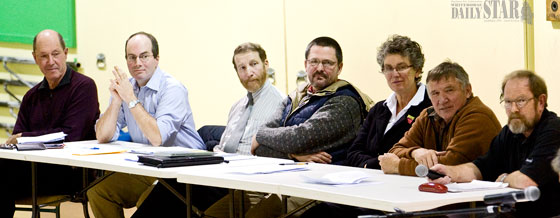
Last night at Whitehorse Elementary School, more than 50 people turned out to hear seven Yukon notables' views on electoral reform.
Those in favour, like Yukon New Democratic Party Leader Liz Hanson, insist it would bring a greater diversity of views to Canada's Parliament and legislatures.
But economist and former Canadian diplomat Keith Halliday, calls those promises of diversity "overblown”, having seen first hand what proportional representation has wrought in the European Parliament.
"On the far right, essentially you've got neo-Nazis from Austria's Freedom Party ... and on the other side you've got hardcore ex-communists,” Halliday said.
Retired public servant Steve Smyth noted that voters in British Columbia, Ontario, New Brunswick and Prince Edward Island have rejected electoral reform.
But the former political science instructor said talk of reforming the electoral system would never materialize into action until citizens had a more concrete idea of what that could mean.
"We need to try it in a jurisdiction and it doesn't have to be a permanent thing,” Smyth suggested. "Until we have a case study, we're just going to keep talking about it and we'll never see it happen.”
When Hanson agreed with the idea of a test run and used the opportunity to promote legislative renewal – her predecessor, the late Todd Hardy's goal to improve how the territory's Westminster form of government functions – Halliday offered the following blessing in jest.
"Sure, you could try it in Whitehorse Centre first,” he said, adding that Hanson and Kirk Cameron, her Liberal challenger in the downtown riding's Dec. 13 byelection, could "divvy up days in the legislature” based on the number of votes each won on polling day.
Cameron, who also took part in last evening's panel on the voter reform fence, drew attention to the dearth of 20-somethings in the audience.
"I think there's a statement there,” said Cameron, adding that there was a general lack of overall strategy in engaging younger voters.
Those calling to reform Canada's electoral system latch on to poor participation amongst the youth, caging their desire for change under the banner of democracy and fairness.
Young people don't vote because they believe their vote doesn't matter, or they don't vote because they feel no connection with the candidates, are common refrains from reformers.
But there is little evidence to show which would improve voter turnout amongst the young – changing the voting system or fielding better candidates offering more interesting and relevant platforms.
Last evening, apart from acknowledging the importance of engaging voters, little attention was paid to the citizen's role in a strong democracy – that turning out to vote once every five years is the bare minimum and people need to do more than simply let the political rhetoric wash over them up until polling day.
Between the Yukon's 2002 and 2006 territorial elections, turnout fell from 78 per cent to 72 per cent voter participation.
For David Brekke, a local proponent of electoral reform who organized Tuesday's panel discussion, it's not so much about turnout as it is about the fact that everybody's vote counts, or at least the chance it counts is improved.
For the Yukon, Brekke proposes a mixed proportional system, in which seats would be allocated in the territorial legislature based on outright winners in paired ridings with the balance of seats to be distributed according to the popular vote. To see how it would work, visit www.electoralchange.ca.
Brekke claims the system would permit individual votes to count up to 90 per cent of the time instead of less than 50 per cent under the current first-past-the-post regime.
It all sounds good on paper, but in reality it's a masquerade for extreme socialism, whereby equality of opportunity is supplanted by equality of outcome, akin to what the Dodo resigns itself to do in Alice in Wonderland.
In the big picture, equality of opportunity can create undesirable results for some, while the later notion of equality of outcome is wholly undesirable as means of operating and functioning in a free society.
One price of freedom is understanding that in a democracy, your candidate, idea or movement is not always going to win the day.
Comments (7)
Up 0 Down 0
Don McKenzie on Nov 20, 2010 at 7:04 pm
As I was not there, I do not know if the thought of a preferential ballot was discussed. The thought process behind this kind of ballot is roughly, that the voter marks down, 1, 2, 3 4, etc, depending on how many contestants there are, the voters personal preference who which contestant gets the seat. When the votes are counted up, the contestant with the lowest number of votes as the #1 choice is dropped, and the ballots for that contestant are looked over to find out who those voters thought the #2 choice would be, and the votes are distributed according to the choice of the electorate. the next lowest vote getter after that, has his/her votes distributed as to that contestants second choice, and it continues like that, until someone has 50% + 1 of the votes.
It would be a long, drawn out process, but it provides 2 VERY important needs to democracy.
1). It would be democratic.
2). Whoever the eventual winner would be, would be able to say HONESTLY, that they were elected by a majority of the voters.
A third interesting development that may come from this, is that our nation might very well be run by centerists. I believe that fringe parties would always lose, and have their votes go to parties that the TRUE majority of Canadians would support. Any political party that goes SO far away from what the majority of Canadians REALLY want, would be eliminated at the ballot box. There would NEVER be a neo-nazi, or a die-in the-wool commie, in ANY position of power, because the initial votes for them, would be distributed to other parties as they got dropped.
The other option I see, is one that was described to me by a friend over 20 years ago. In his scenario, every 2 years, 1/3 of parliamentarians be brought in, so that there is a complete change of parliamentarians every 6 years. And to eliminate to $350 million cost of elections, people are made to sit in the House, if their Social Insurance Number was chosen. It, of course, would theoretically make it possible for over 300 separatists to be in parliament at the same time, or 300 women, or any other scenario one could dream up, but HONESTLY, we could do worse. We put in 2 rules, nobody who is mentally infirm, or a convicted felon may take a seat, and that alone, may make parliament better. A person could only serve that 1 time, 6 year term, and then must make way for someone else. Gold-plated pensions would disappear, and something might actually get done, as there would be no parties involved anymore.
Radical, yes.
but as ideas go, should this not also be considered?
Thank you.
Up 0 Down 0
Conrad Gryba on Nov 19, 2010 at 11:48 am
Here's something you may not know: the Law Commission of Canada published a report in 2006 regarding electoral reform in Canada, and their first recommendation was to add an element of proportionality to Canada's electoral system in the form of a mixed member proportional system.
Whatever your opinion on the matter may be, the growing number of citizens voicing their concerns over the current FPTP system see the two recent referendums in BC, the Ontario referendum in 2007, the PEI referendum in 2005, and the yet-to-surface NB referendum is a clear indication that the 200-year-old FPTP system is no longer as relevant as it once was.
The Greens received over 930,000 votes, yet elected not ONE MP! Fewer Conservative voters in Alberta elected 27 conservative MPs! FPTP is a system that rarely represents the feelings of the majority, and because of this, is ill-suited for use in such a large and diverse country as Canada.
Up 0 Down 0
Stella on Nov 19, 2010 at 8:23 am
Not to mention that every government that has implemented proportional representation have come to regret it. Only those on the far left and right political spectrum still like it.
Up 0 Down 0
Wayne Smith on Nov 18, 2010 at 3:05 pm
Believe it or not, elections are not about winners and losers. Elections are for choosing our representatives, and we are ALL entitled to representation. Under the current system, most of us are "represented" by people we voted against, and most members of Parliament represent mostly people who voted against them. We are already living on the wrong side of the looking glass.
Up 0 Down 0
Claude Tardif on Nov 18, 2010 at 9:41 am
Canada has been slow to change to modern democracy and proportional representation mostly because of this type of biased press. Note also that it is always the politicians that are blamed for Canada's woes; never the press.
Up 0 Down 0
norman alexander easton on Nov 17, 2010 at 1:20 pm
I'm not sure how it works, but I am impressed by the fact that a MP in England was recently stripped of his seat by the courts due to the fact that in his campaign he lied about his opponent. Perhaps if we had legislation that required all candidates to speak truthfully to their position, straightforward and honestly, and prohibited negative campaigns, the resulting vote would be more representative of the population, instead of rhetoric and momentary passion?
Just asking.
And it's not just youth who are cynical about politicians.
PNAE
Up 0 Down 0
Max Mack on Nov 17, 2010 at 10:48 am
The last three paragraphs of the article destroy any pretence of objectivity by the writer (Jason Unrau).
Democracy takes many forms and Unrua's claims that Brekke's proposal "is wholly undersirable as a means of operating and functioning in a free society" are both extreme and reflect Unrau's personal bias.
Anyone who believes that our current system of democracy provides "equality of opportunity" has been deluded by rhetoric.
I don't necessarily support Brekke's proposal, but I am not so foolish as to believe that "equality of opportunity" is achieved by our current electoral system.