Photo by Star file photo
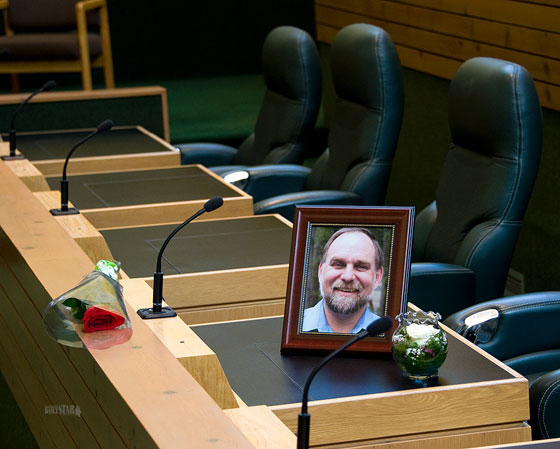
MOURNING A FALLEN MEMBER – Flowers and a photo adorn Steve Cardiff's desk in the legislature after the then-NDP MLA died in a traffic collision July 6.
Photo by Star file photo
MOURNING A FALLEN MEMBER – Flowers and a photo adorn Steve Cardiff's desk in the legislature after the then-NDP MLA died in a traffic collision July 6.
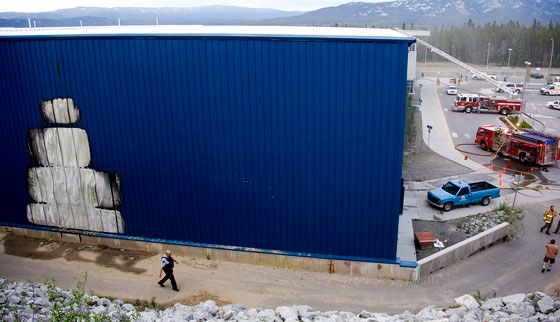
Photo by Star file photo
AN EXPENSIVE BURN – Firefighters work the evening of June 24 on the multimillion-dollar blaze at the Canada Games Centre. Two female minors are subsequently charged with arson.
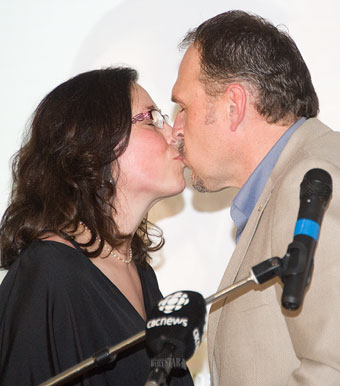
Photo by Star file photo
CONGRATULATORY KISS – Premier Darrell Pasloski shares a special moment with his wife, Tammie, the evening of Oct. 11 after the Yukon Party wins a record third consecutive election.
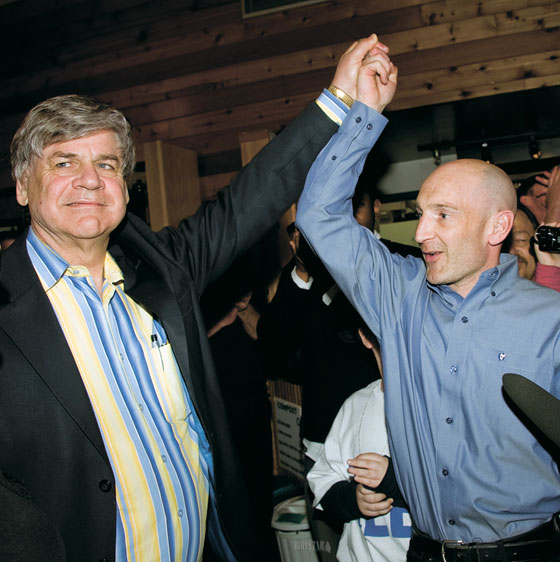
Photo by Star file photo
CONGRATULATORY KISS – Premier Darrell Pasloski shares a special moment wiENDING AN ERA – Outgoing Yukon MP Larry Bagnell (left) and MP-designate Ryan Leef share a moment the evening of May 2 at the Conservatives' election night headquarters.
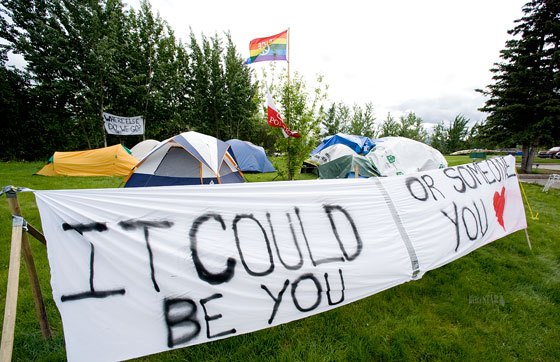
Photo by Star file photo
WE'RE HERE AND NEAR – One of the year's most sustained and high-profile news stories was the blossoming of tent city outside the territorial legislature. The protest underlined the desperate shortage of affordable housing in the city.
Choosing the Yukon's top 10 stories of the year is, to a large extent, an arbitrary task.
Choosing the Yukon's top 10 stories of the year is, to a large extent, an arbitrary task.
It's a mixture of our judgment, of the stories that have attracted considerable attention, or those that have the most significant effect on the largest numbers of Yukoners – or both.
Here, then, are the top 10 stories of 2011:
The Yukon Party wins its record-breaking third consecutive term in October. The NDP moves into the official Opposition office while the Liberals take a free-fall – both in the polls and in the election results.
In April, then-premier Dennis Fentie announces he is stepping down. After nine years in office, he leaves the future of the party up to three contenders: tourism operator Rod Taylor, pharmacist and businessman Darrell Pasloski and economic development minister Jim Kenyon.
Pasloski scores the job at the end of May, winning 767 votes over Taylor's 436. Kenyon manages to round up a mere 48 votes.
Election buzz begins heating up with the summer weather as Yukoners start to put their names forward as potential candidates.
On Sept. 9, Pasloski finally calls the election for Oct. 11. He asks Yukoners to vote for the party he claims pulled the territory out of the economic slump it saw at the turn of the century.
The Yukon Party wins 11 seats, while the NDP leaps from one to six and the Liberals crash to two. Liberal Leader Arthur Mitchell steps down after losing to rookie conservative Currie Dixon in his own riding.
As Pasloski chooses his cabinet and MLAs take their seats in the legislature, it's hard not to notice all the change that has taken place in a year: there's a different premier, Speaker and 12 new MLAs to steer the Yukon into 2012.
Bagnell had first been elected in 2000 by a margin of only 70 votes.
After Gloria Gaynor's I will Survive plays on the loud speakers at the High Country Inn, Bagnell steps up to the podium to concede.
"We accept what (voters) decided,” he tells crestfallen loyalists. "The world's unfolding as it should and things happen for a reason, so there'll certainly be bright days ahead, I'm sure.”
Leef, a 37-year-old former RCMP officer, assistant jail warden and mixed-martial arts fighter, admits he has big shoes to fill.
In March, the average price of a home in Whitehorse is just over $400,000. Yukoners are told that number won't be dropping anytime soon.
An increase in population and a lack of supply to meet the growing demand make buying a home in Whitehorse impossible for many of its residents.
By September, the number has reached $427,000.
The Yukon Party promises to release more land to private developers, but the effect of that won't be seen anytime in 2011.
By the end of November, the average price of a home has surpassed $450,000 — on par with Toronto's average and up from $378,000 a year earlier.
The dubious icing on the cake perhaps forms in December, when Yukoners have the chance to put their names into a lottery for unserviced lots in the new Grizzly Valley subdivision. The most expensive sells for a breathtaking $217, 634.
The protest begins in June, when local activist Helen Hollywood sets up her tent, joining an existing protest alongside workers at Norcope Construction upset over a government contract award for work in the Whistle Bend subdivision.
Protesters from all walks of Whitehorse life are drawn to the encampment. By July, the protest has become a squatters' settlement on the lawn of the territorial legislature, with about 40 tents at the protest's height.
For a while, tent city acts as a symbol of the dissatisfaction of many Yukoners who perceive inaction of the various branches of government to address the growing need.
In November, the protesters are joined by Mark Bowers, who brings the worldwide occupy movement to Whitehorse. He sets up his camper on the lawn of the legislature, alongside Hollywood and the other protesters.
It proves short-lived. Already facing cold weather and dwindling numbers, by Nov. 8, the campers are evicted by the White Pass and Yukon Route, owners of the property, and moved forward onto government property.
Within weeks, the few remaining tenters leave the lawn, some being offered a room at the Chilkoot Hotel.
Come the end of July, the commission releases its new plan. It recommends, again, that 80 per cent of the watershed be protected.
Environmental groups and opposition parties are delighted, while First Nations say they will accept the compromise in the name of working together. The Yukon Party remains mute.
As election hype starts to grow, well-known Canadian environmentalist David Suzuki speaks to Yukoners before embarking on a canoe trip in the watershed with his family.
He says any wilderness left on this planet should not be touched — including the Peel.
During the election campaign the NDP and Liberals promise to accept the final recommendations, while the Yukon Party won't answer the question.
Pasloski even accuses other parties of being irresponsible to throw their support into the plan without knowing how much money it will cost the government to compensate mining
companies which already have claims staked in the watershed.
When the legislature convenes Dec. 1, Energy, Mines and Resources Minister Brad Cathers tables a series of letters from the four affected First Nations. They loosely agree to push the approval of the final plan to June 2012.
Once ignited, the fire eats through three pallets of pads, climbing the centre's wall all the way to the ceiling. A fine layer of soot covers all surfaces in the centre.
After much delay, both minors plead guilty.
Just as the last rink is opening in early November, another fire breaks out in the arena's air handling unit but is extinguished immediately.
After having initially been shot down in 2005, the plan to construct the Porter Creek D subdivision with a road connecting the Alaska Highway across the creek was raised again in 2009.
By 2011, groups such as the Friends of McIntyre Creek and the Yukon Conservation Society, backed by many Yukoners, argue the area should be protected or even preserved as a park.
Organizations like the Whitehorse Chamber of Commerce and the Yukon Real Estate Association advocate for development in the area.
A wildlife assessment determines the area is not a corridor for large mammals due to human presence.
The creek's future proves a major concern during the territorial election campaign.
Both the Liberals and NDP support the area's preservation, while the Yukon Party supports further consultation with the various stakeholders.
On Dec.12, in a four-three vote, city council approves formally taking the proposed subdivision to the planning stage.
The document from the Commission for Public Complaints Against the RCMP says police policies were not followed and officers and guards treated Silverfox with callousness and disrespect.
The report, like the 2008 coroner's inquest conclusions, stops short of recommending any disciplinary action against the officers and guards who failed in their duty of care to Silverfox.
The 43-year-old man had died from a blood and lung infection in December 2008, likely brought on by inhaling his own vomit in the cell.
The same day the report is released, Silverfox's family invites the Yukon's top Mountie to a healing circle. Both sides hope this is the first step toward healing the yawning rift between the police and the Little Salmon-Carmacks First Nation, of which Silverfox had been a member.
He also orders the government to restore $1.95 million earmarked for French first-language programs but had instead gone to French immersion programs.
The government appeals the decision in August, citing what it called a number of legal errors and claiming bias on the part of the judge.
In early November, a Court of Appeal judge put the building of a new new school on hold until the appeal is completed, likely in March or April 2012.
Not even a month later, Ouellete orders the government to pay nearly $1.5 million for court costs and legal costs in what he calls acts of bad faith, both in general and during the trial.
The 54-year-old Mt. Lorne MLA had been a husband, father and grandfather. He had represented the riding in the legislature since 2002.
His death leaves party leader Liz Hanson as the sole New Democrat to bring her party into the fall election.
A few weeks earlier, Environment Minister John Edzerza had stepped down from his post to battle leukemia.
He watches the new cabinet take office in early November, but passes away at the age of 63 at the end of the month.
In order to encourage thoughtful and responsible discussion, website comments will not be visible until a moderator approves them. Please add comments judiciously and refrain from maligning any individual or institution. Read about our user comment and privacy policies.
Your name and email address are required before your comment is posted. Otherwise, your comment will not be posted.
Be the first to comment