Photo by Vince Fedoroff
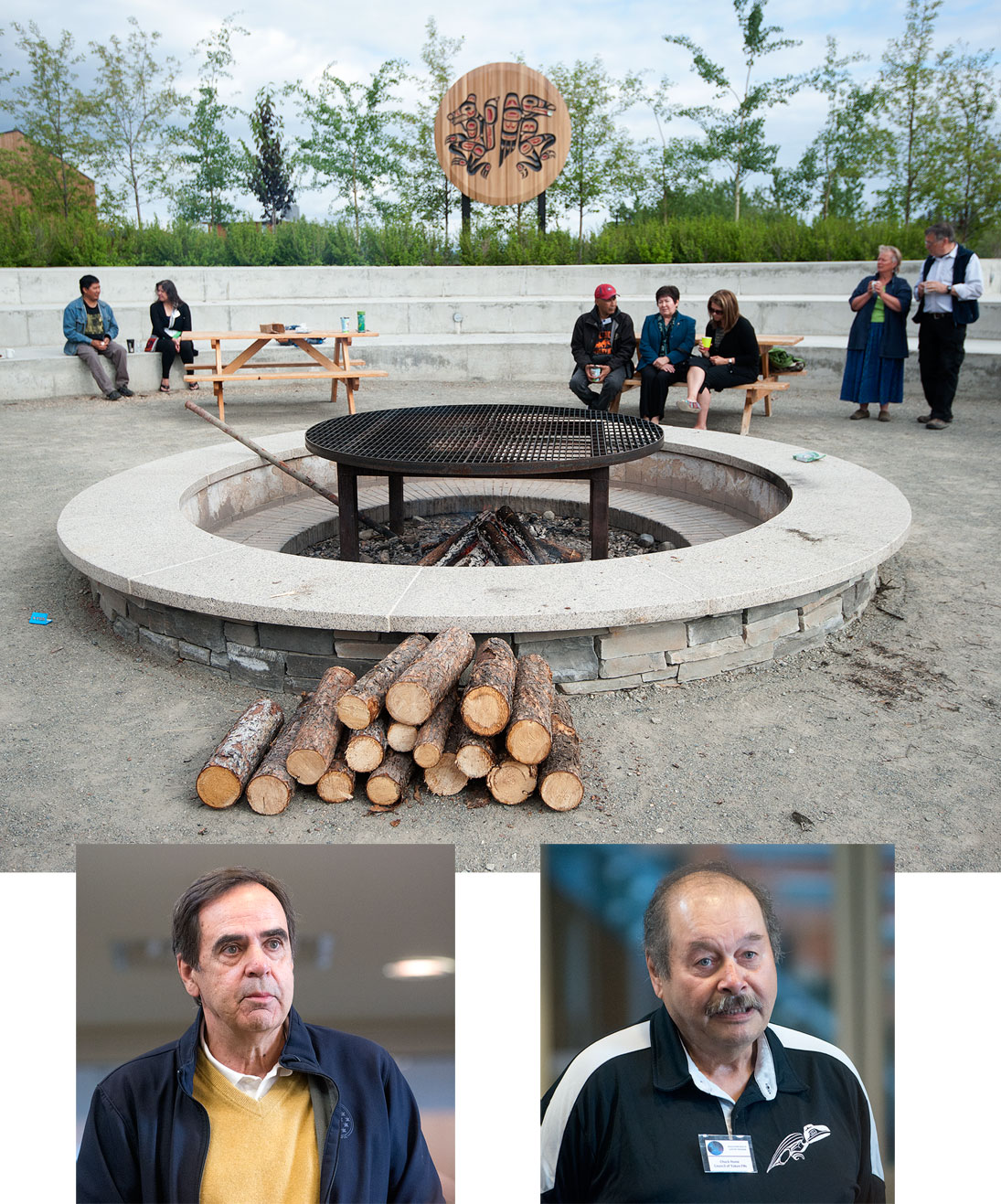
SOLEMN PREPARATION – A sacred fire was lit at 6:30 this morning at the Kwanlin Dun Cultural Centre for the Truth and Reconciliation Commission’s final report. Rod Snow, left, Chuck Hume
Photo by Vince Fedoroff
SOLEMN PREPARATION – A sacred fire was lit at 6:30 this morning at the Kwanlin Dun Cultural Centre for the Truth and Reconciliation Commission’s final report. Rod Snow, left, Chuck Hume
Yukoners gathered in the foyer of the Kwanlin Dün Cultural Centre this morning,
Yukoners gathered in the foyer of the Kwanlin Dün Cultural Centre this morning, where the Truth and Reconciliation Commission (TRC) of Canada’s calls to action were being streamed live from Ottawa.
After six years of hearing statements from nearly 7,000 survivors and witnesses of abuse at Indian Residential Schools, the three Commissioners released their findings today in a 360-page report summary, which includes 94 recommendations.
Within the recommendations, there was an emphasis on change in policies and programs as well as memorials. Governments across Canada are urged to adopt the United Nations Declaration on the Rights of Indigenous Peoples.
Also highlighted in the report are the steps necessary to protect child welfare, preserve native language and culture, promote legal equity and strengthen information on missing children. A national inquiry into missing and murdered aboriginal women, and an annual report on the state of aboriginal peoples were also suggested.
The importance of education was identified, not only for aboriginal Canadians, but for others as well.
TRC commissioner Dr. Marie Wilson emphasized gaps in Canadian history classes and demanded that a mandatory curriculum be implemented and accredited.
The commission also called on the government to equalize education funding between First Nations living on and off reserves and increase access to post-secondary education.
These recommendations, all 94 of them, represent the the first step toward advancing reconciliation, said Justice Murray Sinclair, chair of the TRC.
Sinclair said seven generations were denied their identity as they were forcibly removed from their homes and separated from their language, culture, spiritual traditions and their collective history.
Cultural genocide is the term the TRC used to describe the establishment and operation of residential schools.
“We need reconciliation so our broken country can be whole again,” Wilson said.
Reconciliation, the report states, will happen only when there is awareness and acknowledgement of the past and action to change behaviour.
Premier Darrell Pasloski thanked Yukoners for risking their own psychological and spiritual well-being while sharing their experiences with the commission. For many, it meant recounting an inexplicably painful past that they had desperately tried to forget.
For Vincent Smarch, it’s a pain that is present in his life every single day.
The 54-year-old was taken to Lower Post school in B.C. in 1966. He remembers stopping in Teslin, where his grandparents said to him, “You’re going to school. Be strong.”
But it wasn’t the kind of school where at 3 p.m., he could hop on a bus and go home to his parents.
Smarch can remember getting dragged out of bed for midnight mass at the school and being handed a candle to hold during the Roman Catholic prayers. He says kids were falling asleep on their feet, and nuns would walk by and poke them with sharp objects to jolt them awake.
This, he says, is just one of the small examples of abuse the kids endured at Lower Post, a notorious residential school known for its physical, sexual and emotional abuse.
“It’s the dirty little secret that they wanted to keep buried,” he says.
Apology is the first step in the right direction, he says, but he isn’t ready to forgive and forget just yet. He admits that he probably will never recover from that harrowing experience in his lifetime.
“You don’t ask Jewish people to forget the Holocaust, or Japanese about Hiroshima, so why would you ever ask us to forget this?”
For report commissioner Chief Wilton Littlechild, one recurring message stood out during the six-year commission— “Our spirit cannot be broken.” Littlechild noted that among the many stories of atrocities, there were also ones of hope.
After the commissioners made their closing address, residential school survivor and Champagne/Aishihik First Nations elder Chuck Hume addressed the crowd of Yukoners. He noted that this report is “a very important milestone” in a long road Canadians have been travelling for a long time.
“Just to give you an idea, when I was young, about five or six years old, my mind was way out,” he said, gesturing outward with his arms. Residential schools, he said, were started with the purpose of narrowing that vision.
“We were forced to go through life and never open that gap,” Hume said, with his hands clasped together to represent the suppression he and other residential school survivors experienced.
Local lawyer Rod Snow also spoke on behalf of the Whitehorse United Church.
“We were all reminded today that this is all about children. The speakers we heard from were old, but this happened to children,” said Snow.
He reiterated Sinclair’s comment from the commission — that this is not a First Nations problem, but a problem that involves all Canadians.
And now, Snow said, Canadians have been challenged.
We have an opportunity to respond, and we will be judged on how we respond to that challenge, he said.
Snow’s statement was met with a hug from Hume and a standing ovation from the crowd.
Brown paper bags were dispersed around the room, with the words “bag of tears” written on them. These bags are meant to collect the tears of individuals and later be burned in the sacred fire that was lit at 6:30 this morning — a small step in the long road of reconciliation that is to come.
See commentary; related coverage.
In order to encourage thoughtful and responsible discussion, website comments will not be visible until a moderator approves them. Please add comments judiciously and refrain from maligning any individual or institution. Read about our user comment and privacy policies.
Your name and email address are required before your comment is posted. Otherwise, your comment will not be posted.
Comments (3)
Up 15 Down 5
David David on Jun 5, 2015 at 12:46 am
Time to put things right. No more apologies.
Up 23 Down 6
Diane tichard on Jun 3, 2015 at 9:14 pm
I can only say -- this saddens me
Up 43 Down 16
Bev Edzerza Bapty on Jun 2, 2015 at 8:06 pm
I cried as I read this. I had siblings who went to residential school - I, fortunately did not, however, I was subjected to racial abuse throughout my life. How do you accept/explain this to yourself or to your children. My Dad had the foresight to move away from the reserve, sign away his Indian rights so his wife could get medicine & his children didn't have to go away. Thank you Dad - George Agouta Edzerza - you were a man before your time.