Photo by Vince Fedoroff
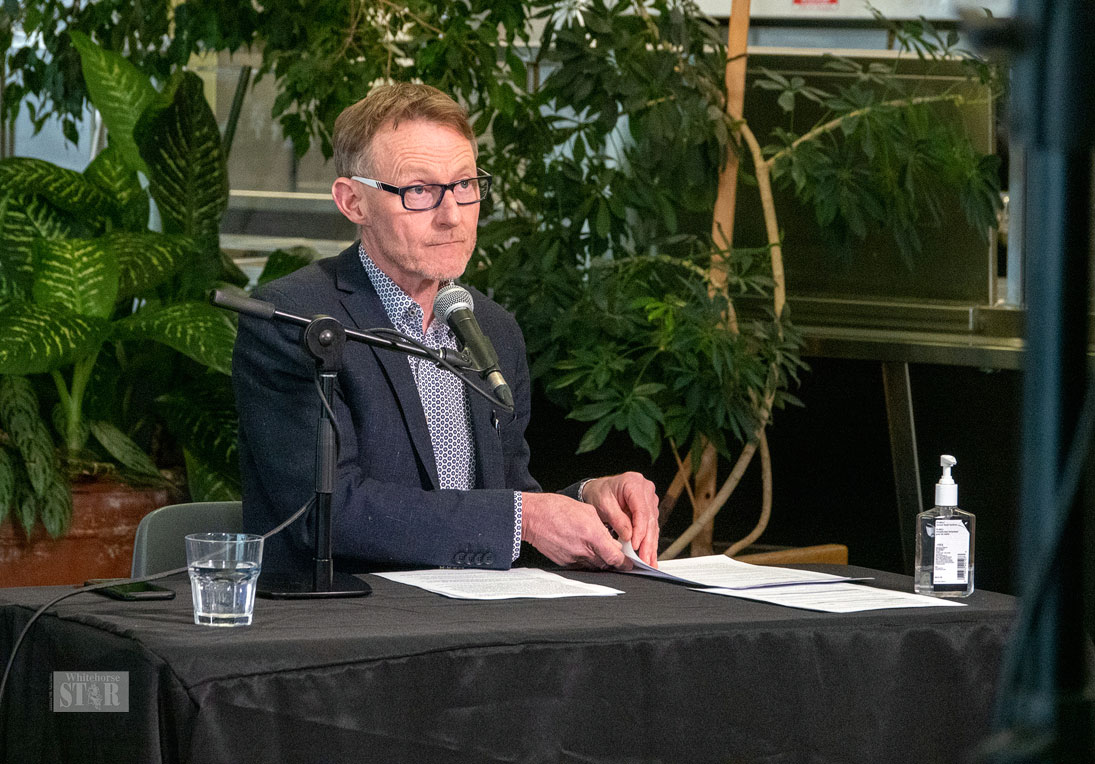
INFORMING THE PUBLIC – Dr. Brendan Hanley, the territory’s chief medical officer, is seen at Monday afternoon’s update on the territory’s COVID-19 situation. A seventh case has been reported.
Photo by Vince Fedoroff
INFORMING THE PUBLIC – Dr. Brendan Hanley, the territory’s chief medical officer, is seen at Monday afternoon’s update on the territory’s COVID-19 situation. A seventh case has been reported.
The Yukon has a seventh case of COVID-19, with four cases now recovered, leaving three active cases currently recovering in isolation.
The Yukon has a seventh case of COVID-19, with four cases now recovered, leaving three active cases currently recovering in isolation.
The seventh case was found in an individual who travelled to Europe and was in self-isolation upon returning to the Yukon.
In a medical briefing held Monday afternoon, Dr. Brendan Hanley, the territory’s chief medical officer, said the newest case poses little risk to the public.
“I want to be clear that these are not cases that keep me up at night,” Hanley told reporters.
“We will continue to see these cases pop up like little arrows trying to penetrate the armor we have created –– an armour of safe physical spacing, of hand washing and of restricting or reducing travel both to Yukon and within our beautiful territory.
“Our public defence will easily hold against these viral intrusions as long as we maintain our guard.”
No Yukon cases have required medical treatment so far.
Hanley said health officials are continuing aggressive testing measures and search for signs of community spread, or cases that are not travel- involved or can’t be traced back to a previous case.
The chief medical officer urged Yukoners to take advantage of Easter long weekend with safe outdoor exercise, but reiterated that people should not plan to gather for the holiday.
“It’s important for us to pace ourselves as we go through this pandemic experience,” Hanley said.
“We do know we’re in this for the long haul and we need to look after ourselves physically as well as mentally.”
Though he recommended that Yukoners plan for outdoor activities, he warned against backcountry adventures or dangerous activities that could require assistance from first responders.
For the same reason, he warned against the excessive consumption of alcohol or recreational drugs.
Hanley addressed the World Health Organization’s recent pivot to support jurisdictions recommending the wearing of face masks.
Dr. Theresa Tam, Canada’s chief public health officer, said Monday that people should wear non-medical masks in situations where safe physical distancing isn’t possible.
Hanley and Tam noted that medical masks should be reserved for health care workers, who are facing shortages in such supplies.
In regard to wearing homemade masks, Hanley said the masks do not replace physical distancing, hand washing and other virus fighting measures.
“Wearing homemade masks is not a prudent measure,” Hanley said.
“It has not been shown to protect the person wearing it, but can be a way to reduce the chance of you infecting others. Think of cloth masks as another way to cover your face when you cough.”
Hanley suggested that wearing a mask might make some people feel safer, and they’re welcome to do so, but nobody should feel pressured to don a face covering.
There are multiple levels of community response plans being worked out for the communities, Hanley said.
The response plans mirror the Yukon’s current systems for treating sick members of rural communities.
Generally, if a person is infected with COVID-19 in a rural community, he or she would be instructed to self-isolate at home.
If the individual requires medical treatment, there are systems in place for health centre workers to communicate with the Yukon’s main medical pathways.
The response plans include facility management and protocols for prevention, as well as public health guidance for caring for sick individuals.
There is also guidance for educating community members on safety protocols.
Hanley said the territory’s actions to fight COVID-19 have been successful so far, and health officials are constantly revising strategies as situations change.
“I think we’re confident but we’re vigilant,” Hanley said.
He said the Yukon is in the fortunate position of being able to learn from other jurisdictions, both within Canada and around the world, which are farther advanced in the spread of the virus.
In order to encourage thoughtful and responsible discussion, website comments will not be visible until a moderator approves them. Please add comments judiciously and refrain from maligning any individual or institution. Read about our user comment and privacy policies.
Your name and email address are required before your comment is posted. Otherwise, your comment will not be posted.
Be the first to comment