Territory purchases two new ambulances with added features
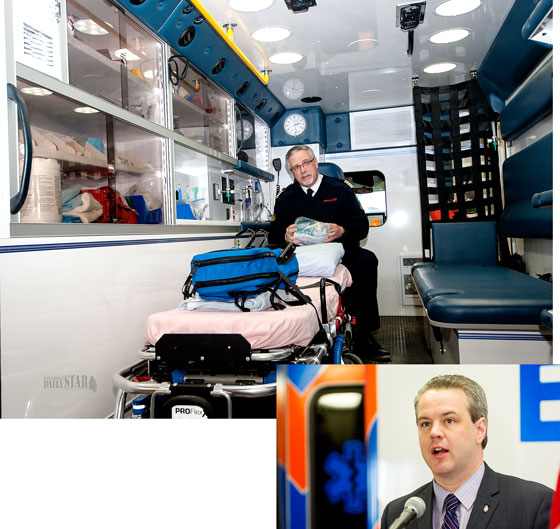
In 1990, paramedic Eric Grasholm began his career with the territory's Emergency Medical Services.
By Stephanie Waddell on February 28, 2014
In 1990, paramedic Eric Grasholm began his career with the territory's Emergency Medical Services.
There's been "quite the change” Grasholm said Thursday afternoon as government officials showed off the two newest ambulances in the fleet purchased for $306,000.
Sitting in the front seat of one of the new rigs, it was easy to see, quite literally, the bells and whistles of the new vehicle.
An iPad is attached to the dash with a number of electronic copies of any number of manuals and documents used by paramedics as well as maps and GPS capabilities.
There's also a separate GPS next to it.
A series of switches operates the flashing ambulance lights on the front, side and back of the vehicle. Gone are the early days when the lights were a distinct red, Grasholm said, pointing out that they are now red, yellow and white as the red was sometimes harder to see.
While the red, yellow and white lights have been part of ambulances for some time now, the new vehicles feature brighter lights.
The sirens these days also allow paramedics like Grasholm to choose a variety of noises to notify the traveling public to pull over and stop so the ambulance can tend to the emergency.
Radios are also operating on a different frequency, leading to better timing at city intersections where traffic lights are programmed to change for emergency vehicles.
Since getting the new vehicles, Grasholm said he has noticed the lights changing for the ambulance sooner than they were previously.
The new ambulances also feature a scene lighting system to help emergency medical staff see better in the dark, improved reflective markings and a back-up camera to make the vehicle safer.
Multiple electrical and oxygen outlets allow staff greater flexibility in providing care, it was noted at the press conference by Community Services Minister Brad Cathers.
"These ambulances will support our highly-skilled EMS responders and help them do their jobs safely and efficiently,” he said.
With the two new ambulances in Whitehorse, it's expected two of the older emergency vehicles will be transferred to one of the rural volunteer EMS services.
A total of 58 full-time staff, including paramedics, critical care team members, dispatch and 155 EMS volunteers respond to more than 7,000 calls across the territory. About 5,200 of those calls come from Whitehorse, 1,300 from rural communities and there's approximately 860 medevacs by air from the territory to medical facilities in the South.
"We take this responsibility very seriously,” said EMS director Michael McKeage.
"When the call comes, we are rolling.”
McKeage said EMS is grateful to the territory for the new purchases which will help paramedics do their work more efficiently with improved visibility on the roads, LED lights that will decrease maintenance needed on the lighting system, and a more efficient working space inside the ambulance will help paramedics better care for the patients as they move them to hospital.
He noted the public has a role to play in assisting EMS staff as well and issued a reminder for drivers to pull over and come to a stop when they are in front of an ambulance flashing its emergency lights.
Home address numbers should also be clearly visible from the street so paramedics know where to go.
McKeage encouraged those dealing with a medical situation who are worried it may not be serious enough to warrant a call to EMS, not to wonder whether they should call and instead just make the call so medical care can be received ASAP.
Be the first to comment