Teamwork essential for reaching goals, says ex-hockey executive
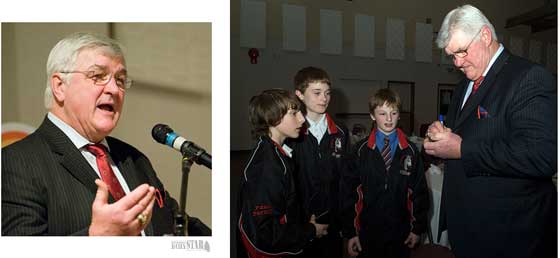
Teamwork was one of the central points of Pat Quinn's speech at the Partnering for Success economic summit banquet on Thursday evening.
By Jon Molson on March 6, 2009
Teamwork was one of the central points of Pat Quinn's speech at the Partnering for Success economic summit banquet on Thursday evening.
The former National Hockey League player, coach and general manager addressed a sold-out room, sharing his experiences with such traits as skill, character and passion.
"Partnering for success, I understand exactly what you are trying to do because it has been a part of my life for a long time," Quinn said at the beginning of his speech.
"The concept of working together is a concept of teams. Your business, your industry, your sports, your government, your first nations people are trying to come together to promote your economic prosperity.
"That's exactly what I've tried to do, and in 1963-64, I turned pro, and prosperity for me was trying to play hockey for a living and at the same time get my education."
The summit, which ended today, was organized by the Whitehorse Chamber of Commerce, an organization that strives to bring local businesses together.
It also hopes to expand the Yukon's economic opportunities by identifying and seeking out solutions to challenges.
The chamber is a private sector initiative and has 450 to 500 local business in its membership.
The chamber hoped Quinn's speech, given at the Yukon Convention Centre, would motivate his listeners.
It was open to the public and cost $25 per person, which included dinner.
The dinner also was a fundraiser for the Whitehorse PeeWee Mustangs, who will travel to Trail, B.C. later this month for the provincials hockey tournament.
Quinn, who most recently coached Canada's U-20 team to a gold medal in Ottawa at the ISF World Junior Hockey Championship, drew on his past hockey experiences to get his message across.
He stressed team building, teamwork, leadership and communication, saying all those elements are necessary to get good results on the ice or in the boardroom.
"In tough economic times like you're facing, it's even more important to develop the fundamentals of team," said Quinn.
One of his themes was in regard to the whole being more important than the sum of its parts. Quinn illustrated this with his experience coaching the U-18 Canadian team last spring in Russia.
Heading into the tournament, Quinn said he was concerned because Canadian teams in that particular age bracket had never done well in that competition.
Quinn added he thought it was because of it being the players' draft year, and 100-plus scouts around the world in attendance.
"What happens with these young people in my mind was that they were so concerned with their individual appearance and showing their skills that they forgot about the elements of becoming a team, and that was the reason why Canada hadn't done so well," he said.
"I am happy to say, I was apprehensive about taking that group, but once we got together, found out it was the furthest from the truth."
Canada's team ended up winning gold at the tournament. In fact, in 10 appearances behind the Canadian bench, Quinn has medalled eight times, winning five gold medals, two silver medals and one bronze.
He said his personal highlight was Canada's 2002 Winter Olympics gold medal, which ended a 50-year drought for the country.
Besides individuals getting in the way of team goals, Quinn also warned about complacency, using former Toronto Maple Leafs player Alexander Mogilny as an example.
Mogilny, Quinn said, was one of the most talented players he has ever coached. However, the Russian never reached his full potential because of his habit of getting into what Quinn referred to as the "rocking chair."
Quinn went on to say teams don't just come together; that it is an evolutionary process that needs to be worked on.
He said there are four primary and two secondary behaviours that make up the essence of winning teams.
The most important is commitment, followed by growth, which provides a mission and direction. The third is goals to provide clarity and the fourth is a winning approach.
Quinn said the two additional factors are skills and size, in terms of numbers.
He added leadership is needed for both. In addition to leadership, Quinn said follower ship is also important.
When assessing members of the team, said the burly Irishman, he looks at it like a triangle.
On the one side, he said there is skill, while the other is knowledge and the third is attitude.
He said attitude is the most important.
"That's what allows the other two sides to work," Quinn said. "Attitude includes all those intangible skills that contribute to who you are, attributes like courage, perseverance, work ethic, humility. It's an endless list."
Quinn received two ovations for his speech, which chamber president Rick Karp said did a good job emphasizing the value of teamwork.
"We are not dealing with sports," he said. "We are dealing with something much more serious, and that's the future of the Yukon. And so we have to pull the business community together as a team, just as Mr. Quinn was talking about in his speech tonight.
"If the business community pulls together as a team, then we as a single unit will be successful."
Comments (1)
Up 0 Down 0
Arn Anderson on Mar 7, 2009 at 11:54 am
There is no I in Team, but there is an M and a E though.