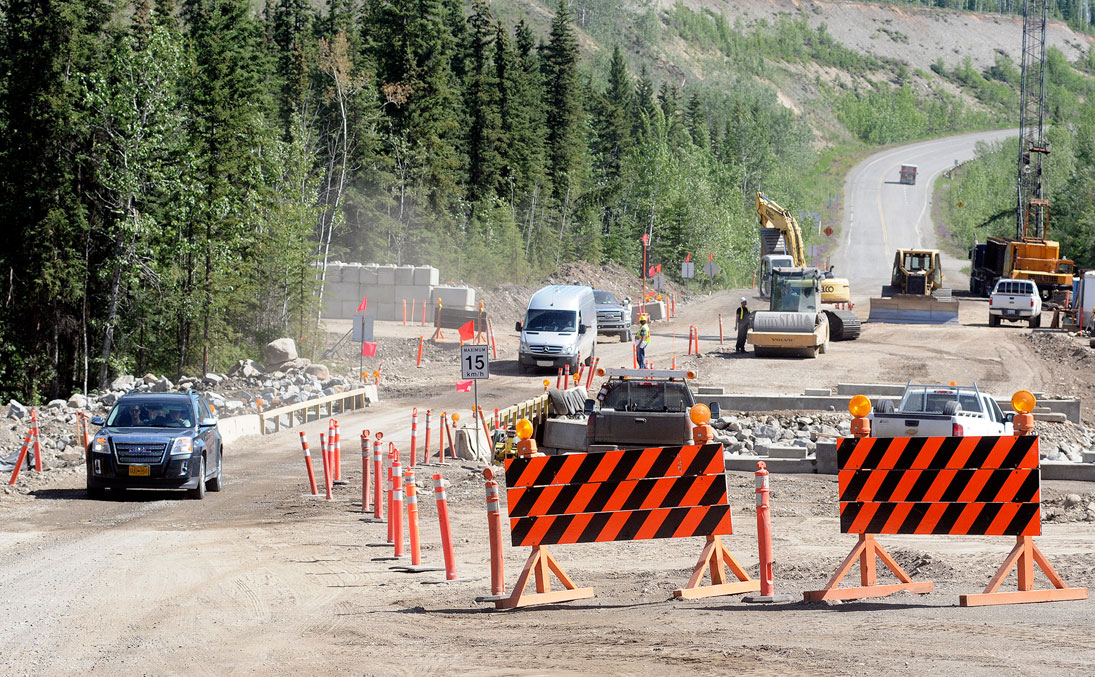
Photo by Marcel Vander Wier
BACK ON TRACK – Placement of waste rock at the Tatchun Creek Bridge recommenced early last week, following a green light from the Yukon Water Board.
Photo by Marcel Vander Wier
BACK ON TRACK – Placement of waste rock at the Tatchun Creek Bridge recommenced early last week, following a green light from the Yukon Water Board.
Placement of waste rock from the Minto Mine to provide bank stabilization resumed last week at the Tatchun Creek Bridge project.
Placement of waste rock from the Minto Mine to provide bank stabilization resumed last week at the Tatchun Creek Bridge project.
A stop work order was issued in early June by the Yukon Water Board after new concerns were raised by the Little- Salmon Carmacks First Nation.
The board subsequently ordered the Yukon government to conduct further testing to determine whether minerals were being leached into the salmon-bearing creek from the waste rock and whether the waste rock was acid draining.
Testing of the material was conducted back in 2012 as part of the original review of the government’s application, prior to the board issuing a water licence in February 2013.
Concerns were raised by the First Nation after work began this spring when discolouration of water from rain runoff was noticed.
The order to stop placing the rock as rip rap was issued June 4, and the government was instructed by the board to conduct further testing.
Assistant deputy minister Allan Nixon of the Department of Highways and Public Works said last Thursday the tests confirmed the waste rock was not acid draining and was not at risk of leaching minerals into the creek.
As part of the condition to recommence the placement of the waste rock, the government has been instructed by the board to conduct ongoing monitoring of the creek water to ensure the material is remaining stable.
The stoppage did cause some delays in the project but Nixon believes they’ll be able to complete the critical part of the in-stream work before the window closes with the arrival of the annual run of chinook salmon.
He estimates the delay and ongoing monitoring will add approximately $250,000 in additional costs to the $4.5 million project.
In order to encourage thoughtful and responsible discussion, website comments will not be visible until a moderator approves them. Please add comments judiciously and refrain from maligning any individual or institution. Read about our user comment and privacy policies.
Your name and email address are required before your comment is posted. Otherwise, your comment will not be posted.
Comments (2)
Up 1 Down 1
Fred Green on Jul 8, 2014 at 1:13 pm
The proper procedure (MEND) for testing rock of this nature requires Humidity cell testing and kinetic Testing. This takes up to a year. How HPW could conclude their testing in a couple of weeks is the outstanding question. There is a real possibility that the testing is inadequate. In this case, if they are wrong the fish will suffer. If one looks at the waterline license MS12-062-2 final decision reasons for decision you will find that the first round of testing was questionable causing the board to amend the license adding more appropriate (though still inadequate in my opinion) conditions.
Up 1 Down 3
Just Say'in on Jul 7, 2014 at 10:56 pm
When are these bands going to stop all this nonsense? They are going to spend us into the poor house if we let them. They already get concessions for every project that happens in their territory. They are just chronically against everything unless they are getting a big fat cut. The next step by YTG and Feds should be to cut back band funding when value added projects are slowed or shut down. After all that is where the tax money comes from and if they don't have it they should stop some of the spending in the way of funding to the bands that do not want to participate in prosperity.