Photo by Vince Fedoroff
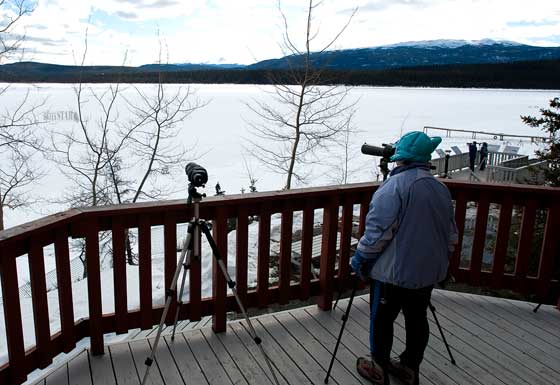
GAZING AT WINGED WONDERS – Visitors to Swan Haven view the much admired birds from the provided scopes last Sunday. Swans are still some distance away at Marsh Lake.
Photo by Vince Fedoroff
GAZING AT WINGED WONDERS – Visitors to Swan Haven view the much admired birds from the provided scopes last Sunday. Swans are still some distance away at Marsh Lake.
Wildlife viewing biologist Bruce Bennett expects the peak period for trumpeter swans migrating through M'Clintock Bay won't for be another week or so.
Wildlife viewing biologist Bruce Bennett expects the peak period for trumpeter swans migrating through M'Clintock Bay won't for be another week or so.
Though seven trumpeters spent the winter out at Johnson's Crossing, the first of those arriving from down south didn't show up in the Yukon until around mid-March.
Eighty-one of the big birds were counted from the Swan Haven observatory and interpretive centre Wednesday night, along with scores of different ducks and other birds.
Altogether, from Johnson's Crossing to Carcross, M'Clintock Bay to the Tagish Narrows, it's estimated there are about 400 trumpeters taking a break today in the southern Yukon.
Swan Haven opened last Friday, the same day a northern harrier hawk was sighted. That made it the first species spotted this spring that wasn't recorded in the Yukon during the winter at any time, by anybody.
Bennett said even plenty of waterfowl are seen here during the winter.
There's a group of mallard ducks, for instance, which spent the last few months at the McIntyre Marsh along the Fish Lake Road, he pointed out.
"Golden eyes and mergansers (ducks) often overwinter below the Whitehorse dam.”
The annual Christmas bird count, Bennett added, records all kinds of species.
But nowhere did anybody see a northern harrier this winter, he said.
The wildlife biologist noted a flock of swans at Johnson's Crossing has spent the last four winters there, though it's uncertain if they've been the same birds, perhaps a family group – the goose, the gander and their offspring.
It could be the same adults with each year's brood, and maybe not, Bennett said.
He said it's difficult to say for sure because there hasn't been a lot of banding of swans for identification purposes in the Yukon or elsewhere.
As far any anybody knows, he added, Johnson's Crossing is the only open water in the Yukon where the trumpeter swans have spent the winters recently, though there have been reports from other areas over the years.
Bennett said last year's daily count of trumpeters peaked at 2,432 on April 7, a little earlier than normal.
Timing for this spring's migration is so far looking more typical, and he expects the peak to occur next week, around April 14.
Bennett said the migration of the smaller tundra swans doesn't hit full swing until later in April, somewhere around the 26th.
It seems in recent years, however, fewer tundras are stopping at M'Clintock Bay, for some reason or other, Bennett said.
He suggested it may be with the rising population of trumpeter swans, the southern waters used by both species during their migrations have become less appealing to the tundras.
Skipping dinner at M'Clintock Bay, Bennett said, isn't going to create a hardship with the smaller, high-flying swans which reach invisible heights on their way north, to as far as the Beaufort Sea coast.
History shows that at the turn of the 20th century, after the trumpeter populations across North America had been ravaged by demand for their meat and pretty feathers, the birds were near extinct, with the population estimated as low as 500 on the whole continent.
Scientific surveys in the Yukon and Alaska last summer turned in a count of 28,238 trumpeter swans; 3,238 counted in the Yukon and 25,000 recorded in Alaska.
Research shows most trumpeters migrating through the territory are heading west across the border.
The total population of trumpeter swans in North America – or the world, as this is the only continent where they live – is estimated at 46,000, comprising three distinct populations – the Pacific Coast population, Rocky Mountain and the interior population of the midwest United States.
Of the 3,238 trumpeters counted in the Yukon last summer, records indicate approximately 2,000 were of the Rocky Mountain variety, which tend to occupy more northern and eastern areas of the territory, like the Mayo district.
Of the 25,000 counted in Alaska, however, science says it's pretty much a given every single one of them is from the Pacific Coast population.
Records indicate the population of tundra swans in North America – or the world – is estimated at about 150,000 birds, about 80,000 of which make up the western population.
Swan Haven is open through April from 5 p.m. to 9 p.m. on weekdays, and from noon to 7 p.m. on weekends and holidays.
In order to encourage thoughtful and responsible discussion, website comments will not be visible until a moderator approves them. Please add comments judiciously and refrain from maligning any individual or institution. Read about our user comment and privacy policies.
Your name and email address are required before your comment is posted. Otherwise, your comment will not be posted.
Be the first to comment