Suzuki savours watershed, witnesses engagement
After spending 14 days in a canoe, David Suzuki's message is the same: the Yukon needs to protect 100 per cent of the Peel watershed.
By Nadine Sander-Green on August 25, 2011
After spending 14 days in a canoe, David Suzuki's message is the same: the Yukon needs to protect 100 per cent of the Peel watershed.
And it's up to Yukoners to put pressure on the government to do just that, he says.
"As an outsider, I kept thinking, ‘Oh, my God, this is priceless to see the watershed like this,'” the renowned environmentalist told local reporters Wednesday afternoon.
"Very few people will get to experience the watershed as it is now.”
Suzuki is now back from his trip on the Peel and the Hart rivers. He spoke from Vancouver through a conference call.
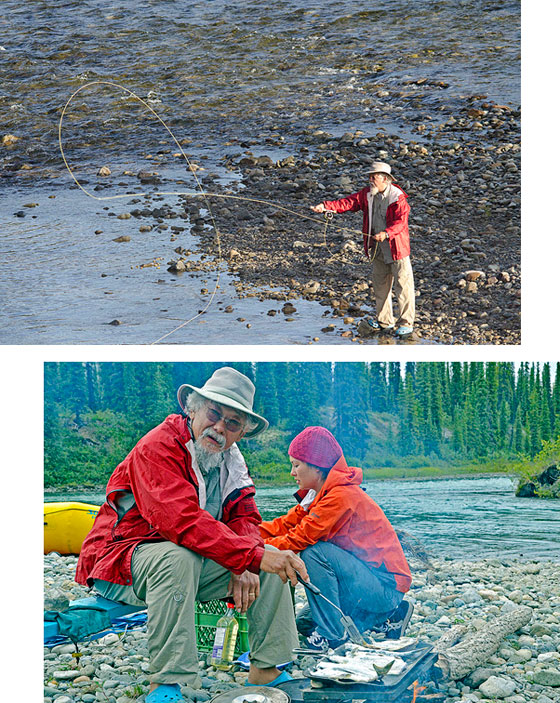
The 75-year-old was in Whitehorse for a public presentation at the end of July before he and his family embarked on a canoe trip on the Peel and Hart rivers.
Suzuki said everytime he comes to the Yukon, he's reminded of how fortunate Canadians are to travel for two weeks without seeing a sign of another human.
But after a few minutes of waxing poetic about his trip, Suzuki went right to the heart of the matter.
People who stake claims, he said, should not determine the future of the territory.
"People who have stakes, what the hell have they put out, just to put a stake in the ground? Have they invested money? Most of the people who are staking have nothing to do with the Yukon itself,” said Suzuki.
It's crazy if we're going to let those stakes now somehow determine the future of the territory, he continued.
"The big question is: is the Yukon content with people coming in, taking our resources and then shipping them out?” asked Suzuki. "Is there going to be some sort of long-term plan?”
Look to Bolivia, suggests Suzuki.
The country mines lithium, but decided to keep its resources within its own boundaries.
"The Bolivians are saying, Well, we'll share the lithium with the rest of the world. What do you want? You tell us what you want you want to do with it and we'll do it here in Bolivia,'” he said.
At the end of last month, the Peel Watershed Planning Commission released its final plan. It recommended, as it did in its previous version, that 80 per cent of the watershed be protected.
The territorial government rejected the 2009 plan, and has yet to say if it will follow the recommendations in the new plan. The government agreed to come up with a decision by November, but since the plan was released a few months late, the date is up for debate.
So what now?
Suzuki says it's the job of Yukoners to put pressure on the government.
"From what I understand, the vast majority of Yukoners are for the preservation of the entire watershed,” said Suzuki.
"One has to impress that on government.”
The problem, he continued, is we're not getting enough democracy. People aren't getting out and being actively involved in the process.
People aren't registering what the things are that matter to people who are getting the vote, he said.
"We're seeing at all levels of government, the tremendous power of corporations ... we can't allow the corporate agenda to continue to drive priorities.”
As for the trip itself, Suzuki was a bit disappointed with the number of animals they saw.
He had hoped to see more grizzly bears and moose. He and his family did, though, feed themselves on grayling almost every day.
And although being away from the phone and e-mail was a much needed break for the man who is often referred to as
Canada's leading environmentalist, there was an event that even topped that: Suzuki's daughter got engaged.
Her boyfriend, Chris, asked her to marry him at a what Suzuki calls a "particular junction of two great rivers coming to flow as one.”
She said yes.
Comments (3)
Up 0 Down 0
Marco on Aug 26, 2011 at 3:53 am
Note to JC
You sound like an Economist
Focus on love, peace, music and good times with friends and not blowing up the side of a mountain or damning rivers, and dreaming of gold dust.
Beating people up or stealing, those are jobs too. Get my drift? Where do you draw the line.
Ask the people of Cape Breton what they think of their Coal Based Economy. oh yeah I forgot it died with the land.
WAKE UP!
Up 0 Down 0
Marco on Aug 26, 2011 at 3:45 am
Abundance=choice=freedom and those who run the show from behind the curtain don't want that.
They believe scarcity=dependency=control
For every bit of wilderness we lose, the meaning of life goes with it.
For example The Yukon gold rush. What was that all about? What does gold have do with life? You can't eat it, sleep on it, talk to it, breath it etc. THis idea of the economy is just that, an idea not a reality.
SAVE THE YUKON WILDERNESS
Up 0 Down 0
JC on Aug 25, 2011 at 9:22 am
Canadians and Yukoners need jobs. Is the great Suzuki going to provide for them? I've noticed over the years he find solutions for putting people to work. I bet he hasn't missed a good meal in many a year because of lack of work. I suggest he stay home and clean up the environmental mess in Vancouver Harbour. Personally, I think people are getting just a little fed up with the likes of Suzuki and his compatriot Al Gore.