Photo by Vince Fedoroff
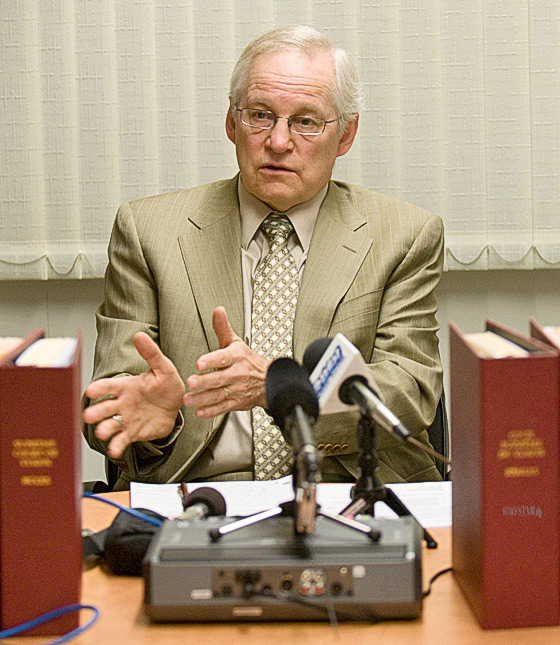
HISTORIC LEGAL CHANGES UNVEILED - Yukon Supreme Court Justice Ron Veale explains the court's imminent adoption of its own set of rules during this morning's news conference.
Photo by Vince Fedoroff
HISTORIC LEGAL CHANGES UNVEILED - Yukon Supreme Court Justice Ron Veale explains the court's imminent adoption of its own set of rules during this morning's news conference.
The Supreme Court of Yukon will adopt its own set of rules effective Monday of next week.
The Supreme Court of Yukon will adopt its own set of rules effective Monday of next week.
The new rules mean that for the first time ever, the territory will not have to rely on the British Columbia Supreme Court Rules.
Yukon Supreme Court Justice Ron Veale told a news conference this morning that until now, the Yukon has been "saddled" with annual changes to the B.C. set of rules, resulting in a "patchwork quilt" of rules that are often unproductive for Yukon courts.
There are 66 rules in total, said Veale. While the format of the rules for the Yukon is the same as the rules in B.C., the content has changed - in some cases, significantly.
One of the changes is dropping the "ancient writ of summons format for the simpler statement of claim," says a release from the Supreme Court.
Debbie Hoffman, a family lawyer and member of the rules committee, explained that the committee worked to ensure plain language was used as much as possible when drafting the new rules.
Particularly with rising numbers of self-represented litigants, Hoffman said, it's important to avoid complex legal terminology where possible.
Another new rule stipulates that case management conferences will become mandatory within the first 60 days of the case's commencement.
While the Yukon justice system already uses settlement conferences and family law case conferences to "assist in the timely conclusion and hearing of cases," according to a press release, the new rule will further ensure that cases can proceed as quickly as possible.
This rule is intended to facilitate access to justice, said Veale.
The new rules include the ability to request litigants to appear to explain delays and why a case has not proceeded to trial in one year.
The rules will also include the "principle of proportionality."
This means that the time and expense incurred for an individual case will be based upon the importance of the issues and the complexity of the proceeding.
To illustrate, Veale said a frequent problem arises in family court when opposing parties submit affidavits with contrasting evidence relating to issues such as child custody or financial matters.
While the parties involved often prefer a timely decision despite the contrasting affidavits, such a matter will often go to trial. This results in unnecessary delays and added expense, said Veale.
But under the principle of proportionality, such issues will now be resolved more quickly.
Veale said the Yukon frequently has legal counsel from Outside, and that these lawyers are obligated to be informed about the rules in this jurisdiction.
In order to encourage thoughtful and responsible discussion, website comments will not be visible until a moderator approves them. Please add comments judiciously and refrain from maligning any individual or institution. Read about our user comment and privacy policies.
Your name and email address are required before your comment is posted. Otherwise, your comment will not be posted.
Be the first to comment