Subdivision may sprout from First Nation's land
The Yukon government is open to the idea of financing subdivisions on aboriginal settlement lands, says Premier Darrell Pasloski.
By Chuck Tobin on September 6, 2011
The Yukon government is open to the idea of financing subdivisions on aboriginal settlement lands, says Premier Darrell Pasloski.
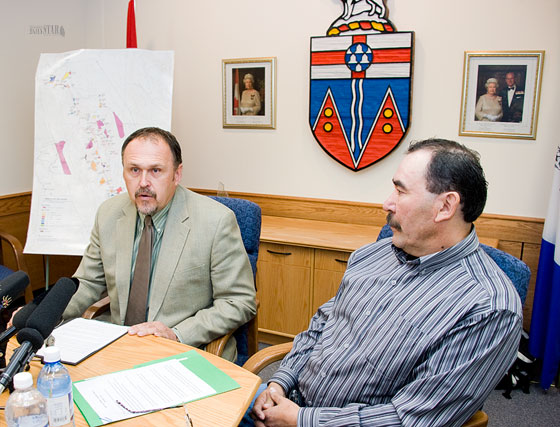
Pasloski and Chief Rick O'Brien of the Kwanlin Dun First Nation held a news conference last Friday to announce their intention to work co-operatively on Kwanlin Dun's desire to provide new housing opportunities in Whitehorse on leased land.
Asked specifically about the government providing financing, as it's doing for the new Whistle Bend subdivision in Whitehorse, the premier said everything is on the table for discussion.
The letter of understanding signed by Pasloski and O'Brien commits the parties to forge ahead in eight specific areas.
Listed as one of the areas of interest is exploring the type of land registry required to satisfy the banks and Canada Mortgage and Housing Corp. (CMHC) before they'll lend money to build on land that is not owned but is under a long-term lease.
Both Pasloski and O'Brien emphasized while providing housing opportunities on leased aboriginal land is new to the Yukon, it's become common down south.
"In the Yukon, through our partnership with the Yukon government, Kwanlin Dun will develop a framework for the long-term leasing of individual lots that will offer affordable, secure and long-term available to all Yukoners,” said O'Brien.
"This leasehold option will broaden the range of choices of home ownership available to Yukoners while generating revenue and providing a range of benefits to the Kwanlin Dun community.”
By not having to buy the land as part of the mortgage but rather enter into a lease arrangement based on the assessed value of the land, housing is made more affordable, the two leaders agreed.
O'Brien said he would like to see dirt being moved next year for a new subdivision on settlement land, though a site has not been identified.
Kwanlin Dun, the chief pointed out, owns approximately 40 square kilometres inside the city, for which it currently pays about $500,000 in property tax annually.
He said providing the settlement land for housing benefits the First Nation by generating revenue from leases, and eliminating the property tax, as property taxes becomes the responsibly of the lease holder.
Kwanlin Dun also receives a portion of the income tax paid by residents on settlement land, through a standard provision in the land claim settlements, O'Brien pointed out.
"Under this new arrangement, there are a number of options that we will explore that could result in more opportunities for residential land development,” the premier said.
"I am very pleased that the Yukon government and Kwanlin Dun First Nation have agreed to work in such a collaborative manner on this important initiative.”
The Yukon has already partnered with the Teslin Tlingit Council in a similar fashion to bring on new residential lots, Pasloski pointed out.
He reiterated that providing government financing for subdivision development on settlement land through a similar cost recovery method used in the development of Yukon government subdivisions is an option.
"Both governments recognize the need for affordable housing and the need for developed land in the city ... and surrounding area,” Pasloski said.
Colin McDowell, director of land management for the Yukon, explained in an interview after the press conference the government and the Teslin Tlingit Council are currently working a joint-initiative to bring on 12 to 14 country residential lots. He pointed out the proposal is currently undergoing a screening by the Yukon Environmental Socio-economic Assessment Board.
All the lots will be made available through a long-term lease arrangement. That's because it was felt it would be appropriate to have two different methods of land tenure in the same subdivision – one for YTG land and one for Tlingit land, McDowell explained.
Tom Beaudoin, director of lands for Kwanlin Dun, explained there's already been a significant amount of work completed to open the door for large subdivision developments on settlement land.
The parties, for instance, have been meeting with representatives of the banking community and the CMHC to come up with mortgage and lease documents acceptable to all parties, he said.
One of the key elements, said Beaudoin, is developing a land registry system which provides the same level of service and legal records for land lease arrangements as the existing land title office provides for land ownership agreements.
He said registry work is already underway, suggesting Friday's agreement will go much further in creating the foundation for a new form of land tenure and housing in the Yukon.
O'Brien pointed out the membership of Kwanlin Dun will need to give serious thought about which lands they want to make available for lease to the general public and which lands it wants to keep for use only by the First Nation.
• Under the general provisions of the 11 land claim settlements in the Yukon, the First Nations are not allowed to sell settlement land;
• A portion of the income tax paid by residents of settlement land, both Kwanlin Dun members and non-members, is returned to the First Nation.
Under a similar arrangement, the Yukon government receives a portion of its annual federal funding based on the amount of incomes tax paid by Yukoners.
• Under standard Yukon government policy, the cost of developing subdivisions is recovered through the sale of the lots.
The government, for instance, has already spent $50 million or more on the development of the Whistle Bend subdivision. Whistle Bend is expected to provide an inventory of urban lots for the next 20 years, beginning next year.
By Chuck Tobin
Star Reporter
Comments (5)
Up 0 Down 0
Yukon Girl on Sep 7, 2011 at 4:33 am
In all honesty I think that if the FN's want to develop their own land for their own people it would best be done with their own funding. Don't tie up the Territorial Government in this as I believe the settlement land should stay as FN's land and therefore they should incur their own costs for development. At the same time I believe the FN's should consult their people to see what their views are on the situation, do they really want the land developed and have green spaces destroyed? As a culture derived from living off the land I really don't think this is in the best interest of their people or anyone else.
Up 0 Down 0
mark on Sep 6, 2011 at 10:03 am
I wish my first nation of Taan kwachan would get some land and house its members, not just a select few outside of Whitehorse
Up 0 Down 0
JC on Sep 6, 2011 at 8:59 am
And if the Yukon Party intends to do this, they won't get my vote this October.
Up 0 Down 0
FED up with PC on Sep 6, 2011 at 7:53 am
NO ...lets not go there. I would rather my peoples money spent on our peoples lands. We spend scads already on elitists issues/concerns...ENOUGH!
If the F/N's wish to build neighborhoods with monies handed to them by "our" governments from their own budgets...fill your moccasins I say.
To start building entire "hoods" with our cash to appease the PC Crusaders and funnel EVEN more cash into the drain to NEVER hold title to our investments...seems so....STUPID!
So stupid in-fact I expect this to "move forward" with all the inertia 30 million plus tax-payers will be forced to pay for...as per!
Since when did THE Yukon...turn into Japan with no land left...?
Support this Darrell, my vote is gone!
Up 0 Down 0
Groucho d'North on Sep 6, 2011 at 7:38 am
Armed with only a lay knowledge of Land Claims- I have a question: As quoted above; "Under the general provisions of the 11 land claim settlements in the Yukon, the First Nations are not allowed to sell settlement land..."
I notice in the Real Estate flyer a couple weeks ago the failed Great River Journeys camp at Lake Lebarge is up for sale at $750K, are there special caveats for certain cases or is this a case of poor ad copy?