Students gain a taste of working with the best
For Yukon cooks who strive to buy and eat locally grown food, February is a particularly bleak time of year.
By Justine Davidson on February 6, 2009
For Yukon cooks who strive to buy and eat locally grown food, February is a particularly bleak time of year.
But for the bags of new Yukon Gold and Yukon Red potatoes available at most grocery stores around town, there isn't a heck of a lot to choose from in the way of 100-mile-diet-friendly food.
Of course, there are those busy beavers among us who have put aside substantial winter stores of Yukon-grown root vegetables, berries, meat and fish, but you won't find any of that at the Real Canadian Superstore.
So when celebrity chef David Adjey arrived in town this week to prepare the menu for the Canadian Cancer Society's fund-raiser held Thursday, people would be forgiven for wondering how he would stick to his local-food cooking philosophy.
"I think of it as a ripple," he says of how to create a meal. "You start locally and then move out - always looking for the best products - local, regional, national.
"Key in on that one magical ingredient, in this case elk, and bring ingredients in from all over the world."
And being in a remote location is no reason to skimp on the fresh ingredients, he says.
"I look out the window and I see ice fog and the SS Klondike and inside I see some of the best produce you'll see anywhere," he remembers from a trip to Riverside Grocery.
Adjey was invited up to the Yukon by the organizers of the Relay For Life campaign to cook for and host last night's fund-raising event at the High Country Inn.
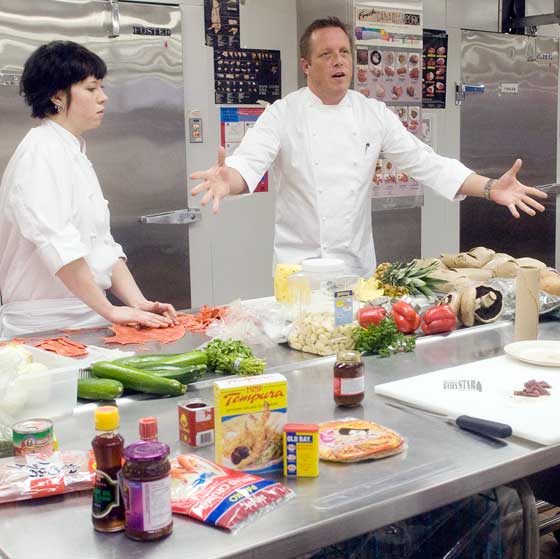
Not to miss out on an opportunity, Yukon College asked him to spend a day with the school's culinary arts students, to give them a taste of what it's like to work with one of Canada's most famous chefs.
"You've brutalized my cilantro! It looks like lawn clippings," hollers Adjey, sweeping a handful of painstakingly slivered cilantro into the garbage.
"Start again," he commands the young woman in charge of the herb.
"Stop what you're doing," he snaps at another student. "How did the cutting board look when I showed it to you? Not like that. Do it like I showed you."
His instructions are peppered with expletives, and he doesn't mince words when telling the students they've done something wrong. But for all his swearing and snapping, the dozen chefs in training seem to be enjoying themselves.
"You're brilliant," he tells one student, before getting back to the business of food.
Without any fresh local produce to work with, Adjey focused his efforts on finding local meat.
He visited Ford Farms and the Circle D Ranch, two area elk farms, with the culinary arts students and picked up the most tender cuts of the lean meat available.
Back at the school, he was showing his white-coated protégées how to create an appetizer that is beautiful to the tongue, and the eye.
"Look at this," he says proudly, holding up a baked tortilla cracker topped with a pineapple, red pepper and cilantro salsa.
"It didn't come from a can. It didn't come from the Death Star. It didn't come from a frozen box. Someone who loves food made this."
That is Adjey's modus operendi, to make sure that every item coming out of his kitchen is lovingly prepared with the finest fresh ingredients.
Chefs, he tells the students, have the power to change a whole community's attitude toward food.
"You're a two-hour flight away from the best greenhouses in North America," he says, referring to B.C.
"That means you have access to some amazing food. So develop a relationship with the suppliers. Let them know you expect a certain quality, that you'll take your business elsewhere if that quality isn't there.
"And explain that to your customers. Tell them the reason some dishes are more expensive is because you refuse to use a low-quality product."
This way, he says, the producer and consumer will both come to realize the value of growing and buying quality food, instead of just going for the cheapest or the food they are most accustomed to.
He uses lettuce as an example.
"You know those pillow packs the spring mix comes in?" he asks
"They spent millions of dollars designing that bag so the lettuce doesn't wilt, pumping it full of carbon dioxide. But it's almost all water; it should wilt. So enjoy lettuce when it's in season, but otherwise just get over it."
Adjey's stream-of-consciousness chatter continues as the students diligently mince, julienne and sliver on his orders. The chef stops taking for a moment to sip his black coffee.
"Where are you eating tonight?" one of the college employees asks during his break from cooking instruction.
"I don't know about tonight," he says, "but tomorrow morning I'm having breakfast at the '98."
Comments (1)
Up 0 Down 0
Lesli Solon on Feb 15, 2009 at 8:53 am
Hello..
As I read this article I thought..
I resent my tax dollars being spent to bring David Adjey here to humiliate and verbally abuse our college students. I know they are not children..but they don't deserve to be treated this way. The old 'children learn what they live' is true. Perhaps David Adjey idolizes Gordon Ramsey..and we need to let them stick to 'reality tv'.
Thankx..Lesli