Student home after surviving ship sinking
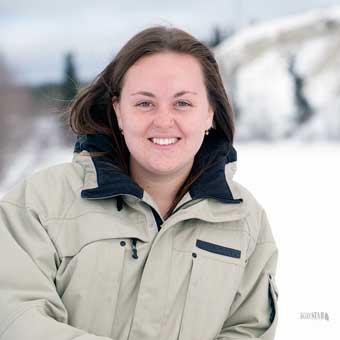
Erica Trimble wanted to earn her high school diploma aboard a tall ship while sailing the world because she craved adventure, but last week the 17-year-old student got a little more adventure than she bargained for.
By Jason Unrau on February 26, 2010
Erica Trimble wanted to earn her high school diploma aboard a tall ship while sailing the world because she craved adventure, but last week the 17-year-old student got a little more adventure than she bargained for.
Trimble was one of 48 students and 16 crew members who escaped the tall ship S.V. Concordia after it capsized and sank 500 kilometres off the coast of Brazil.
On Wednesday, a week after abandoning ship in the middle of the Atlantic Ocean, Trimble returned home to Whitehorse and shared her harrowing story of survival with the Star.
It was approximately 2:30 p.m. local time on Feb. 17, when Trimble assumed her shift on deck watch as a squall approached. This was her second crossing of the Atlantic, so she was prepared for the rough seas ahead, but what she and others aboard the ill-fated Concordia have called a "fluke event,” would cut the voyage drastically short.
While it's normal for a sailboat to pitch from side to side, particularly in heavy winds, a micro burst – a rare yet powerful down draft of air in a small area – sealed the fate of the 57.5-metre long, 400-ton ship.
"I was standing on the starboard side when the ship tipped over onto its port (side),” Trimble recalled of the moments before the ship capsized, tossing her overboard.
The micro burst had just delivered a massive gust of wind which the three-masted barquentine was unable to recover from.
"The ship started to go over to one side ... and when the railing went under, I knew the ship wasn't coming back,” said Trimble. "(The wind) pushed the hull completely over in less than 15 seconds.”
Sliding across the midship deck, Trimble grabbed onto a rope, "but I had to make a decision, hang on and injure my hand when I hit the end, or let go ... so I let go of the rope.”
Trimble's decision plunged her into the ocean, but in seconds, she managed to scramble back onto the boat, now laying on its side in the churning sea.
"I climbed back onboard over the helm and stood on the wall of the classroom, which was now the floor,” she said.
In the face of the disaster unfolding, Trimble had little time or inclination to celebrate her first chin-up, completed as she lifted herself back aboard the ship, a feat she was unable to accomplish in previous fitness tests.
"I was like, ‘Holy crap, get your emergency suit on and get into a lifeboat.'”
As students helped each other into survival suits, crew members deployed five inflatable life rafts. Trimble jumped back into the water, swam toward one of them and was hauled aboard by other students.
"I felt so much adrenaline, fear and shock all at the same time and the second I got into the lifeboat, I couldn't move my arms and legs; they felt like they weighed 100 pounds,” is how Trimble described her reaction to those desperate moments.
Twenty minutes later, the Concordia slipped beneath the waves, as students and crew watched from the life rafts. The sinking happened so fast, crew members had no time to send a distress call and had to rely on an emergency beacon on one of the lifeboats.
Trimble credits a top notch crew, emergency training and daily practice for what seafarers would call a miraculous outcome; nobody perished in the wreck.
Increasing the odds for such an outcome is the fact that prior to the capsizing, nearly all crew members and students were on the top deck, either aiding in the boat's navigation or attending class.
Now dispersed amongst four of the five life rafts, the 64 sailors were adrift on the Atlantic, bobbing helplessly in rough seas just south of the Equator, their floating classroom heading to the bottom of the ocean.
Despite attempts to tie the four rafts together, the raft Trimble and 19 other people were on drifted away from the others.
As the time passed, Trimble said, feelings on the life raft went from lament for the ship, the students' home for the past six months, to thoughts nobody would find them.
"Everybody was really bummed out and then there was a lot of doubt ... ‘what if we die out here?' people were saying,” said Trimble of the chatter, which only served to strengthen her resolve. "‘Well, if anybody is getting out alive,' I thought, ‘it's going to be me.'”
Rainy weather enabled those on Trimble's life raft to conserve emergency drinking water and each raft was equipped with a two-week supply of what Trimble described as "astronaut food.”
Nearly two days after Trimble and her mates abandoned ship, her life raft was spotted by a Brazilian Air force plane. A short while later, two merchant vessels – Hokuetsu Delight and Crystal Pioneer – scooped both groups from the sea.
The Crystal Pioneer, whose usual consignment consisted of lima beans bound for Holland, was now ferrying Trimble and the rest of her life raft company back to dry land, while the others were safely aboard Hokuestsu Delight.
As the Crystal Pioneer was bound for Argentina, a Brazilian Navy helicopter relieved the merchant ship of its newfound passengers, and all 64 Concordia sailors were eventually reunited in Rio de Janeiro.
Now back among family and friends in Whitehorse, Trimble said the experience has not deterred her passion for sailing or for adventure.
"I can't base a whole lifetime at sea on just one mishap,” said Trimble, whose life goals include becoming a bush pilot.
The young sailor also spoke enthusiastically about the volunteer work she participated in, the highlight of which was a work stint in Senegal, West Africa, where Concordia students helped build community gardens.
In March, Trimble will return to Lunenberg, N.S., where she originally embarked on her Class Afloat program, to complete her studies, but these will likely occur on land.
The Transportation Safety Board of Canada is investigating the sinking.
Be the first to comment