Photo by Whitehorse Star
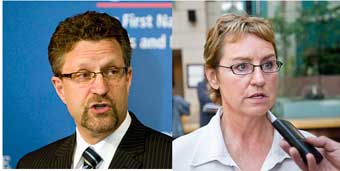
Federal Indian Affairs Minister Chuck Strahl and Marie-Louise Boylan
Photo by Whitehorse Star
Federal Indian Affairs Minister Chuck Strahl and Marie-Louise Boylan
Federal Indian Affairs Minister Chuck Strahl met with aboriginal leaders in Haines Junction yesterday
Federal Indian Affairs Minister Chuck Strahl met with aboriginal leaders in Haines Junction yesterday to try to hammer out new funding arrangements aimed at implementing self-government agreements for 11 Yukon first nations.
While the talk was large on platitudes for "open dialogue” and "collective efforts”, it was short on specifics, particularly financial details and accountability for the tens of millions Ottawa has spent and continues to spend each year on Yukon's first nations.
"I don't get into the dollar amounts,” Strahl said of new dollar figures currently under negotiation. "Obviously, there are increased sums involved ... for gaps in the current arrangements (and) increased responsibilities that will cost more.”
When Strahl was asked about figures contained in previous fiscal transfers, the minister said he did not have those details but that the department could provide them.
Yesterday, the Star contacted Indian Affairs' regional office in Whitehorse, however, by press time today only a partial list of consolidated figures were made available.
"We don't do (individual) accounting,” said Marie-Louise Boylan, spokeswoman for Yukon's Indian Affairs office. "It must exist but it just takes a little bit longer (to get) and won't meet your deadline.”
In 1993, the federal government signed land claim and self government deals with the Champagne and Aishihik First Nation, First Nation of Nacho Nyak Dun, Teslin Tlingit Council and Vuntut Gwitchin First Nation. Four years later, Little Salmon Carmacks First Nation and Selkirk First Nation inked similar agreements and in 1998 the Tr'ondek Hwech'in First Nation joined the land claim and self government club.
Between 1994 and 1998, the federal government made "settlement payments” totalling $38.4 million and "implementation” payments totalling $16.7 million to the above first nations, however a breakdown of those sums was not available.
By the time Carcross-Tagish First Nation, the 11th signatory of the umbrella final agreement mandating Yukon land claims, inked its deal in 2006, the total annual "settlement payment” had ballooned to $17 million and just a year later (2007-2008 fiscal period) that figure climbed to more than $45 million.
Boylan said the annual increases on cash flowing from Ottawa to Yukon first nation coffers can be explained in two ways; more first nations signing deals and those first nations drawing down the provision of services previously delivered by Ottawa.
Finding qualified individuals to staff a myriad of board and administrative positions associated with individual first nations' governments – and remunerating them – is often caged as a capacity challenge that becomes more cumbersome as first nations take on more provisional responsibilities.
In what has become a perennial event in the territory, first nation leaders continue to lobby for more federal funding to implement self government provisions laid out in their respective claims. And the expense for Canada to make good on its commitments is likely to increase.
Michael Hale is the director of land claims and self government implementation with the government of the Yukon. In terms of the federal transfer negotiations in Haines Junction, the territory is just an observer, he said.
"We would be the body that would negotiate the assumptions of responsibility agreements for Yukon programs ... (and) there haven't been any to date,” Hale said today.
"All the (service transfer agreements) to date are more directly related to federal programming that has been offered by Ottawa.”
The territory's Land Claim Secretariat, funded to the tune of more than $7 million annually, is likely to get busier as first nations decide whether or not to download service provision currently offered by the Yukon government.
"We get notice letters from first nations in what program areas they have an interest in and we'll negotiate any area they have an interest in,” Hale said.
Under the 11 first nations' self government agreements, they reserve the right take over social and welfare services, health care, guardianship, custody, care and placement of children, education programs and inheritance, wills and administration of estates.
Attempts to contact Andy Carvill, grand chief of the Council of Yukon First Nations, to expand on comments he made following negotiations in Haines Junction were unsuccessful. As of press time today, Carvill had not
returned calls from the Star.
Yesterday, Carvill thanked Strahl for his commitments, adding he hoped to "build upon the successes that we have and continue to have and work on collaborative governance.”
Strahl said he is aiming to strike a new funding deal with Yukon first nations by November so the government can include changes in time for the 2010-2001 federal budget.
In order to encourage thoughtful and responsible discussion, website comments will not be visible until a moderator approves them. Please add comments judiciously and refrain from maligning any individual or institution. Read about our user comment and privacy policies.
Your name and email address are required before your comment is posted. Otherwise, your comment will not be posted.
Be the first to comment