Photo by Vince Fedorof
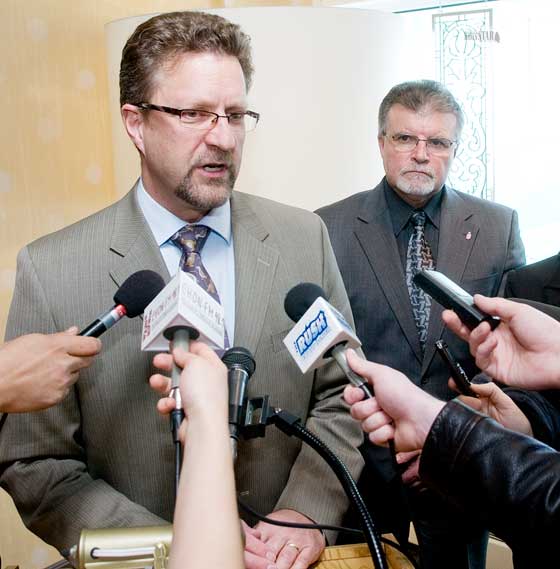
HELPING BUILD THE YUKON – Indian and Northern Affairs Minister Chuck Strahl (left) speaks with members of the media Friday afternoon in Whitehorse while Premier Dennis Fentie looks on.
Photo by Vince Fedorof
HELPING BUILD THE YUKON – Indian and Northern Affairs Minister Chuck Strahl (left) speaks with members of the media Friday afternoon in Whitehorse while Premier Dennis Fentie looks on.
Indian and Northern Affairs Minister Chuck Strahl has dismissed a Fraser Institute report suggesting stimulus spending,
Indian and Northern Affairs Minister Chuck Strahl has dismissed a Fraser Institute report suggesting stimulus spending, including the federal government's $47.2-billion Economic Action Plan, contributed little to Canada's economic turnaround.
Strahl was in Whitehorse last week to announce more federal infrastructure spending for the Yukon.
On Friday, he said the Fraser Institute, an economic think-tank that promotes free market principles, is dead wrong.
"Frankly, I think groups like the Fraser Institute are now just a little cocky ..., you know, now they say, ‘there was no need to have worried, it was all under control, it was all tickety-boo, the government didn't need to do anything,'” said Strahl when asked about the group's March 23 assessment of impacts of the federal government's recession spending.
"That's just simply not true.”
By the end of 2008, the failures of banks and investment houses worldwide in the wake of the sub-prime mortgage collapse in the United States had pushed the Canadian economy into recession.
To counteract this, the federal government offered stimulus spending to provincial and territorial governments with an eye to re-energizing economic activity.
"Throughout the period before and during the recession, and well into the economic recovery in 2009, government consumption and government investment's contribution to GDP growth was markedly constant,” reads the Fraser Institute's March 23 release.
"In other words, whether the economy was shrinking, stagnant, or growing, the government's contribution to economic growth had little effect on changes in GDP growth.”
Strahl said the Fraser Institute's opinion flies in the face of positive assessments by the International Monetary Fund (IMF) and Organization of Economic Cooperation and Development (OECD) and other leading economic organizations.
"The World Economic Forum said that the way we've handled everything, from the banks to the way we handled the stimulus package, was done well and it was necessary,” Strahl said.
"So I simply think it's easy now when we're looking at ongoing job growth, good growth in the economy and increased confidence ... to say, ‘it was all in hand and you shouldn't have done anything.'
I say, ‘well, thanks, Fraser Institute, for coming out. Because you're just wrong.'”
And more stimulus money is on its way north – the reason for Strahl's visit to Whitehorse.
The Indian and Northern Affairs Minister joined Premier Dennis Fentie at the Westmark Whitehorse Hotel to jointly roll out another year's worth of infrastructure spending, and remind the territory of what it's received already.
When Fentie says the Yukon is flush with federal infrastructure cash, he likes to reference the seven-year $183 million in Building Canada Plan money destined for the territory.
The program, which began in 2007, will see nearly $82 million spent in the Yukon between 2009 and 2011, based on the territory contributing 25 per cent to the cost of each project.
In addition to the new and current project spending (itemized at the end of this story), Strahl spoke at the Yukon First Nations Resources Opportunities Conference.
There, he announced $2.25 million for the Yukon Mine Training Association. Of that, $775,000 will go to curriculum development while $1.5 million will purchase a mine equipment simulator.
The Yukon's 2009/2010 Capital Plan, executed in conjunction with Building Canada Plan value:
$38.15 million, based on 75 per cent federal dollars, 25 per cent Yukon contribution:
Faro: water and sewer pipe replacement on its main supply system.
Watson Lake: repairs to its water main and the installation of well head protection to engage two backup wells.
Dawson City: funding to conduct a long-range water system and capital improvement plan, construction of district heating system and "infrastructure elements” in new wastewater treatment facility.
Mayo: extend its water distribution system to Fourth Avenue and the NND residential area.
Haines Junction: overhaul of number two pump house and the completed installation of its number five pump.
Carmacks: wastewater collection system improvements
Teslin: road resurfacing and drainage improvements.
Old Crow: Phase 2 completes another 4.5 kms of roads and associated drainage work.
Valleyview: water reservoir expansion.
Highways 1 & 2: pavement rehab.
Yukon's 2010/2011 Capital Plan, to be executed in conjunction with Building Canada Plan cash, value:
$43.65 million, based on 75 per cent federal dollars, 25 per cent Yukon contribution:
Whitehorse: Marwell water and sewer upgrades.
Faro: water and sewer pipe replacement (Phase 2).
Watson Lake: water and sewer pipe replacement (Phase 2).
Teslin: Phase 2 arsenic treatment, system upgrades for arsenic removal.
Selkirk: new public works shop.
Champagne and Aishihik First Nations: water truck stop.
Rock Creek: upgrade community water supply, well upgrades, filtering treatment systems.
Deep Creek (Ta'an Kwach'an Council): new water treatment plant for Deep Creek and Horse Creek.
Burwash: well head protection to prevent contamination.
Beaver Creek: road upgrades, drainage upgrades.
Carcross: road resurfacing and drainage upgrades.
Old Crow: upgrades to solid waste facility.
Grizzly Valley: hydro line upgrades and access road for future subdivision.
Mendenhall: upgrade community water supply, new storage tanks, filtering equipment systems.
More solid waste projects:
• convert existing unincorporated burn facilities to transfer stations to meet environmental regulations;
• money to design processing facilities for recycling.
Atlin Road reconstruction: between kilometres 12 and 22 and 38 and 41.
Pelly Bridge: corrosion protection, sandblasting and painting.
In order to encourage thoughtful and responsible discussion, website comments will not be visible until a moderator approves them. Please add comments judiciously and refrain from maligning any individual or institution. Read about our user comment and privacy policies.
Your name and email address are required before your comment is posted. Otherwise, your comment will not be posted.
Comments (1)
Up 0 Down 0
Arn Anderson on Mar 30, 2010 at 2:13 am
Corporatism at its finest.