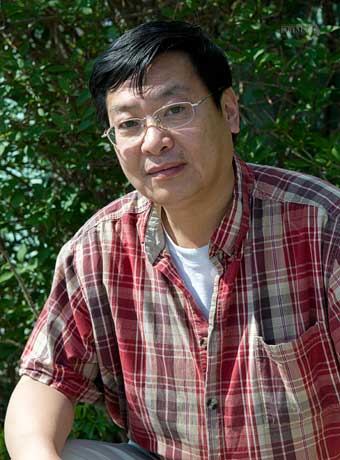
Photo by Vince Fedoroff
REMEMBERING TIANANMEN SQUARE - Yukoner Jim Zheng was living in Beijing when the Tienamen Square massacre happened in 1989. Thursday marked its 20th anniversary.
Photo by Vince Fedoroff
REMEMBERING TIANANMEN SQUARE - Yukoner Jim Zheng was living in Beijing when the Tienamen Square massacre happened in 1989. Thursday marked its 20th anniversary.
A lot has changed for Jim Zheng in two decades, but the battle which began 20 years ago in Beijing's Tiananmen Square continues.
A lot has changed for Jim Zheng in two decades, but the battle which began 20 years ago in Beijing's Tiananmen Square continues.
On June 4, 1989, Zheng was on a train in the Chinese capital when he and others on the train heard gunshots.
A doctor, born and raised in Beijing, Zheng rushed out of the train and made his way to the closest hospital and began treating the injured as soldiers continued firing on democracy protesters regardless of age.
"They shot very young children," he said, recalling a mother being shot shortly after her children.
On June 3, 2009, Zheng - a Yukoner since 1991 along with his wife, Sue-May Zheng, who is also a doctor in western medicine - was still working as a doctor in traditional Chinese medicine, but that's about all that is the same.
Between appointments at his East West Health Centre downtown, Zheng watched and read news reports from China about the 20th anniversary of the Tiananmen Square massacre and made a point of getting his message out about the corruption in the Chinese government.
While Zheng recalled the events of June 4, 1989 and those which followed to bring him and Sue-May to the territory, it is the future of the communist state that Zheng focused on most during an interview with the Star this week.
"We're still really sad because we feel really ashamed to think it's 20 years over for us and it not make any difference," he said. "And also the people who died still, you know, never have peace yet."
The corruption in government has only seemed to have grown worse as the years have gone by, he said. He recalled his sister - who was jailed at one time for practicing Falun Gong - having to cover her phone with a blanket because the government-issued phones in the country are also recorders. He remembered the fear in his brother's voice when he told him the government wanted to talk to him.
Zheng also spoke of organ harvesting from prisoners and in army hospitals, and many other human rights violations.
In his own case, Zheng remembers Tiananmen Square being the site of a number of protests prior to the 1989 massacre.
In 1988, he was there supporting students on a hunger strike while his wife provided medical treatment to the protesters.
At that time, it wasn't uncommon for citizens of Beijing to talk to army personnel and let them know the importance of the students protesting. For many of the soldiers, at 19 or 20 years old, it was their first time in a big city, Zheng said.
"They really (didn't) know what was going on," he said. "We (told) them how important it is to students, there's a movement, and really we're against corruption."
Those soldiers told the citizens they could never shoot their own people, Zheng recalled.
It was a different army that came in and killed the students on June 4, 1989, he said, citing a report showing there were two different armies in Beijing at that time.
He then recalled his own experience and the initial disbelief about the gun shots he heard as he stepped off the train in Beijing.
"You could see soldiers shooting on both sides of the people," he said, remembering a mother going crazy in the moments between watching her children being shot and being killed herself.
"For me, I think most people like me when I listen to their stories, it's just shock. You just don't know how can this be," he said, pointing out that he too was a soldier at one point.
It's a situation you could never imagine, he said.
As time passed, the possibility the Zhengs were being watched became a reality. At one point, the leader at the hospital where Sue-May worked told her to be careful and not do anything wrong because she could be watched and there was the possibility that she could be the next leader there.
"Since Tiananmen Square happened, the hospital announced she also (would) be watched," he said. The couple decided to leave.
"Lucky enough we met Dr. (Don) Branigan, he was the mayor in town (Whitehorse)," he said.
The now-deceased Branigan, who the couple had met through Tai Chi, needed staff at his clinic. He worked to bring the couple to Whitehorse and, with other residents of the city, fought for their right to stay in Canada when they were nearly forced to leave.
Even after they left, family informed the Zhengs their house was still being watched and at one point when he was able to go back for a visit he was at a store where the clerk, never lifting his head as he spoke, told him he was being watched.
"He said: 'You be watched, actually more than one.' So behind me was someone watching me and more than one," Zheng said.
He ran out of the store and was able to get away from the situation.
The corruption in the government is such that he knows of one man who moved to Toronto to get away from it.
In Canada, Zheng has had a very different experience from where he grew up. Here, he pointed out, police are generally very helpful.
It was thanks to Branigan that Zheng learned more about the very different political climate. He recalled his initial apprehension of going to a political event years ago, remembering that in China such a commitment would be for a lifetime and impossible to get out of. After attending, he soon learned it was vastly different here.
Over the years Zheng has been vocal in his opposition to the current Chinese regime, taking part in protests in other communities like Calgary. Later this month, he will join others in New York for a protest there.
Through these events Zheng hopes to inform the West of the situation in China and the human rights violations that are taking place.
"Western support is very important," he said, noting the amount of business done between China and the West.
"We need to let them know we know what's going on - please don't play us," Zheng said, noting he believes the fall of the communist party in China is coming soon.
"It's time," he said. "Everybody from China tells me: 'It's the time now. We're waiting for too long. Our tolerance is almost maximum.'"
In order to encourage thoughtful and responsible discussion, website comments will not be visible until a moderator approves them. Please add comments judiciously and refrain from maligning any individual or institution. Read about our user comment and privacy policies.
Your name and email address are required before your comment is posted. Otherwise, your comment will not be posted.
Comments (1)
Up 0 Down 0
Arn Anderson on Jun 5, 2009 at 11:20 am
The tradegy surrounding Tiananmen Square is the best example on how 'western democracies' handled the situation. We support China and its rights violations by constantly parading to Wal-mart and Superstore for all those cheap deals for cheap products produced cheaply at the expense of the environment. Remember Tiananmen square when you buy your little re-usable shopping bag from these outlets and read the label, MADE IN CHINA, at least our plastic bags are made in Canada.
How do you like THEM APPLES.