Photo by Vince Fedoroff
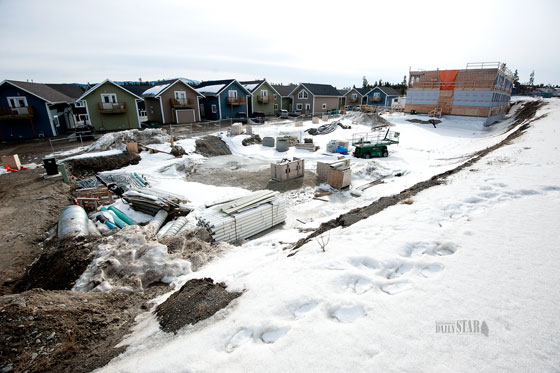
SUBJECT OF LITIGATION – Construction of the partially completed complex in Falcon Ridge began in July 2012.
Photo by Vince Fedoroff
SUBJECT OF LITIGATION – Construction of the partially completed complex in Falcon Ridge began in July 2012.
The gavel is down on the future of a disputed Falcon Ridge condominium property.
The gavel is down on the future of a disputed Falcon Ridge condominium property.
Yukon Supreme Court Justice Ron Veale ruled Friday afternoon that a proposal for a new set of condos is valid and can go ahead as planned, despite objections from many of the area's residents.
Veale put a stamp of approval on an application by a company owned by Whitehorse developer Brian Little for the stacked apartment-style units.
The proposal for the property — originally slated to host a 24-unit condo block — was the latest turn in a two-year legal battle over the future of "Bareland Unit A,” which homeowners thought should be developed in keeping with the single-family residences and rowhouses which surround it.
Veale said the proposal for three contiguous four-plexes, three separate four-plexes and a single-family home — 25 units in total — met the requirements he laid out earlier this year.
Veale ruled in January that a combination of four-plex and single-family units could take the place of the current half-built condo block in accordance with the character of the neighbourhood that residents thought they were buying into based on the original site plan from 2005.
He said then that "it would be unjust and inequitable to the majority of unit owners who oppose the condo developer's proposal to allow it to proceed with the construction” of the building.
The new proposal — one of two put forward by Little — is consistent with the original site plan, as it will be made up primarily of two-storey four-plexes, Veale decided, and did not constitute a 12-plex "in disguise,” as the condo corporation's lawyer suggested.
There was "no requirement that a certain number of unit owners approve or consent,” Veale told the court Friday.
He laid down several conditions for the new development, however.
All parking spaces for the building must be on the property, rather than down the block.
This could pose a problem, since there is only room for roughly 32 spaces, which would serve only 16 units, Veale said, as each home must have two parking spots allocated to it.
He added that the newer portion of Falcon Ridge must have the same amount of green space as the older half, a concern raised by the condo-owners.
Veale also said surface storm drainage deficiencies must be addressed and completed before Sept. 30.
The approved proposal will likely see the foundation of the dilapidated, cube-like condo complex already on the property remain intact, with the rest of its three storeys torn down.
The homeowners had requested that both proposals, ordered by Veale earlier this year, be denied. More than 50 per cent of respondents to a survey sent out by the condo board expressed disapproval of both proposals. Only about 50 per cent of owners from the Copper Ridge-area subdivision's 86 units replied.
In July 2012, Little began construction of the partially completed complex — and has since sunk more than $1 million into the project — despite not having the required consent from nearby condo owners concerned about property values and "community cohesion.”
The squat, four-storey — as originally blueprinted — structure would have the effect of "destroying the character of the development that unit owners found to be so attractive in the first place,” Veale said in January.
Expressing concerns over higher density and neighbourhood character, one homeowner also told the court last year the structure is "half-decrepit” and an "eyesore.”
The condo owners found partial restitution last month when the judge also ordered Little to fork over nearly $400,000 in unpaid condo fees.
In a ruling that resolved much of the acrimonious housing dispute and offered lessons for homeowners and developers alike, Veale said the Falcon Ridge condo corporation is entitled to $394,000 — plus some legal costs — because Little failed to pay his share for units his company owned.
In order to encourage thoughtful and responsible discussion, website comments will not be visible until a moderator approves them. Please add comments judiciously and refrain from maligning any individual or institution. Read about our user comment and privacy policies.
Your name and email address are required before your comment is posted. Otherwise, your comment will not be posted.
Be the first to comment