Photo by Whitehorse Star
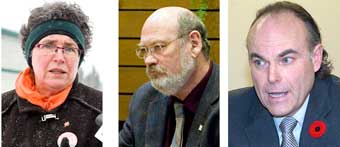
New Democratic Party Leader Liz Hanson, Liberal MLA Don Inverarity and David Hrycan
Photo by Whitehorse Star
New Democratic Party Leader Liz Hanson, Liberal MLA Don Inverarity and David Hrycan
The Star predicted a hefty deficit, as did the opposition parties, but nearly a year later, and with territorial spending overshooting 2010/2011 budget predictions by more than $98 million, the Yukon government remains in denial mode.
The Star predicted a hefty deficit, as did the opposition parties, but nearly a year later, and with territorial spending overshooting 2010/2011 budget predictions by more than $98 million, the Yukon government remains in denial mode.
This morning, no one in government would reveal how big this fiscal year's deficit would be.
Premier Dennis Fentie declined to be interviewed for this story, and David Hrycan, the deputy Finance minister, said Yukoners would "have to wait for the tabling of the budget ... of the appropriation act and that fiscal framework.”
On Tuesday, the cabinet approved a $25.7-million special spending warrant increasing government expenditures for this fiscal year to $1.171 billion.
Last March, Fentie tabled a $1.075-billion budget with a modest $2.9-million surplus; questionable figures, considering the previous year's $1.003-billion budget's projected $19-million surplus had already made a $44-million swing to end up $23 million in the red.
When the public accounts for that year were finally tabled in the legislature in October, the deficit for 2009/2010 was $25.6 million.
Last week, the premier said the territory's finances "are in very healthy shape,” and explained that the $2.9-million surplus his government booked last March disappeared "through the course of the fiscal year (due to) variances (that) take place, as they usually do.
"That's the way the business of government works,” Fentie said.
And in Health and Social Services – almost 25 per cent of the government's annual spending – the "variance” is massive.
Last March, Finance projected $230.7 million in health care spending for this year.
That figure has now jumped to $257.7 million – $11.8 million of that $27-million departmental deficit was included in Tuesday's spending warrant.
Hrycan described Health and Social Services' share of the spending warrant as "... physician and hospital claims; a lot of the times it's for out-of-territory hospital visits ... and also some social assistance.”
Liberal MLA Don Inverarity said today the disparity between projected spending and actual expenditures in Health and Social Services speaks to the government's credibility.
"To me, it comes down to this issue – is the government believable?” Inverarity told the Star.
"We keep harping about being upfront and accountable, and we keep seeing this money (through spending warrants), and again, and again.
Where is it coming from?”
While Hrycan said the government's savings account would be tapped to cover some of the extra spending, there is just $33 million remaining, already down dramatically from where it was two years ago.
In 2009, the Yukon's net financial resources – the government's "cash in the bank” after all liabilities, such as pension commitments, are accounted – were $135.5 million.
In 2010, that figure fell to $67.4 million and by March, 2011, Finance officials estimate the territory's net financial resources for the year ending 2010/2011 to hit $33 million.
Fentie has promised the coming year's budget, to be tabled in the legislative assembly when it reconvenes Feb. 3, would replenish the savings account.
Asked how he intended to do that without slashing current levels of government services, Fentie dodged the question and promised another surplus – a feat his government has failed to achieve two budgets in a row.
New Democratic Party Leader Liz Hanson blamed the government's financial situation on poor planning.
"It's not a budgeting process; it's a spending process, and there's nothing strategic about it,” Hanson said early this afternoon.
"I'm intrigued how he's going to pull a surplus out of (the next budget); I'm predicting spending cuts, and we're seeing these already.”
The first cuts appear to be in Health and Social Services, as it ended its program of mobile mental health nurses – a program paid for by Territorial Health Access Funding (THAF), which expired this year.
Department spokeswoman Pat Living said the end of THAF amounted to a nearly $1-million loss in revenue for the department, and forwarded further queries to the minister, Glenn Hart.
Hart did not return the Star's call for comment on the loss of that program, or the nearly $30 million in cost overruns for his department.
In order to encourage thoughtful and responsible discussion, website comments will not be visible until a moderator approves them. Please add comments judiciously and refrain from maligning any individual or institution. Read about our user comment and privacy policies.
Your name and email address are required before your comment is posted. Otherwise, your comment will not be posted.
Be the first to comment