Photo by Whitehorse Star
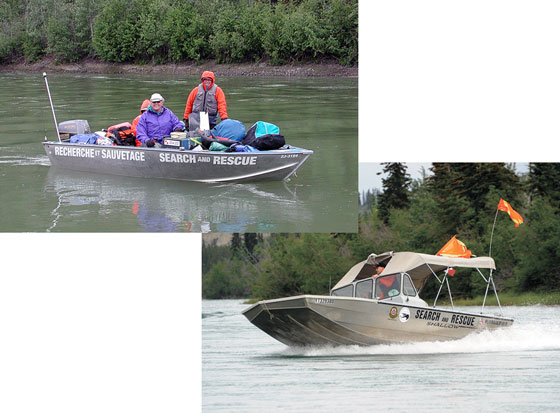
A REASSURING PRESENCE – Members of Whitehorse District Search and Rescue are seen patrolling the Yukon River Quest this year (bottom) and, in the photograph (above), in the 2003 race.
Photo by Whitehorse Star
A REASSURING PRESENCE – Members of Whitehorse District Search and Rescue are seen patrolling the Yukon River Quest this year (bottom) and, in the photograph (above), in the 2003 race.
Whitehorse District Search and Rescue (SAR) has pulled its support from next year's Yukon River Quest.
Whitehorse District Search and Rescue (SAR) has pulled its support from next year's Yukon River Quest.
The volunteer organization withdrew its support last month in a letter signed by president Cam Beemer.
The dispute between the Quest's board and SAR centres around a $500 evacuation fee charged to competitors who have to be removed during the race.
Beemer said in an interview last Wednesday that charging for a rescue goes against the organization's core principles.
"Our concern is that these paddlers are maybe not in the right mind, or they may be basing their decision on that $500 but maybe they should be taken out,” Beemer said.
SAR has been part of the River Quest, a 715-kilometre race from Whitehorse to Dawson City, since its inception 13 years ago.
The SAR boat monitors race waters along with other volunteer safety boats brought on by race organizers.
For the last several years, each team or individual racer is required to put down a cash deposit. It's returned at the end of the race if the team does not require an emergency evacuation.
Organizers have been charging an evacuation fee for at least the last four years, said Stephen Mooney, a former Yukon River Marathon Paddling Association president and current board member.
The fee was originally $200 but was upped to $500 for this year's race.
Mooney said he doesn't believe the extra cost prevents people from seeking assistance.
"If someone really needs help, they will ask for help.”
Any money collected from evacuations goes toward covering the race's costs, which are around $100,000 a year.
In this year's race, only one competitor was taken from the race after an injury, Mooney said.
If participants what to leave the race, they can also sign a waiver, agreeing they are now a tourist and not a racer, and be taken from the race by SAR without charge, he said.
Other racers choose to leave on their own.
In 2011, 72 teams from 10 countries started the race. Fifty-five teams finished, which organizers say is about average.
The number of safety boats on the water depends on the part of the race.
At least five or six will be on Lake Laberge as well as others in areas like Five Finger Rapids and Kirkman Creek, Mooney said.
The $500 fee also helps keep responders, both SAR and the race's own safety boats, from responding to non-emergency situations, Mooney said.
"The other side is that it could jeopardize people who might really be in trouble if our boats are going other places or are filled with other boats.”
Michael Templeton, director of the Emergency Measures Operations for the territory, said each search and rescue society has the autonomy to make its own decision when it comes to volunteering for events like the River Quest.
"We view things like that as a training exercise and it's up to them whether or not they participate,” he said.
There is no territorial policy in place with regards to charging for rescues at events like this, he said.
Race organizers are currently in discussions with other SAR societies to see if any would be interested in taking the Whitehorse society's place.
Even if no replacement is found, Mooney said he is confident the event's other safety boats will be able to keep competitors safe even without the specialized training of the SAR.
For the first time, each boat in next year's race will be equipped with a safety beacon which transmits its exact location to race headquarters every 10 minutes.
That means if a racer hits the emergency button on the beacon, rescuers will know exactly where the boat is and be able to reach them more quickly, Mooney said.
Also new next year, the race's safety committee will be reviewing the résumé of each individual or team looking to enter the race to make sure they have the experience necessary to compete.
Only approved competitors will be permitted to enter the race, Mooney said.
"We tote this as a wilderness race; safety has always been a major concern for us,” he said. "I think our safety measures are always improving every year.”
The 2012 race will run from June 27 to July 1.
In order to encourage thoughtful and responsible discussion, website comments will not be visible until a moderator approves them. Please add comments judiciously and refrain from maligning any individual or institution. Read about our user comment and privacy policies.
Your name and email address are required before your comment is posted. Otherwise, your comment will not be posted.
Comments (3)
Up 0 Down 0
flyingfur on Dec 20, 2011 at 2:16 pm
paddler: Typically the SAR folks have resting areas along the river where those taking a break from their shift can rest and eat, so I suspect the boat is on it's way to drop off those volunteers. Having seen their boats in action during the race and when paddlers are actually in their section of the river all that camping gear is gone for the most part and the SAR folks are ready to go...as always. From just a weight perspective, the boat does not seem overloaded or beyond capacity at all.
Up 0 Down 0
paddler on Dec 20, 2011 at 8:21 am
This article contains several inaccuracies that the YRQ board should clear up about race rules.
I can't help notice that the SARS boat pictured in the article, is overloaded. I wonder where any rescued paddlers and their gear would fit into that craft?
Checking with local outfitters on Lake Laberge they charge $300 to shuttle to the end of the lake. I would think that $500 to get rescued from anywhere on the vast expanse of the 700 kilometer Yukon River is a very good deal. Is the fee not just intended to deter people from getting a ride when they are not in any real danger?
This is an amazing race keep up the good work YRQ!
Up 0 Down 0
bobby bitman on Dec 20, 2011 at 3:14 am
River Quest profiting from the SAR boat and SAR volunteers does not sit right. And saying that a participant can sign a waiver at the time of rescue to avoid the $500 fee and get their $500 deposit back seems strange too: "If participants want to leave the race, they can also sign a waiver, agreeing they are now a tourist and not a racer, and be taken from the race by SAR without charge, he said." I am not sure the article has the details right on that, because if that is the case, the $500 is essentially a voluntarily given donation. The SAR boat just needs to carry waivers, right?