‘Space will take us into the future,' says Canadian astronaut
Nobody gets tired of hearing from somebody who's been to outer space.
By Chuck Tobin on March 18, 2011
Nobody gets tired of hearing from somebody who's been to outer space.
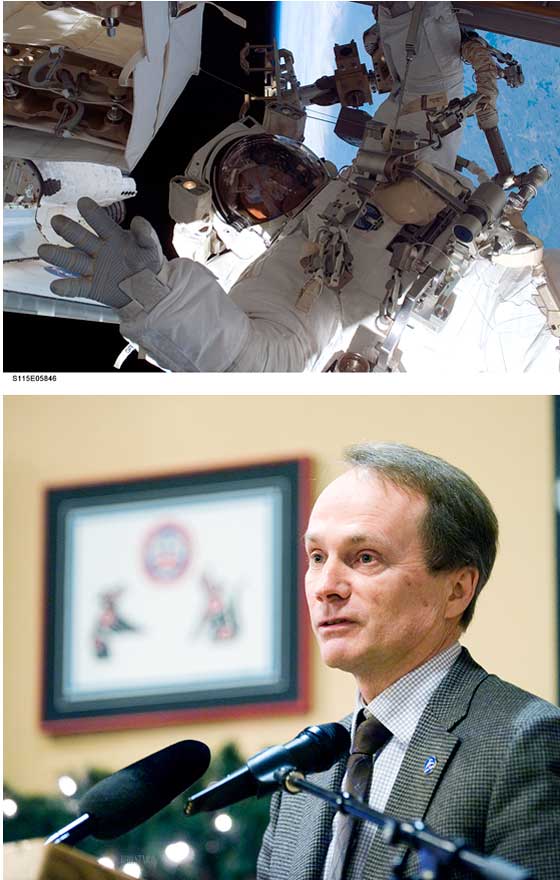
Steve MacLean's been twice as an astronaut with the Canadian Space Agency.
He took his flight aboard Space Shuttle Columbia in 1992, and his second in 1996 aboard Space Shuttle Atlantis.
The doctor of laser physics and now president of the space agency – not to mention a past member of Canada's national gymnastic team – tootled around in his space suit at the end of Canadarm2 while installing solar panels outside the International Space Station.
But he didn't talk about that when he addressed a full room during Thursday's luncheon sponsored by the Yukon Chamber of Commerce.
MacLean didn't talk about the face-peeling gravity during blast off.
He talked about satellites, past, present and perhaps future.
Satellites, he insisted, are the backbone of so many things on Earth, and the next generation is on the drawing board.
Forty-five minutes after the devastating earthquake in Haiti, Canada's RADARSAT satellite system was feeding back information. In the days that followed, through its ability to chart the flow of surface water flow on the ground, it was able to assist Canada's emergency response team target areas where dengue fever was most likely to break out.
RADARSAT 1 and 2 are assisting with Japan's plight today.
MacLean told his audience during the normal course of business, Canada's Earth-monitoring satellite program deals with everything from measuring the Arctic ice pack to tracking ships and deterring illegal fishing or bilge dumping.
In a given day, said the agency president, the RADARSATs will count as many as 50,000 ships around the globe, with the ability to zero in on those not transmitting the mandatory identification code.
The two monitoring satellites provide updates to the Canadian Wheat Board, regarding things like how high wheat has grown in the last week, providing the board with the ability to forecast crops yields and such, MacLean pointed out.
Soon, he said, RADARSAT 1 and 2 will be joined by a constellation of three other companion satellites which will enhance the quality and flow of information back to earth.
The next generation of Canadian satellites is approaching the end of the preliminary planning and design stage, MacLean said.
He said if the POLARSAT project proceeds, the two satellites will be equipped with state-of-the-art technology to provide advanced capabilities in both weather monitoring and telecommunications.
MacLean said the space agency's annual budget of $400 million is divided in half between the agency's two mandates: exploring space, and serving government.
Of the 51 per cent dedicated to serving government, keeping track of the ice pack and international shipping, a full 90 per cent is focused on the North, he said.
MacLean said focusing on the North provides essential information for the entire country.
Canada's space program and its assets, he said, should be an integral part of the country's infrastructure.
"If we do that, space will take us into the future. I really believe that.”
MacLean said if POLARSAT goes ahead, it would have the ability to image the entire Arctic region every 15 minutes.
It would provide the quality data required to keep pace with the growing sophistication of the communication industry, he said.
The agency president doesn't see a day yet when satellite communication alone will able to service the North and replace existing Earth-bound technology like the network of fibre-optic cables.
But POLARSAT would add to the Canada's satellite communication system which started right here in the Yukon, with Rolf Hougen's initiative to create Canadian Satellite Communications. CanCom was responsible for launching ANEK F1 and F2, which still serve Canada's telecommunication needs.
And Hougen was in the audience to hear tell of the future.
"I would like to recognize the man who pioneered telecommunications in the North, the one and only Rolf Hougen,” said Senator Dan Lang before introducing the president of the Canadian Space Agency.
But what about being in space?
"Phenomenal,” MacLean said when asked by a member of the audience following his presentation. "It is absolutely phenomenal that I have had the privilege of living in space for 23 days.”
There is nothing like a sleep floating in zero gravity, never mind looking out the window, he said.
As for takeoff, 2 1/2 minutes of pure thrust and vibration until the two solid fuel boosters depart. And then quiet, and after 8 1/2 minutes, you're in space, orbiting the Earth.
Be the first to comment