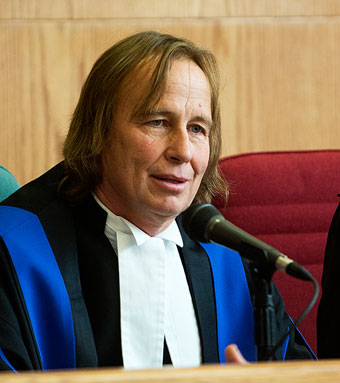
Photo by Whitehorse Star
Judge Michael Cozens
Photo by Whitehorse Star
Judge Michael Cozens
The Yukon Court of Appeal has upheld a sentence for robbery given to a man with fetal alcohol spectrum disorder (FASD) and a lengthy criminal record.
The Yukon Court of Appeal has upheld a sentence for robbery given to a man with fetal alcohol spectrum disorder (FASD) and a lengthy criminal record.
The court decided last Thursday that the 16-month sentence Franklin Junior Charlie, 30, received is not too light, given his cognitive problems and need for support and treatment.
The jail term was “beyond the low end of range of sentences” for similar offenders, the three-judge panel acknowledged in its written decision.
It agreed with the sentencing judge, however, that rehabilitation would better serve both Charlie and society than a lengthy incarceration would.
Charlie was sentenced last spring, after pleading guilty to robbery.
In May 2013, Charlie and three friends, all intoxicated, went to a home in Ross River, looking for alcohol.
They entered the house after knocking. The owner, a 78-year-old man, refused to give them any, and either Charlie or another man in the group pushed him down.
The homeowner left and called police. The group then broke into the man’s locked bedroom. They took his jacket, which contained his wallet and medication, and a mickey of liquor.
The jacket was later found on a trail with $1,700 missing from the wallet and Charlie was seen at a store in the community with an undetermined number of $100 bills.
In a detailed 37-page sentencing decision, Judge Michael Cozens opted to have the man serve nine weeks on top of the 14 months he’d spent in pre-sentence custody.
He’d also spend three years on probation.
The Crown appealed, seeking 24 months with the pre-custody time taken into account.
Cozens “was obviously influenced by Mr. Charlie’s difficult circumstances and the long-term impact of the systemic failure to address his needs,” wrote Justice Pamela Kirkpatrick on behalf of the appeal court panel.
Its decision details Charlie’s background.
He is First Nations, born with FASD, a result of heavy drinking by his mother, who had attended a residential school.
He’s had severe behavioural and learning problems since he was a child, which resulted in social difficulties, unstable living placements and his getting in trouble with the law, according to a report.
Charlie’s intellectual functioning is “extremely low.” He has limited reasoning skills, and can only process a small amount of information at a time. He has “severe deficits” in his memory, and is “essentially illiterate.”
“His cognitive deficiencies are exacerbated by his significant addiction issues,” the report states.
He has a severe disability and “requires placement in a living situation equipped to manage complex developmental delayed adults.”
As well, Charlie has a lengthy criminal record, with theft, trespassing, mischief, and robbery convictions.
“He is seriously compromised, but has the potential to do well in a controlled community environment,” Kirkpatrick wrote.
“Although he is the author of his misdeeds, they flow from his inability to control himself when he consumes alcohol or drugs,” a result of his FASD, which in turn is a result of the federal government’s residential schooling system.
“Without rehabilitation, his pattern of offending clearly will continue. With rehabilitation, he has a chance to lead an effective life. Society is best served if that were to occur.”
Another territorial court judge attempted to achieve this previously.
When sentencing Charlie for a robbery in 2011, Judge Heino Lilles said it was “imperative” that Charlie’s probation officer, the Department of Health and Social Services, the Fetal Alcohol Syndrome Society of Yukon, his parents and his First Nation prepare a treatment, supervision and support plan in time for his release from jail.
That never happened.
But things were looking up for Charlie before he committed this offence.
Just before his release from the Whitehorse Correctional Centre in April 2012, he found out about a training program in B.C. for heavy equipment operation. His mother helped him fill out an application form when he got home to Ross River.
Charlie was accepted, and the Ross River Dena Council agreed to pay his tuition and living costs.
“Everyone in Ross thought I was going to fail it,” Charlie told a pre-sentence report writer. “They thought I was wasting the band’s money and stuff like that. A lot of people thought that, and I proved a lot of people wrong back home.”
He successfully completed the two-month course and obtained workplace certifications. But he was unable to find work.
He returned to Ross River, where he helped build houses. He quit after people teased him about getting the job because his father worked at the band office.
Charlie rekindled his relationship with his son’s mother, and when that ended in March 2013, he started to drink heavily.
In his Gladue report, he said that at the time of the robbery, he felt that his life was “f*ed up” and that he “didn’t give a sh no more” and just felt like giving up.
The report states that Charlie should be held accountable for his actions – that FASD isn’t an excuse.
But the lack of support for his disability is like a second penalty.
Without help, he may find himself incarcerated “by default,” which alone doesn’t help him to improve and doesn’t minimize his risk to society when he’s released.
“If doing the same thing over and over again and expecting different results is one of the definitions of madness, then we might all be crazy,” the Gladue report states.
Cozens considered Charlie’s “special circumstances” when crafting his sentence, and didn’t err in imposing something outside the normal range, the appeal judges decided.
They also noted that Charlie, who was released from jail about six months ago, hadn’t breached his strict probation conditions.
He lives in Ross River, which has an RCMP detachment. In such a small community, police will be able to keep an eye on him, the decision states.
The appeal was heard in Vancouver early last month.
In order to encourage thoughtful and responsible discussion, website comments will not be visible until a moderator approves them. Please add comments judiciously and refrain from maligning any individual or institution. Read about our user comment and privacy policies.
Your name and email address are required before your comment is posted. Otherwise, your comment will not be posted.
Comments (5)
Up 17 Down 3
Mary on Feb 5, 2015 at 10:02 am
This is his trait. He did the same crime against an elderly gentleman in Whitehorse a few years back and stole his his truck, not once but three times, and was let off and for the old man he was told to go through his vehicle insurance to recover damages that Franklin Charlie did. Now let's cry FASD to get off.
Jail, jail...are these the changes that Stephan Harper had in mind. Let the criminals off easy and make the victims suffer over and over again. Franklin Charlie and all the other Franklin charlies should be in JAIL! period!
Up 12 Down 1
Wayne on Feb 4, 2015 at 10:59 am
I cannot let this go. It's "get a haircut, and get a REAL job."
Up 18 Down 8
Just Say'in on Feb 3, 2015 at 1:14 pm
Just like the old song from the seventies said "GET A HAIRCUT AND GET A NEW JOB" Come on Mike, think it through. You are a judge not a social worker, that is their job.
Up 30 Down 8
Josey Wales on Feb 3, 2015 at 8:26 am
Awesome, a FASD AND a Gladue double shot!
Martin Luther King once said.... "I have a dream that my four little children will one day live in a nation where they will not be judged by the color of their skin but by the content of their character."
Folks...IMHO, the insanity will never stop. What of the mothers?
Up 31 Down 9
June Jackson on Feb 2, 2015 at 8:49 pm
The "poor poor criminal" judgements infuriate me...4 drunks break into an old mans house and get almost nothing because of their "special circumstances.."
I wonder how long tax paying law abiding citizens will put up with this crap..how happy with this lack of justice is the victim? Our judges..need to be elected..law has to be concerned with victims and the public..
I think the justice system is a farce and has failed the public miserably.