Photo by Whitehorse Star
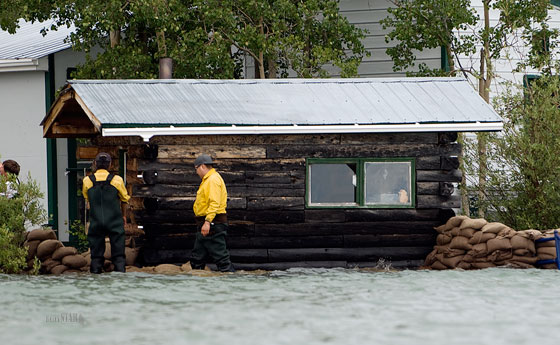
WATER, WATER EVERYWHERE - The summer of 2007 saw the lives of many Marsh Lake residents dominated by unusually high water levels. The photo above shows the typical consequences.
Photo by Whitehorse Star
WATER, WATER EVERYWHERE - The summer of 2007 saw the lives of many Marsh Lake residents dominated by unusually high water levels. The photo above shows the typical consequences.
Southern Lakes residents should not expect another summer of record flooding, Yukon government experts are saying.
Southern Lakes residents should not expect another summer of record flooding, Yukon government experts are saying.
After last year's 67-day flooding emergency, those words may be met with hesitation, given the damage to homes and residents' struggles.
But Ric Janowicz, manager of the environment department's hydrology section, said early indicators, when compared to last year's, show little chance of repeated flooding.
"Last year, Marsh Lake had a very anomalous year," Janowicz said at a press conference Thursday afternoon.
"I don't expect to be anywhere close to where the levels were last year."
Janowicz spoke to media about the Yukon Snow Survey Bulletin and Water Supply Forecast, dated April 1.
The report summarizes streamflow conditions for 56 Yukon locations, every March 1, April 1 and May 1. The information is then used to make projections of runoff levels in the summer.
"It all comes down to the timing of the snow melt," said Janowicz.
Last year's flooding in the Southern Lakes region came as a result of above-average snow melt. High rainfall and glacier melt levels contributed as well, and are regular factors of flooding, he explained.
"But last year's record snowpack skewed the figures," he said.
If this week's cool weather continues, he said, the snow melt and runoff should drain slowly, and not cause flooding problems.
General Yukon snowpack levels studied appear to be normal, says the report.
Though snowpack levels in the south central and eastern regions of the Yukon are labelled as "above normal" for this time of year, much is in higher-elevation areas, where runoff will occur slowly.
The only forecast flooding concern is in the Liard River basin, which contains Upper Liard and Watson Lake.
"We will be keeping an eye on the Liard River basin," said Janowicz.
Though he and his staff have given Southern Lakes residents a pre-emptive all-clear for major flooding concerns, he did specify that some flooding is normal.
He said while flood levels above 30 centimetres are not expected, it is typical for water levels to skirt just under this threshold.
"Near-flood level perception happens ever two or three years, and this may well be one of those years," he said.
In the long run, Marsh Lake residents should keep their rubber boots around.
"Climate change projections and trends mean we can expect Marsh Lake levels to increase," said Janowicz.
In the last 10 years, Marsh Lake has only seen flood levels exceed 30 centimetre twice, in 2007 and 2004.
Last year's experiences are certainly not memories Marsh Lake's residents want to relive.
Starting in July, basements began to flood, and water just kept pouring in. Then the water levels started rising above the banks, threatening to pour directly into homes.
Yukoners from far and near quickly volunteered to sandbag afflicted areas of Marsh Lake flooding, creating barricades, known as the Great Wall, around the water's edge.
The flooding threat continued from July 17 to Sept. 22, when levels began to recede to more manageable levels.
In order to encourage thoughtful and responsible discussion, website comments will not be visible until a moderator approves them. Please add comments judiciously and refrain from maligning any individual or institution. Read about our user comment and privacy policies.
Your name and email address are required before your comment is posted. Otherwise, your comment will not be posted.
Be the first to comment