Snowmobile bylaw would be ineffective, city told
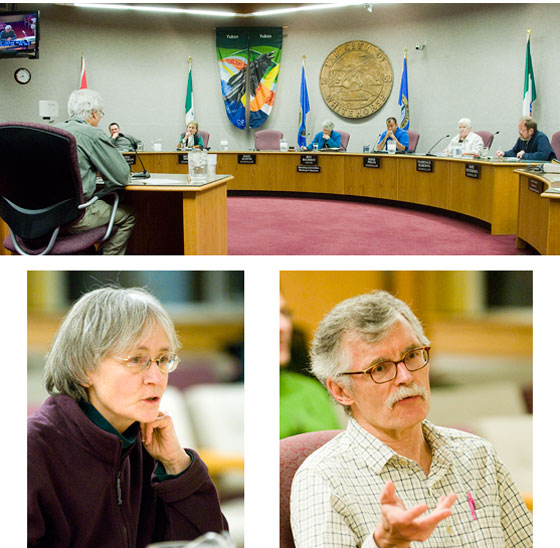
The city's proposed snowmobile bylaw has no teeth to deal with the issues that count, concerned residents told city council again last night.
By Chuck Tobin on January 24, 2012
The city's proposed snowmobile bylaw has no teeth to deal with the issues that count, concerned residents told city council again last night.
There are still matters of noise and other nuisances, and safety and environmental considerations which are not dealt with in the bylaw, council heard.
Porter Creek resident Keith Lay appeared last night to reinforce his belief the bylaw does little to address the concerns of residents bothered by constant noise from snowmobilers travelling regularly around their neighbourhoods.
There are snowmobiles using trails and roads at great speeds that pose a public safety issue, he suggested.
"This bylaw as it is now written, does not effectively deal with those concerns,” Lay told council.
He said city council's decision to permit the continued use of residential streets by snowmobilers is essentially a blank cheque to let snowmobilers keep rattling around neighbourhoods.
The snowmobile bylaw is scheduled to go before city council for first reading this coming Monday.
Originally passed in 1972 and updated periodically, it has been under review since the city established its Snowmobile Task Force in September 2010.
The legislation, including a draft bylaw presented to the public last fall, has been through a public review process, including a two public surveys.
Bylaw manager Dave Pruden told council Monday night there is nothing preventing the city from sending the final proposal out for another round of public review.
Doing so, however, would likely mean not approving the bylaw until sometime after the snow is gone, he said.
Pruden told council successful implementation of the new legislation will require a significant public education component, and his department is already exploring both high school and elementary school programs.
Following first reading Monday night, council is scheduled to host another public input session on the proposed bylaw Feb. 13.
Following a summary of the public input session to council at its Feb. 20 meeting, the bylaw is scheduled to go for second and third readings Feb. 27.
The new bylaw would:
• require all operators to have completed a safety course and received a certificate by next Jan. 5;
• virtually restrict the operation of snowmobiles on public land in the city to riders who are 16 or older, just as they are now under the territorial Motor Vehicles Act;
• establish a city-wide, maximum speed limit of 50 kilometres per hour, though there are provisions to
establish different speed limits on different trails in the future;
• require helmets to be worn;
• require snowmobiles to stay on trails through areas designated as environmentally sensitive; and
• permit snowmobilers to use residential streets to access the nearest trailhead;
Hillcrest resident Peter Long told council the city can use as much education as it would like, but there's still nothing compelling snowmobilers to stay on motorized trails in areas where they're not legally bound to.
There's nothing compelling snowmobilers to leave the areas surrounding residential neighbourhoods where they're not legally bound to, he pointed out.
Dorothy Lebel, just as she did a couple of weeks ago, reinforced her concern the proposed bylaw does not set out a minimum age requirement for the operation of snowmobiles.
A 2011 DataPath Systems survey indicates 74 per cent of Whitehorse residents want snowmobile drivers to be at least 16 years of age, she told council last night.
She said the Canadian Pediatric Society recommends 16 as the minimum age.
But yet, the bylaw makes no mention of it, she said.
Lebel pointed out the bylaw does require the use of helmets, just as the Motor Vehicles Act does.
It is silent, however, on the age restriction, though the territorial act stipulates a minimum age of 16 for operating a snowmobile on streets, roads and highways, she pointed out.
"I understand that the city decided to specify the helmet requirement in the bylaw for clarity and public education,” Lebel said. "But that should apply even more to minimum age.
"Just about all snowmobilers we see around town do wear helmets already. But we see many underage snowmobile drivers, and they're often the ones breaking the law.”
Lebel said education about age restrictions is needed, and it should start with the city's bylaw department.
Pruden said in an interview this morning while the age restriction is not set out in the bylaw, it is established in territorial legislation.
According to the law, he explained, snowmobilers must be 16 to drive on a highway.
Pruden said every centimetre of trail in the city, designated or otherwise, is considered a highway by definition, and is therefore restricted to drivers who are 16 years of age or older.
Technically, he said, if somebody drives across a lake on a fresh pillow of snow, there is no age restriction.
But by driving across the lake, they've established a new trail, a new highway, and should they return on that very trail, the law would require they be at least 16, he explained.
Pruden said the city is looking at providing access to the new safety certification online, much like the federal government provided online access for motorboat licences.
There will also be local classroom provided for those more comfortable with the hands-on approach, he said.
Pruden said the cost of the certification program is estimated at between $30 and $50.
Comments (3)
Up 0 Down 0
Yukon Hootch on Jan 25, 2012 at 4:01 am
I am really on neither side of this debate as there are so many factors that must be considered but I would like to express a couple valid points I think many are overlooking when it comes to youth operating snowmobiles, ATVs, etc.
Focusing on the issue of young people being permitted to operate, it has been my experience that when given proper instruction and supervision most youth drive small engine units quite capably. There are exceptions to this of course, for example the youth that lost his life this year in Porter Creek (RIP) but look at the reported incidents of what goes on at both the Skagway and Haines Summits each April long weekend. It's a given each year someone(s) gets hurt up there and no one can dispute that. Those aren't kids getting hurt, they are adults. I am simply trying to say that adults make mistakes the same as youth and I for one would rather see a youth start off their driving career learning on a smaller vehicle instead of a in a car or truck on the highway. Not to say a fatality cannot occur in a smaller unit but it is more of a stepping stone to graduating to a car/truck.
Another point is simply that I would rather youth be occupied with ATVs, dirt bikes, etc outside than rotting away behind a video game. I most certainly would rather see them engaged in any activity rather than being bored and breaking into my house.
Up 0 Down 0
Any-mouse on Jan 24, 2012 at 11:32 am
this isn't going to help, just a waste of tax money. The Yukon has too many ski-dooers with many trails and this most likely is not even going to slow any drivers down.
Up 0 Down 0
Billy Polson on Jan 24, 2012 at 10:46 am
Given the amount of enforcement necessary.....this will be a joke. Who would want Pruden's job...."too much noise"..."I just want to ride my snow machine"...."I'm afraid they'll run me over"....and imagine all the antisled folks with their interpretation of the bylaw, wagging their fingers at snowmobilers, phoning Pruden with their complaints, writing the newspaper....good god.
On the positive side, it will be entertaining.