Snowbirds winged their way through city
The Snowbirds are Canada's premier demonstration air squadron.
By Mark Prins on July 27, 2010
The Snowbirds are Canada's premier demonstration air squadron.
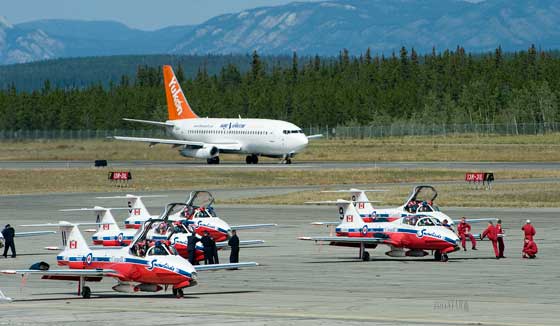
Flying in the Canadair CT-114 Tutor, the 431 Air Demonstration Squadron dropped into Whitehorse on Saturday evening on their way to perform in Alaska. The last two aircraft arrived Sunday morning, having overnighted at Fort Simpson, N.W.T.
The 431 was en route to Elmandorf Airforce Base in Anchorage.
The squadron has a full 10 days of events and flying. VIP tours and two days of air shows along with regular training will keep this squadron busy.
They hope to have a couple of days off to prepare for the air show.
Moving the squadron across Canada is often at the mercy of the weather.
The Tutor is not an all-weather aircraft, preferring the clear skies to the storms of the North. The timetable was built to allow a few weather days so the squadron wasn't pushed to arrive and perform.
The specialty flying team flew an air show in Yellowknife on Saturday and departed for Whitehorse the same day.
Like the small aircraft of the North, the Tutor has a limited range of 480 to 640 km (300-400 miles).
This means like the Cessna 172 or 1946 Taylercraft they have to hopscotch across the country airfield to airfield.
The flight from Yellowknife was to Fort Smith, where they re-fuelled.
Then it was on to Watson Lake, where they fuelled up again, and finally Whitehorse.
Sunday's departure was delayed by the U.S. customs entry port of Northway still being available, but there was no fuel for sale.
The squadron filed their flight plan for Gulkana, Alaska, with Yakutat as their alternate landing point.
According to their commanding officer, the marine weather was "poor”, so they hoped to land in Gulkana, which would leave a "straight hop to Elmandorf.”
Some local aircraft enthusasists were at Erik Nielsen Whitehorse International Airport to watch the Snowbirds.
These aviators used to fly into Alaska regularly, and are accustomed to the difficulty of the U.S. customs paperwork. They have given up on flying into the U.S. due to the requirements of that country's government.
The Snowbirds are members of a military squadron who seem to have the same issues with U.S. customs.
The 431 as a demonstration squadron used to fly the Canadian flag outside of Canada and to inspire her domestic population.
Listening to the conversations around the viewing areas on Sunday afternoon as the Snowbirds took off, they are doing both.
Conversations ranged from the need for the Canadian Armed Forces to the younger people wanting to become pilots. The most common theme was the disappointment that there wasn't an air show in Whitehorse.
The Snowbirds are performing with the U.S. Navy's Blue Angles, Air Force Academy Wings of Blue, F-22 Raptor, the Screaming Eagles jump team and many other units.
This is considered tha largest aerial display in Alaska, and is expected to draw more than170,000 attendees.
Weather permitting, the Snowbirds will be back through Whitehorse early next week. They are scheduled for an air show in Whitecourt, Alta. at the end of next week.
The Big Diamond Formation that the squadron overflew Whitehorse on Saturday evening was just a hint of the flying skills this squadron demonstrates.
Mark Prins is a Whitehorse writer and photographer.
Comments (2)
Up 1 Down 0
DG on Jul 29, 2010 at 12:45 pm
These aircraft were never meant to be long distance flyers. They were designed as trainers and trainers don't generally need to go a great distance so they were designed with smaller fuel tanks.
They may be 50 years old but they are beautiful airplanes to watch nonetheless. As far as grandkids flying them would you really want them learning to fly in 35+ million dollar hornets or the new JSF. (for those that don't know Joint Strike Fighter is the aircraft that Canada is replacing the CF-18 Hornets with)
On a further note the CT-114 Tutor is only flown by the Snowbirds in Canada. The "grandkids" are now learning to fly in the CT-156 Harvard II (turboprop) and the BAe CT-155 Hawk (jet) aircraft.
Up 0 Down 1
JC on Jul 27, 2010 at 9:43 am
Good grief! I can get more mileage out of my 1 inch water pump. These jets are so old (50 years) the grand children are flying them now.