Skeleton’s discovery excites paleontologists
The Yukon paleontology department is hoping for the return of a skull removed from the skeleton of a horse discovered last Friday evening in the Carcross Desert.
By Whitehorse Star on May 31, 2016
The Yukon paleontology department is hoping for the return of a skull removed from the skeleton of a horse discovered last Friday evening in the Carcross Desert.
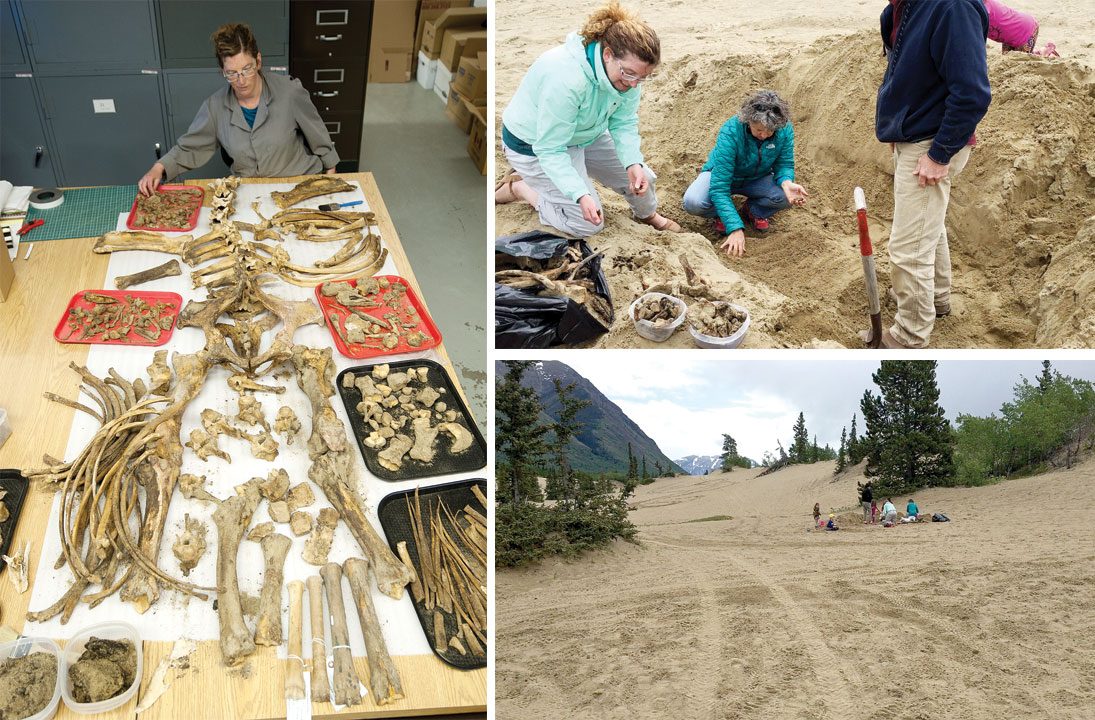
Assistant paleontologist Elizabeth Hall said today the skeleton was discovered near the pullout into the dessert by passengers and the driver of a tour bus that stopped by.
“They noticed something sticking out of the ground and they went to investigate,” she said, adding the tour guide then contacted Yukon government archaeologist Greg Hare.
Hall said she and Hare went to the site Saturday morning, but the skull that had been seen Friday evening had already been removed along with parts of the legs.
Even as it is the skeleton is a valuable find but it would be much more so if the other parts were returned, she said.
Hall said while it is illegal to remove those types of items from a site, the department is interested in having them returned, not prosecuting the individual who took them, as they may have been removed simply out of curiosity and interest.
Evidence indicates the remains are not prehistoric, and are likely from the Gold Rush period, she said.
Hall said the “large horse” or modern day horse skeleton adds to the collection of bones they use to compare with other remains found to assist with identification.
In this case, she said, the skeleton was largely intact, and includes the remains of a fetus.
She said the leg bones were still attached to the hip sockets.
There is no evidence so far that indicates the horse was chewed on by a carnivore, she said.
“Both Greg and I were quite excited,” Hall told the Star.
“It is so nice to have a complete skeleton from every animal .... For completeness, we would like to have the skull.”
Hall noted it is also rare to find skeletal remains of an animal with some cartilage still preserved, as was the case.
“The Carcross Desert in some ways is almost the perfect environment,” she said of conditions required to maximize preservation.
Hall said they most likely will be carbon dating the bones to get a better idea of how old they are.
Though a portion of the skeleton was visible on the surface, the excavation of the remains meant digging down to a depth of about one metre by two metres in length and a metre across. It took approximately three hours to complete the work.
Hall said a member of the Carcross/Tagish First Nation’s heritage department was at the site during the excavation.
Comments (1)
Up 0 Down 2
just Say'in on Jun 5, 2016 at 1:17 am
“Both Greg and I were quite excited,” Hall told the Star.
Haha, I bet they were. Full time, high paying Government jobs and probably the first thing they have found and they are only 100 year old bones of someones horse. REALLY.