Shooting a quarter-century of Yukon history
His photographs have recorded the territory's history, wildlife, events and changing landscape for more than a quarter-century.
By Stephanie Waddell on December 19, 2008
His photographs have recorded the territory's history, wildlife, events and changing landscape for more than a quarter-century.
And while Robin Armour has retired from his role with the territorial government as its photography supervisor, he'll continue shooting the Yukon's places and people on a freelance basis.
"It's been quite the trip," he said in an interview late last week as he wrapped up his final day on the job.
The time is right to move on from his full-time gig with the government to take things at his own pace and shoot when and where he decides, Armour said.
He recalls a career spent watching the pivotal accomplishments of many Yukoners, from the signing of first nations and land claims and self-government agreements to medalling at Canada Games and Arctic Winter Games.
"That's kind of been the great part of the job is you have to be a sort of photographic jack of all trades," he said.
And while the 61-year-old Armour's been a constant behind the camera since 1981, the equipment in front of him has changed tremendously, moving from the world of film and darkrooms to digital technology.
In 1981, Armour arrived in the territory from Banff, Alta. to work in archives after four years of working in the archives of the Canadian Rockies there following his graduation from the photography program at the Banff School of Fine Arts.
He was told about the job with Yukon Archives from a friend who lived here at the time. He had told his friend that if any jobs opened up to let him know.
Growing up on Quebec's Gaspé Peninsula, Armour had always wanted to travel to the North.
"Actually, I wanted to go even further north, up to the Arctic, but my wife wouldn't have anything to do with that," he said. "She said, 'Whitehorse, Yukon, that's good enough.' "
With that, the couple moved up to the territory, with Armour taking the job at Yukon Archives.
"So I worked with the Archives for a few years and then the chance came to expand into doing more of the regular photography for YTG," he said.
To keep up his skills in historical photography, Armour continued to curate photography exhibits at museums around the territory, taking shows to other parts of the country and the United States, while also shooting for the Yukon government.
"That was back in the days when we had a darkroom here and a darkroom that I could use at MacBride Museum (where he served as president for a few years)," he said. "Now I don't have a single darkroom."
These days, his work is all done on computers. The territory first started converting its massive library of photos to digital documents about 10 years ago, making it among the first jurisdictions to do so, he said.
It was for that reason his assistant, Rob Bales, was initially hired on a contract basis to turn all the government's photographs into digital files.
Many of those photographs came from the manual SLRs Armour used in those early years.
"We were shooting with medium and large format, all the way up from 35-mm to four-by-five-inch cameras. And we shot a lot in black and white, and colour negative and transparency film and we processed everything here," he said, adding that even slides were processed and mounted in the government building.
While Armour's former position falls now under the Department of Tourism and Culture, in the early 1980s it ran out of the Executive Council Office, with Armour shooting for all departments.
As a "jack of all trades", Armour would find himself going from taking pictures of placer mining to school programming shots or photos of tourist sites around the territory.
His career also took him to each of the Arctic Winter Games since he arrived along with a few Canada Games over the years.
"They're very challenging," he said, pointing out it not only meant having to get the right shot at the right moment, but also getting a photo of each Yukon athlete competing at the Games.
The move to digital photography has also meant where Armour was once expected to process photos from events like the Arctic Winter Games in a couple of months, he's now expected to do the editing and processing within a week or two.
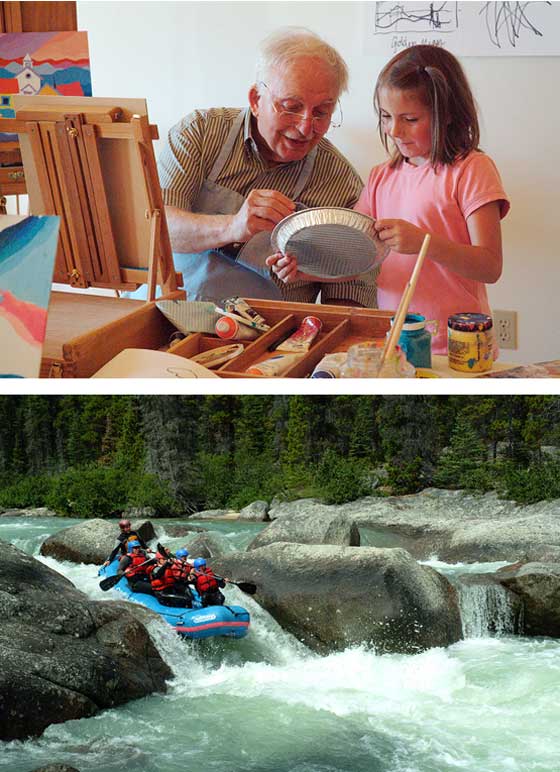
He admits there were other government staff looking at him with a little bit of envy when he was taking off for a trip along the Yukon or Tatshenshini rivers to shoot the scenery for work.
Other times, he'd head out on horse riding trips to get some shots for the Tourism department. One such journey saw him travelling in the Rose Lake area with Art Johns and David Peters, among others.
"There were some great times with great people," he reminisced.
Along with the great people in the territory, Armour has also occasionally had the chance to show other photographers and writers around the territory.
Most recently, a couple of Mexican photographers took in dog mushing,
While those trips were the fun part of his job, he also would shoot the more historical moments happening at the time: visiting dignitaries and, perhaps most importantly, the signing of first nation land claims and self-government agreements.
"They were always such a momentous time period in the evolution of the territory. Each signing was of incredible significance to each particular first nation so the ceremonies were always so moving and historically significant for the whole territory," Armour said.
Never knowing what he was going to be doing next kept Armour in the job for close to 30 years. While some may expect a job with the government to be the subject to a certain amount of bureaucracy, Armour has been able to avoid that for the most part.
"Because of the darkroom, my office has always been in the same location for 28 years," he said.
"And no matter what department I've been with, I've never actually been housed in the same building as the department, or seldom anyways.
"It's the nature of the job that you can escape and get out of the office and travel around the territory quite a bit. You don't really have to be embroiled in politics or bureaucracy too much so that's probably one reason that I've lasted this long."
As Armour gets set to move onto his own schedule, he will continue to be involved with the Ted Harrison Artists Retreat at Crag Lake, an initiative he's been involved with since its inception a number of years ago.
Be the first to comment