Sewage treatment plant will meet deadline
DAWSON CITY – Dawson City is about two years and $25 million away from having a final solution to its secondary sewage problems.
By Dan Davidson on September 28, 2009
DAWSON CITY – Dawson City is about two years and $25 million away from having a final solution to its secondary sewage problems.
However, officials with the Yukon government and Corix Water Systems are positive about not only meeting but beating the most recent court-imposed deadline at the end of 2011.
Catherine Harwood, acting senior advisor in the the Department of Highways and Public Works' deputy minister's office, summed up the background to the project during a news conference held last Thursday in Whitehorse.
"After the referendum in March 2008, (the department) had to decide how to manage the procurement of a solution for wastewater treatment in Dawson,” Harwood said.
At that point, a citizens' referendum had put an end to the government's proposed site for an aerated surface lagoon at the junction of the Dome Road and Klondike Highway.
"Knowing the history of the issue, the deputy minister decided that instead of government commissioning a design and then asking for construction bids, the project team, including Dawson, would explain the challenges and issues, and publicly advertise for industry-suggested solutions,” Harwood said.
"This has led to Corix proposing an innovative solution for Dawson that we believe will meet all our goals.”
The proposal had to meet court-imposed restrictions in terms of time and long-term operations and maintenance costs. Any solution had to be affordable for the town in the long run.
Harwood noted that any solution also had to have redundancy built into it.
"There are no experts across the city who can be there in an hour to help in an emergency,” she said.
"So, the level of redundancy for this plant is to have alternate equipment for everything, not just a few important pieces of equipment. That redundancy is provided in the design of the plant.”
The timing of commissioning and the warranty had to be unique to the Dawson situation, she added.
Instead of the industry standard of 28 days, Corix will operate the plant for a full year while training Dawson staff to take over, and will provide an additional two years of warranty service.
Corix's David Speed summed up the list of contractors involved in the project: NORAM Engineers & Constructors, HÄN Construction, EBA Engineers & Consultants, Allnorth Consultants, Construction Drilling, Keith Plumbing & Heating, Dorward Engineering, Ben's Electric, Boni-Maddison Architects, Gage Babcock Associates, and Corix Water Systems.
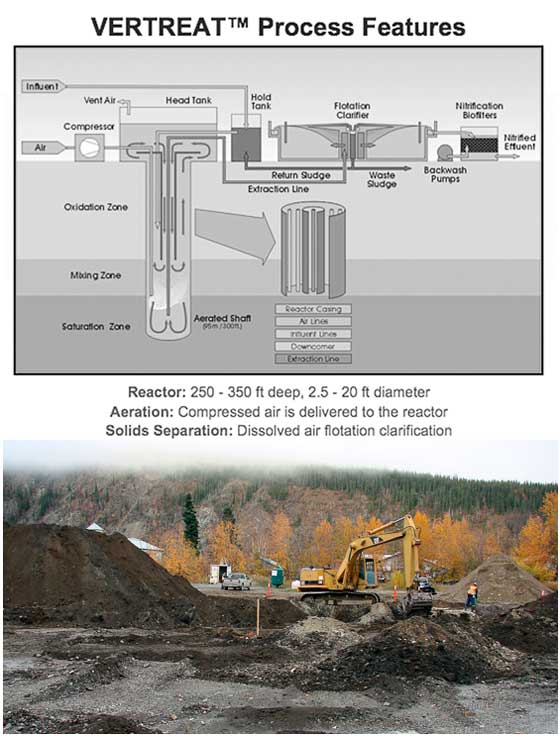
The key to the system being used in Dawson is the Vertreat process developed by NORAM Engineering.
The advantages to this deep shaft pressurized and vertical version of a lagoon were summed up by NORAM's Clive Brereton.
He called the system a good fit for an area where there are concerns about space limitations, extreme low temperatures, fluctuating loads, possible seismic activity, high precipitation, proximity to residential areas (visual impact), and possible odors.
In addition, the Vertreat system uses about half the power of either a conventional mechanical system or a standard aerated lagoon.
It takes up less space than either of these options and, in the site chosen for the installation, will not require the laying of additional sewage pipes, lift stations and force mains.
In operation, the waste water (called "influent” at this point) will enter a holding tank at the indoor plant site and be redirected to the aerated shaft, where a sort of high pressure aerated lagoon-type process will take place in several stages.
The treated liquid will be extracted from the shaft and conducted to a flotation clarifier, where any sludge will be separated from the liquid.
Some of this will be returned to the deep shaft to assist in the reactions there. Waste sludge will be dewatered (dried) and trucked to the landfill.
The treated water will be discharged to the Yukon River via the existing force main and discharge pipes.
There are some possible concerns about the long-term integrity of the existing force main, which is quite old, and Harwood said her department is working with the City of Dawson and a consultant to see what ought to be done.
A long-term plan for dealing with the sludge has yet to be developed and is not really part of the SST contract.
Harwood expects there will be a trailer load every other day in the summer, when there are perhaps 4,000 people in the area; hardly any at all in the winter, when the population drops to around 1,500.
The contaminated land in the former Yukon government highways yard is being removed to be treated prior to site preparation beginning.
An estimated 300 cubic metres (but likely more) of soil are being relocated to a land treatment facility being built at Kilometre 11 of the Top of the World Highway.
The soil will be spread on a lined and designed area, to be turned and monitored until it is known that the hydrocarbons have broken down. This is being organized by the territorial Department of Environment.
Be the first to comment