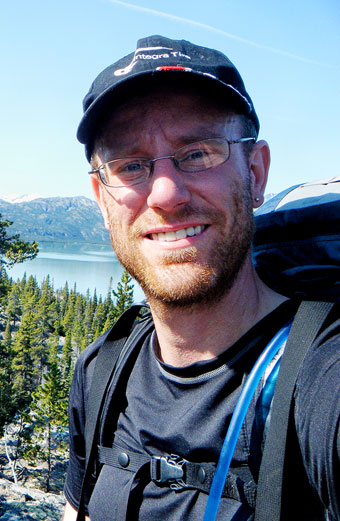
Photo by Whitehorse Star
Denis Chabot
Photo by Whitehorse Star
Denis Chabot
A fuel company supervisor and two local businesses were before Yukon territorial court for sentencing Wednesday following the accidental death of tire technician Denis Chabot in 2011.
A fuel company supervisor and two local businesses were before Yukon territorial court for sentencing Wednesday following the accidental death of tire technician Denis Chabot in 2011.
They made their case alongside the Crown as to what punishment should be meted out, with wide gaps between the two sides.
Frank Taylor, his company, North 60 Petro, and Integra Tire were each found guilty in January of one training or safety procedure breach in an incident which saw the 34-year-old Chabot crushed while beneath the semi-truck he was servicing.
On Wednesday, the Crown requested a penalty of $10,000 for Taylor and $100,000 each for the two companies.
Defence lawyers submitted that penalties of $2,500, $30,000 and $35,000 for Taylor, North 60 and Integra Tire, respectively, were more appropriate.
Judge John Faulkner hinted that whatever the amounts, they might go toward an organization like the Northern Safety Network, which offers workplace safety programs and courses.
Faulkner said he will hand down a sentence at 9:30 a.m. Friday.
Crown lawyer Judy Hartling noted that at $150,000, the Yukon has the second-lowest maximum penalty for workplace breaches, as defined under the territorial Occupational Health and Safety Act.
Thus, she argued, the judge should not shy away from a sentence closer to that cap.
"It may appear that $100,000 is seeking a large fine, but compared to other maximums across Canada, that may not be so.”
Alberta, by comparison, has a maximum sentence of $500,000.
Hartling said the main principle behind the fine is deterrence.
The penalty should not be so small as to make it "appear to be a licence for an illegal activity,” she said, quoting case law.
That a fatality resulted from the training and safety failures demands a steeper punishment, she said.
"Mr. Taylor made a huge mistake ... in that he did not make sure (the truck driver) did a walk-around. And worse, he saw him get into the truck,” Hartling told the court.
She was referring to Taylor's failure, as supervisor, to ensure his employee conducted a "walk-around check,” a safety procedure in which drivers walk around their tractors to look for any risks or hazards before driving away from a site.
Chabot was not under the vehicle until right before the driver departed.
However, the employee would likely have spotted the torque wrench leaning against the back of the vehicle at the time, alerting him to the fact that work may not yet have been completed.
Chabot likely crawled under the truck to retrieve a bottle jack seconds before the vehicle pulled into gear on Nov. 15, 2011.
He was killed almost instantly.
Through parts of the hearing, Integra Tire co-owner Paul Bubiak — cleared of all four charges related to the incident — sat hunched forward in the courtroom gallery, hands tented to his lips.
Andre Roothman, the lawyer for Taylor, noted the judge's own
acknowledgment that the North 60 owner "did not create the hazard that led to Mr. Chabot's tragic death.”
Thus, Roothman argued, Taylor "should bear only his proportion” of the "contributory negligence” involved in the death at Integra Tire — referred to during the trial as the Yukon Tire Centre.
"He did what he thought was adequate at the time in terms of company policy,” Roothman said.
"I'm not sure I understand you,” the judge replied. "The company policy required that you walk around that truck. Period.”
"Well, it's the prior actions and failures that ended up on his lap,” Roothman said.
"But if any of those links ... in the chain of events ... had been removed, Denis Chabot would be here today,” Hartling responded later.
Taylor, who has been at North 60 for nearly 20 years, has no prior convictions under the Occupational Health and Safety Act.
"So it's not easy for him to accept that he screwed up,” Roothman added. "It's something that has haunted him and will keep on haunting him.”
North 60 lawyer William McNaughton said the company is "working hard to continue to instill a safety culture to prevent anything like this from happening again.”
He noted that while the 31-person business transports and sells fuel — for a net income of nearly $1 million in 2012, for example — "North 60 is not a large company,” and its profit margins are tight.
McNaughton reiterated that North 60's failure to provide walk-around training "wasn't the direct cause of Mr. Chabot's death; it was an indirect cause or contributing factor.”
Since that fateful day, North 60 has maintained a rigourous safety committee with rotating members "so that all the employees ... do the hands-on safety training.”
Integra Tire lawyer Jim Tucker appealed for a lighter sentence too.
He noted the company, which Bubiak bought in 1987, had no other safety infractions before or since the fatality.
Prior to November 2011, "it sought out ... what it understood to be the gold standard of safety and training for its tire technicians.”
While Integra Tire had admitted to not having a lockout procedure, the judge stated in January that the company was largely compliant with safety regulations.
"The evidence satisfied me that, far from being a safety outlier or scofflaw, Yukon Tire made considerable efforts to train its employees and to foster safe work practices,” Faulkner said.
But the judge also noted that "lockout procedures are designed so that a vehicle cannot be energized or moved when the technician working on it does not expect it” — precisely what happened to Chabot when he was partially under a semi-truck on that fateful November day.
"I do not accept ... that simply switching the ignition off but leaving the keys in the vehicle is sufficient from a safety perspective,” Faulkner said in January.
"That is the true source of the danger, and the most likely way for the vehicle to become energized or to be moved unexpectedly is for another person to turn the ignition on.”
Tucker noted remedial steps, like implementing a lockout procedure, taken by Integra Tire since the fatal incident.
The company has even lost business because of it, "which I would submit is a testament to the dedication that it has to the safety procedure in place now,” he said.
Tucker also noted the "remorse and sadness” demonstrated by the company, its shareholders and employees.
The company paid for a flight to Quebec for Chabot's partner, Kristy Lerch, so she could attend his funeral.
An annual minute of silence and a memorial plaque at Integra Tire keep Chabot in mind for both employees and clients.
New hires are always told about the fatal incident, Tucker said.
"The lessons of that accident are used to impress on everyone at Yukon Tire how important it is for everyone to follow safe work practices.”
Tucker said a $35,000 penalty, with at least two months for payment, would be appropriate.
The maximum penalty of $150,000, while comparatively low on a national scale, "is a matter for the legislation to deal with,” and "appropriate given the circumstances of the Yukon and its residents,” he said.
At the start of the hearing Wednesday, there was disagreement between the two sides over admitting as an exhibit a victim impact statement by Kristy Lerch, Chabot's partner of about nine months at the time of his death.
Roothman said the issue was not the author's credibility — the usual grounds for rejecting a statement — but the content itself.
He said the lengthy letter "cannot fit into any of these categories” — the resultant physical, emotional or financial injuries typically set out in such statements.
Rather, it was similar to what he described as the "public lynching” of the defendants in a letter to the editor from Lerch published in the Star last month.
Despite Roothman's protestations, the judge admitted the statement, with some parts redacted.
"I've been in this business for 25 years. I've seen a lot of these. I think you have to give me a little credit in being able to separate the wheat from the chaff and not become overwhelmed by this submission,” Faulkner told Roothman.
In the statement, Lerch recalled seeing Chabot's body on the evening of Nov. 15, 2011
"I touched the dimple through his beard, the one I loved to kiss,” she wrote. "I smelled anti-septic and blood.”
Lerch also described the "numbness and pain” she's experienced since her partner's death.
"How will I live without him? ... Loss and despair, my new normal.
"I am living in a parallel dimension of death, darkness and loss .... I haven't felt joy since he died.”
In order to encourage thoughtful and responsible discussion, website comments will not be visible until a moderator approves them. Please add comments judiciously and refrain from maligning any individual or institution. Read about our user comment and privacy policies.
Your name and email address are required before your comment is posted. Otherwise, your comment will not be posted.
Comments (5)
Up 0 Down 2
Wholesale Shoes Online on Apr 9, 2014 at 12:52 pm
precisely similar other women with narrow feet, you might induce besides leftover without any other Selection but to receive your womens narrow shoes custom made. This Alternative is in truth high priced than merely experiencing a standard sized pair of shoes.
Wholesale Shoes Online http://wholesalenike.page4.me/
Up 18 Down 4
Josey Wales on Apr 7, 2014 at 9:38 am
Gee...I've mentioned this prior, and now? again...
Why no drawn out public court time for the owner whom played a role in the expiration of FIVE...yes folks please not forget...the FIVE folks whom died in a typical Whitehorse shanty?
Yes what happened at the tire shop was bad indeed, but...FIVE dead...no court time...no crack down on the many whom profit well with ZERO actual accountability for the dumps they own and damage caused by them and should have had a TEAM of inspectors crawling all over them like T.S.A. agents.
Myself, I'll never forget five people I never knew and how their deaths were completely avoidable...nor should anyone else forget.
We will see how the next workplace death is handled I suppose, unless it happens within the government machine...then a toothless inquiry of polite suggestions will follow...
Up 7 Down 2
Karen Braun on Apr 5, 2014 at 1:08 pm
Denis's death was a tragic loss not only to his partner Kristy and his family but also the community within which he lived. It's sad that such a tragedy needs to occur for people to learn how safety should be conducted and employees protected. The lock out procedure that the judge described seems like the best safeguard to avoid this type of accident. Hopefully this never happens again.
Up 6 Down 12
James W on Apr 4, 2014 at 4:45 am
When a life is lost, under any circumstance it is a tragedy. The relationship Denis and his partner shared, was special. Denis always had such a big smile on his face when he talked about the adventures he had with his partner. The court made the right decision reading the victim impact statement in court. All parities charged pleaded not guilty, fiercely fighting the charges. It is important to remember the details surrounding the loss of Denis. Even though his family was not in Whitehorse, Denis was cared for by his Partner that afternoon in the Hospital.
Up 3 Down 20
Sandy M on Apr 3, 2014 at 11:14 pm
I don't think the article published by Kristy was "public lynching," but a way of mourning her loss. Grief, is our internal response to loss, and mourning is sharing our grief outside ourselves - which is how we heal and integrate our new reality of life without a loved one. Part of mourning is asking WHY questions and wondering, from all angles, why did he have to die? The article she published asked some very real WHY questions that she wants answers to. As she should. As for her victim impact statement - there are most definitely physical, emotional and financial ramifications (or "injuries") when it comes to grief...and for someone to argue there isn't is the one who most obviously needs to hear the victim impact statement...I hope they listened.