Photo by Whitehorse Star
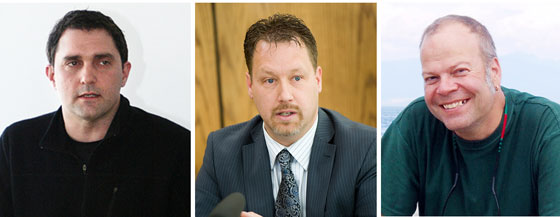
Sandy Silver, Steve Nordick and Jorn Meier
Photo by Whitehorse Star
Sandy Silver, Steve Nordick and Jorn Meier
Ed. note: this is one of a series of riding profiles the Star is publishing in the leadup to the Oct. 11 election.
Ed. note: this is one of a series of riding profiles the Star is publishing in the leadup to the Oct. 11 election.
The Klondike is the gateway to the northern Yukon.
The riding comprises a vast area from the White River at the south end of the riding to the Eagle Plains Lodge in the north and from the Alaska border to the Dempster Highway.
Most Klondike residents live in and around Dawson City, with most working in tourism, placer gold mining, government and agriculture.
Key issues in the Klondike are housing, the future of the Peel watershed and public development in Dawson.
All three major parties are represented in the Klondike.
Steve Nordick of the Yukon Party is the current MLA.
For much of this year, he has held a number of cabinet positions, including Minister of Economic Development as well as the minister responsible for the Yukon Housing and Liquor Corporations and the Yukon Lottery Commission.
Nordick has lived in Dawson City for the last 20 years. He and his wife, Tracy, are raising their young daughter Madison in the community. The family formerly owned and operated the Fifth Avenue Bed and Breakfast in Dawson.
"I will continue to work with the people of the Klondike and ensure that their voices are heard,” says Nordick.
"Most of the decisions I make, I make because my daughter will be two in December and I want her to be able to share in this great community in the next 20 years, for herself and for her family.”
Jorn Meier is the NDP candidate. Born in Germany, Meier has has lived in Dawson for the last 18 years, with his wife and daughter.
His background is predominantly in municipal level politics, though he also ran for the NDP in the last territorial election. Meier served with the town's chamber of commerce and has spent the last 10 years in various volunteer positions throughout the community.
"We need transparency and a new approach,” he says. "I will represent every constituent, not just those who vote for me.
"I have friends and people I have worked with throughout the community, people who may or may not vote for me but they will work with me, and because of that, I think I can make the government up here a little more inclusive for everyone.”
Sandy Silver is running for the Liberals. Originally from Antigonish, N.S., he tried his hand as a lobster fisherman but settled on a career in education, starting in Victoria and moving on to Yukon, where he has taught for the last 14 years.
"In our constituency, there are a lot of programs and major public projects proposed without enough consultation from Klondikers,” he says.
"We have some really great people here, we are very functional and we are a distinct and intelligent community. We have a keen sense of what we need for the next five years, 10 years, but what we get are big budgets overspent on ideas we don't need.”
A major issue for all three candidates is the future of the Peel watershed.
Nordick believes the issue will be solved if the negotiations can continue among the territorial government, the mining companies and the affected First Nations.
"We need to honour the commitment to the ongoing process with the effected First Nations,” says the incumbent.
"We have an agreement in place that isn't complete, and it would be irresponsible to prejudge the situation based on that. I firmly agree that the First Nations, and the territory will come to an agreement if the process is followed.”
The other two major parties believe the findings of the Peel watershed final plan should provide the final answer to the situation.
"We need communication between municipal, territorial, federal and First Nations governments as well as the mining companies,” says Silver.
"Most mining companies want to work with stable governments, which is why we have to go forward with the Peel watershed plan; we need proper land use plans and input from all stakeholders.
"We also need to listen to the companies because many of the decisions made in Whitehorse apply poorly in the goldfields.”
"We are partners with the First Nations under the final agreement,” says Meier. "The Peel agreement set aside 80 per cent of the area for conservation and we want to do that, but in a way that is fair to miners and stakeholders in the region also.”
Housing is the other primary issue in the Klondike.
Silver favours a new set of solutions he says would include Dawsonites in the development process.
"There has been some fabulous work done here,” he says. "We have had a lot of suggestions about converting vacant commercial properties, infilling lots, as opposed to building outward.”
Meier proposes opening up more lots and more affordable mortgages.
"When I came here 18 years ago, there was a housing crisis. Now there is a major housing crisis. We need to open up more lots, make mortgages more affordable to young people, to everyone,” he says.
"One thing to consider,” says Nordick, "is that the municipality is really responsible for freeing up development land. I stand willing to work with them to offer land to Yukon Housing. I also want to work with the private sector to build a market rental apartment building in town.”
Public buildings such as the new hospital, now under construction, are another key concern.
Says Nordick: "My number one concern is that we offer first-class health care to our friends, residents, people of the Klondike. We need to ensure that we provide the tools necessary to do the good work they are capable of. The hospital association will continue to work with nurses and doctors for what's best for the community.”
"People want to know what they are getting from the government in Whitehorse,” says Meier.
"Everyone needs a hospital, and we are getting less than one ... collaborative care makes sense for the community.”
Silver believes a new, more inclusive vision is required.
"We need to find out what the appropriate model for health care in Dawson is and how to apply it here,” he says, likening it to the proposed new recreation centre in Dawson City
"It's another big promise, made without our input, like the rec. centre. Klondikers need the opportunity to contribute in these decisions.”
Klondike has been a Yukon Party stronghold for the last several elections.
In 2000, Peter Jenkins – now Dawson's mayor – won the riding with 42 per cent of the vote. He was re-elected in 2002 with 55 per cent of the vote.
Nordick was elected with 46 per cent of the vote in the 2006 election in which 79 per cent of Klondikers turned out to vote, one of the highest rates in the territory.
See Riverdale South profile
In order to encourage thoughtful and responsible discussion, website comments will not be visible until a moderator approves them. Please add comments judiciously and refrain from maligning any individual or institution. Read about our user comment and privacy policies.
Your name and email address are required before your comment is posted. Otherwise, your comment will not be posted.
Comments (1)
Up 0 Down 0
Junie Jackson on Sep 30, 2011 at 7:26 am
Geez... this might be the first election in 50 years that i didn't bother to vote in.