Photo by Vince Fedoroff
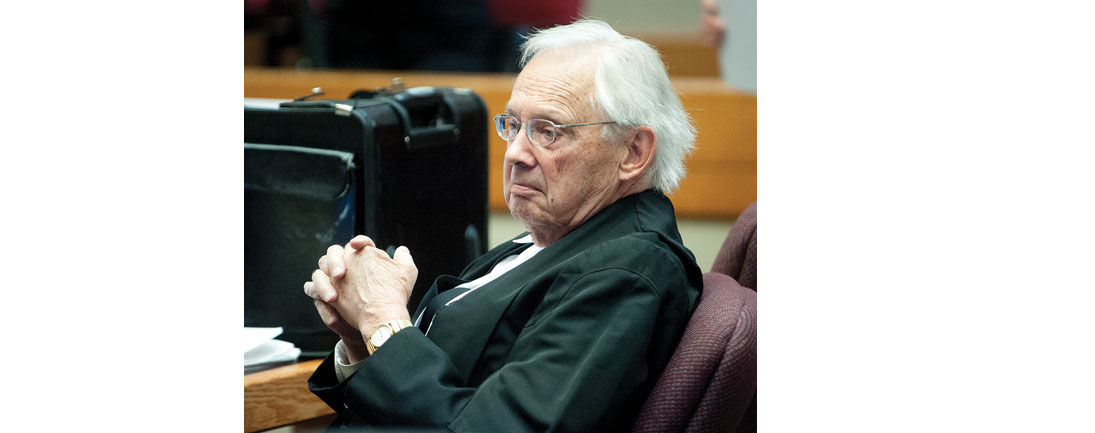
CASE OPENS – Jurist Thomas Berger waits this morning to make his opening remarks in Yukon Supreme Court.
Photo by Vince Fedoroff
CASE OPENS – Jurist Thomas Berger waits this morning to make his opening remarks in Yukon Supreme Court.
The trial that will decide the fate of an expanse of northern Yukon wilderness began Monday morning in a packed courtroom in Whitehorse.
The trial that will decide the fate of an expanse of northern Yukon wilderness began Monday morning in a packed courtroom in Whitehorse.
The weeklong court case, presided over by Yukon Supreme Court Justice Ron Veale, will see First Nations and environmental groups go head-to-head with the Yukon government over usage of the Peel River watershed.
The First Nation of Na-Cho Nyak Dun and the Tr’ondek Hwech’in, as well as the Yukon Conservation Society and the Yukon chapter of the Canadian Parks and Wilderness Society (CPAWS), are suing the Yukon government over its plan to protect about 30 per cent of the region and open the rest to oil, gas and mineral exploration.
About 50 people, including First Nation elders, media and other members of the public, milled about the courthouse Monday before filing into one of two courtrooms at 10 a.m.
Due to the significant public interest in the case, it’s being live-streamed in an adjacent courtroom with added seating.
Both rooms were packed with standing room-only. A buzz filled the main room in the minutes leading up to the start, and news photographers snapped shots.
Though photography and videorecording are typically forbidden in Yukon courtrooms, Veale last week ordered that photos would be allowed during the first five minutes of Monday’s proceedings. As well, CPAWS was permitted to videorecord inside the courtroom from 10 a.m. to 12:30 p.m. on Monday.
In his ruling, Veale set down a number of conditions for the photographers and videographer, including a requirement the material recorded not be used for reporting the proceedings, and not be used for satire or comedy, and not be sold.
Three large maps of the watershed were displayed on easels in the jury box.
Before the trial, Jimmy Johnny, an elder who lives in Mayo, said he felt nervous.
“This is a big case,” he said. “I never thought it would come down to this.”
He first visited the watershed in 1958, when he was 13 years old. It’s traditional territory – home to campsites and burial grounds – his ancestors travelled across for years.
“It’s very important to us as human beings, especially First Nations,” Johnny said.
In his opening remarks, Thomas Berger, the renowned lawyer representing the First Nations and environmental organizations, described the history of discussions about the region’s protection, including a land-use plan prepared by the Peel Watershed Planning Commission after seven years of research and consultation.
“The recommended plan determined that 80 per cent of the Peel Watershed should remain wild and that 20 per cent of the Peel Watershed should be open to development by way of oil and gas exploration and mining exploration,” Berger said.
In January, the government rejected the proposal, opting instead to protect 29 per cent.
The roots of this issue date back to 1993, when the government of Canada, the Yukon government and Yukon First Nations signed the Umbrella Final Agreement, through which the First Nations surrendered title to an amount of land about the size of Spain.
“The outcome of the case will depend on the interpretation of the Umbrella Final Agreement,” said Berger.
The government argues that it has the final say over the region’s land use and that it doesn’t have to accept the commission’s recommendations.
The First Nations and environmental groups disagree.
“This legal case will set a precedent for how land claims are interpreted across the North,” Karen Baltgailis, the outgoing executive director of the Yukon Conservation Society, told the Star last week.
“What it will determine is whether governments can simply pay lip service to the land claims agreements or whether they will actually have to listen to the spirit and intent of those agreements.”
A vigil was planned for this afternoon on the courthouse steps. From 9 a.m. to 5 p.m. through the week, a fire circle will held at the Kwanlin Dun Cultural Centre. As well, on Thursday at 7 p.m., an event called Voices of the Peel - Together Today for our Children Tomorrow will be taking place at the cultural centre.
In order to encourage thoughtful and responsible discussion, website comments will not be visible until a moderator approves them. Please add comments judiciously and refrain from maligning any individual or institution. Read about our user comment and privacy policies.
Your name and email address are required before your comment is posted. Otherwise, your comment will not be posted.
Be the first to comment