Photo by Photo Submitted
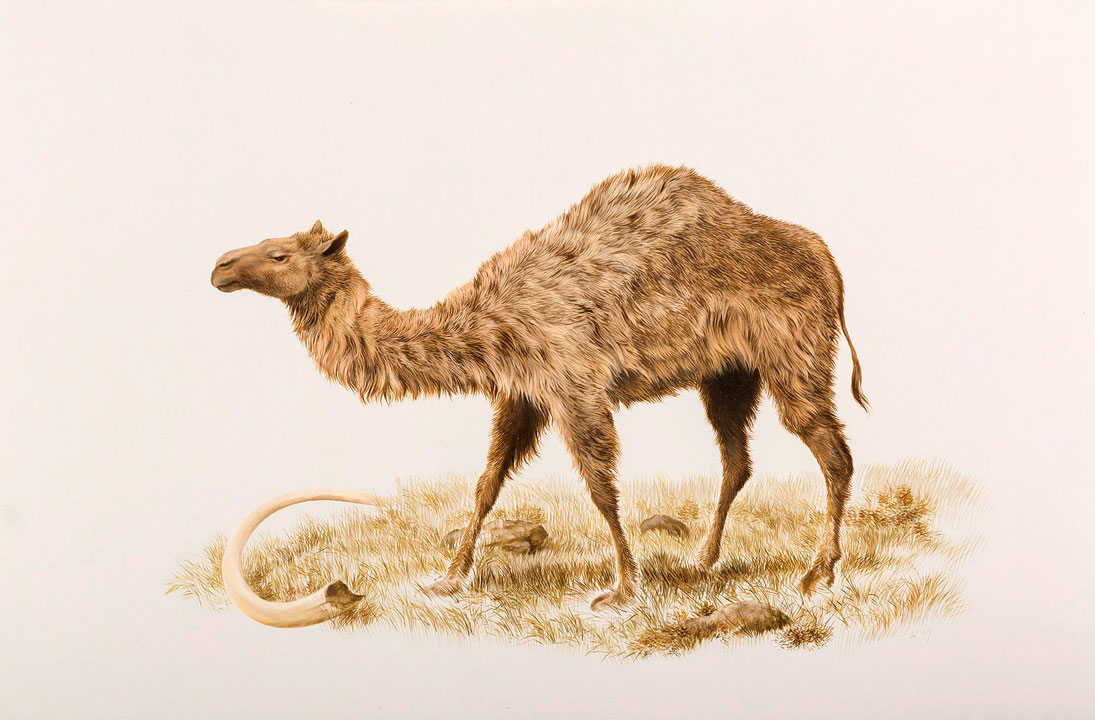
FROM A BYGONE ERA – An artist’s reconstruction of Camelops hesternus , the Western Camel, is shown in this handout image. THE CANADIAN PRESS/HO-Government of Yukon-Artist George Teichmann (1997)
Photo by Photo Submitted
FROM A BYGONE ERA – An artist’s reconstruction of Camelops hesternus , the Western Camel, is shown in this handout image. THE CANADIAN PRESS/HO-Government of Yukon-Artist George Teichmann (1997)
Miners working the Klondike have uncovered an evolutionary treasure that one paleontologist says is as precious as gold.
Miners working the Klondike have uncovered an evolutionary treasure that one paleontologist says is as precious as gold.
Three fossils recovered from a gold mine outside of Dawson City in 2008 are the first Western Camel bones found in the territory and Alaska in decades.
They are forcing scientists to redraw the family tree of the now-extinct, ice-age animal, said Grant Zazula, a paleontologist with the Department of Tourism and Culture.
For decades, scientists believed the Western Camels that once lived in North America were related to llamas and alpacas common to South America.
They now have the genetic proof they are actually more closely tied to the camels inhabiting Asia and Arabia, said Zazula.
“You know gold miners ... spend their whole summer digging through that frozen ground looking for gold, and we couldn’t care less about the gold,” he said.
“For us, the gold is the fossils because it’s this incredible resource for understanding extinct and ancient animals of the ice age. It’s really our gold mine for sure.”
Zazula said scientists can now begin to understand why the camels went extinct 13,000 years ago, at the end of the ice age.
For the past century, paleontologists have studied camels and, based on comparative anatomy, divide bones and fossils into two main branches that led to the animals found in Arabia, Africa and Asia and llamas and alpacas found in South America, said Zazula.
He said paleontologists believed Western Camels were like “giant llamas” or “llamas on steroids.”
That theory began to change in 2008, when miners uncovered bones, preserved in the permafrost, while hydraulically stripping the earth near Dawson City, he said.
The bones were so well-preserved, they still held DNA, unlike other mineralized fossils.
Zazula said a colleague from the American Museum of History picked out the specimens.
“When that was found, we really couldn’t believe it because, like I said, there hasn’t been a camel bone found in over 30 years, and we knew they were so rare and it was so well-preserved.”
Zazula said he sent small pieces of the bone to geneticists at the University of California Santa Cruz who were assisted by a statistician and a geologist.
The results have been published in the journal Molecular Biology and Evolution.
A news release says the DNA indicates the Western Camels split off from the branch that includes modern-day camels about 10 million years ago.
It notes most lived in southern areas of North America, but some made their way north during a relatively warm period of the last ice age about 100,000 years ago.
The animals remained in North America until the end of the ice age, when they went extinct.
Zazula said the findings will make scientists re-examine other species, too.
“There’s something pretty spectacular about holding on to a bone that’s 100,000 years old that can tell us so much about the history of the past and the history of the land you live in,” he said.
“I think that’s pretty spectacular.”
By Keven Drews
The Canadian Press
In order to encourage thoughtful and responsible discussion, website comments will not be visible until a moderator approves them. Please add comments judiciously and refrain from maligning any individual or institution. Read about our user comment and privacy policies.
Your name and email address are required before your comment is posted. Otherwise, your comment will not be posted.
Comments (1)
Up 10 Down 1
Suggestor on Jun 10, 2015 at 5:38 pm
Maybe it's time we started a Dinosaur Museum in Dawson what with all the fossil and bone finds. The 8 million boondoggle funding proposed for soccer stadium with turf that the National team members don't even want would be much better invested in a facility of this sort.
Grande Prairie is developing one at Pipestone which is close to Wembley.