Scientists fighting sovereignty debate: historian
It's not a boundary dispute that will likely end with the country with more military might winning, but rather with science.
By Stephanie Waddell on April 3, 2009
It's not a boundary dispute that will likely end with the country with more military might winning, but rather with science.
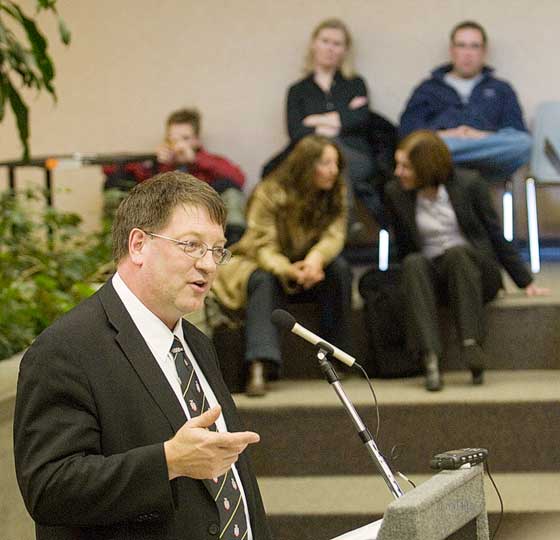
Former Yukoner Ken Coates, a Canadian historian and an expert in northern issues, addressed upwards of 70 people on the issue of Arctic sovereignty at Whitehorse's Yukon College campus Wednesday evening at the annual Maddison Chair lecture.
Along with those who came out in person, others took in the lecture by video conference at Yukon College campuses in Teslin, Watson Lake, Dawson City and Carmacks. Still more were able to view the lecture by webcast.
Coates is currently the Dean of Arts at the University of Waterloo in southwestern Ontario, and has done extensive work on publications and articles involving the Arctic. He told the crowd the issue of Arctic sovereignty that's cropped up over that past three or four years is, in fact, not new.
"This is actually the same thing over again," he said, referring to it instead as a new version of the same debate that's been happening for a century.
Not much has been learned from the previous debates, he said. While it's become a different world and there are different sorts of issues,"it all sounds vaguely familiar," said the graduate of F.H. Collins Secondary School.
At stake is the future of the North, the territories, and Canada's "self image" as a northern nation, among a list of other matters.
It was a series of things that brought the issue of Arctic sovereignty back to the forefront, Coates said, pointing first to the dispute with Denmark in 2004/2005 over the control of Hans Island, which sits between Greenland and Ellesmere Island.
"This is like the turbot war; this wonderful Canadian conflict where we find something really, really inconsequential and get really mad about it," he said. (He was referring to the 1995 seizure of a Spanish vessel that had been fishing while unauthorized in what the federal government called Canadian waters.)
The Hans Island dispute ended in a division of the island with the boundary running down the middle.
What it also did was to get people agitated and questioning where the boundary goes and why it's important.
"It matters for a couple of reasons and they're all pretty much inter-connected," Coates continued.
He cited global warming, which is leading to the opening up of the Northwest and Northeast passages for regular navigation, which changes the dynamics of world-wide shipping.
The dispute over control continues, with Canada arguing the waters are inland and therefore subject to regulation, while Americans argue they are international water and therefore open to transpiration.
"Canadians are very nervous about this and so they should be," Coates said, pointing to the environmental risk facing the Arctic should major shipping take place.
And if what's predicted to come from global warming happens, there could also be a less treacherous route over the North, Coates said.
There's also the matter of resource development, with an estimated one quarter of the world's undeveloped oil and gas deposits in the Arctic waters, with northern countries arguing over who owns the area.
"So what you have now is a very different, very unique version of a great boundary dispute," he said.
The current sovereignty debate is not about the land above water, but rather what's under the water and the continental shelf.
"This is where there's an enormous amount of controversy and an enormous amount of uncertainty," Coates said.
The United Nations' convention on the law of the sea allows countries to bring forward their claims to the continental shelf with research.
Russia is claiming its continental shelf extends to the North Pole, with Canada claiming its shelf pushes out toward the North Pole, and Greenland/Denmark pushing its claim toward the North Pole as well. A further boundary dispute exists between the Canadians and Americans north of Herschel Island.
The debate and format of the tribunal that will hear the matter in 2013, has seen scientists come to the forefront of a boundary issue.
"So we now have this really odd situation, that we haven't paid that much attention to, but will become much more intense as the next couple of years go by, where the sovereignty debate is being fought by scientists," Coates said.
"And scientists are real gentle people; you know, they're the kind of people that chase grizzly bears and pick up their droppings, right?
"They'll do under-water exploration and they do geological testing and ... all this kind of stuff and they're really good-hearted people."
Part of modern science is an international sharing of information discovered. It makes for a new twist on sovereignty issues traditionally solved with power, military might and staking a flag in the ground.
"This one is actually up to the scientists, but there's other pieces as well," Coates said.
He then pointed to reports - that seem to make Canadians nervous - of Russia setting up military units that could defend the high Arctic. Meanwhile, Canadians are applauding the federal government's efforts in the North.
"The Canadian interest in doing the same thing is largely for domestic consumption," he said.
As it has been in the past, Canadian interest in the North is reactionary, Coates noted.
He cited occasions, in some cases, before the Gold Rush where Canada sent representatives to the North to defend its interests.
The Northwest Mounted Police, for example, arrived at Fortymile over concerns expressed to the federal government that it was losing money that could be made from American miners.
That set the stage for officers to be in the territory when the Gold Rush broke out.
It is often as a slow reaction to a perceived threat or presence that Canada focuses on its North, he said.
While the North has gone through many changes since the mid-1980s in aboriginal governance, resource discoveries, research, and the political scene, much of it went unnoticed in southern Canada.
"It's not going to be easy for Canada to (respond) to the current challenges," Coates said.
The country doesn't have a tradition of strong military assertion nor powerful military action, instead taking a more cautious approach in matters, he added.
While history would dictate Canada will take the same route on this matter, Coates said it could also be a turning point for the nation. It could make Canada awaken to the possibilities, he said.
If we're fortunate, he later stated, it could indeed be that turning point to focus on the North and take a more proactive approach.
Be the first to comment