Photo by Whitehorse Star
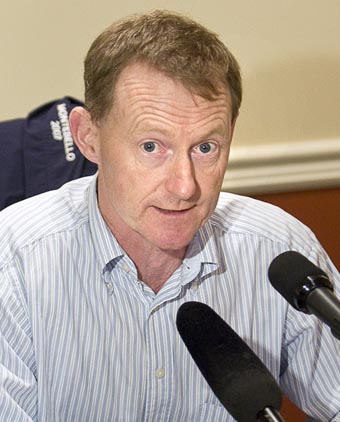
Dr. Brendan Hanley
Photo by Whitehorse Star
Dr. Brendan Hanley
Health and Social Services Minister Glenn Hart was joined by Education Minister Patrick Rouble and the territory's chief medical officer
Health and Social Services Minister Glenn Hart was joined by Education Minister Patrick Rouble and the territory's chief medical officer Tuesday as they dispensed advice on how to best prevent the spread of the so-called swine flu now that children are back at school.
"Schools are being asked to be a little more vigilant,” Hart told a media briefing.
"We are asking them to report high levels of absenteeism and unusual health events to the medical officer of health, as well as to ensure there are adequate hand washing facilities available and an isolation protocol for children who are ill.”
The Yukon's communicable disease officer met with school principals last week to answer questions about the H1N1 virus and to hand out kits which include tissue packs, hand sanitizer dispensers and posters reminding students and teachers to wash their hands often and keep their coughs and sneezes to themselves.
Two years ago, B.C. pediatricians implemented an ad campaign warning parents against the use of antibacterial soaps on their children. Bodies need to come into some contact with germs, the doctors advised, in order to build up immunity.
The Yukon's Dr. Brendan Hanley said the occasional use of hand sanitizing gel when other hand washing facilities are not available is a safe compromise.
"The real concern is with the anti-microbial soaps being used regularly in the home,” Hanley said. ".... I think the use of hand sanitizers as a supplement is not a concern.”
Medical officials have also been talking with school administrators about when to consider closing down schools because too many staff or students are sick.
"We're preparing for worse situations than what we expect,” Hanley said, cautioning people not to get too worried.
There have been no deaths attributed to swine flu in the Yukon, he said, and the territory has been relatively unaffected by the bug.
He noted that while in some American cities the "attack rate” has been as high as seven per cent of the population, the Yukon has seen just a "handful” of mostly mild cases.
No one in the Yukon has died after contracting H1N1.
The virus, originally called swine flu because it is believed to have originated from live pigs, was first identified in Mexico. Pig farmers around the world have pleaded with people to understand the virus is not transferred by eating pork, hence the name change to H1N1.
Hart said there would be an anti-H1N1 vaccine available to Yukoners by December. The vaccine will be given to those who want it at free public clinics which will be held throughout the territory.
Children, seniors, people with pre-existing immune system deficiencies and first nations people have all been identified as being at a greater risk of infection, Hanley said, and will be first on the list to receive the immunization.
In order to encourage thoughtful and responsible discussion, website comments will not be visible until a moderator approves them. Please add comments judiciously and refrain from maligning any individual or institution. Read about our user comment and privacy policies.
Your name and email address are required before your comment is posted. Otherwise, your comment will not be posted.
Be the first to comment