Photo by Whitehorse Star
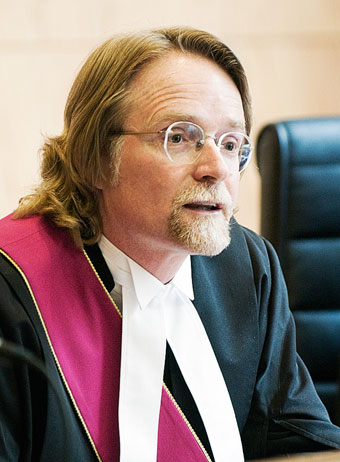
Yukon Supreme Court Justice Leigh Gower
Photo by Whitehorse Star
Yukon Supreme Court Justice Leigh Gower
A 2008 murder victim sold marijuana on an honour system, Yukon Supreme Court heard Thursday.
A 2008 murder victim sold marijuana on an honour system, Yukon Supreme Court heard Thursday.
Gordon Seybold's body was found in the wreckage of his burned-down cabin March 26, 2008. The first-degree murder trial of Christina Asp began earlier this week.
Seybold's long-time friend and former partner, Angelika Lange, told the court Seybold would place drugs and a scale in the locked sauna on his Ibex Valley property and provide trusted customers with a key.
There was a price list on the sauna wall and customers would leave behind money.
The jury of 12 women and two men has already heard a secret-tape conversation between Asp and an undercover RCMP officer where the 34-year-old woman admits to knowing Seybold sold drugs.
Asp later tells the officer, who she believes is the leader of a crime family, that she and her boyfriend beat Seybold to death over a dispute with Asp's mother.
Lange called Seybold her best friend. She described him as a man with a meticulous personality who took good care of himself and liked to run and go to the gym.
In the year before he was killed, the 63-year-old had a stroke which affected his ability to speak. Physically, he was only slightly affected, Lange said.
He continued going to the gym every day and was making progress with a speech therapist.
Lange said Seybold moved from buying and reselling marijuana to growing his own product sometime after the pair broke up in the early 1990s.
She said he had two marijuana-growing operations. One was in a small rented building on neighbouring land while the second larger hydroponic operation was in a two-storey building on his property.
Hydroponic operations involve flooding the roots of the plants with water and nutrients rather than placing them in soil.
The larger unit was built sometime in the 2000s, Lange said.
The setup was "very techie,” she said. "Everything was automated.”
Though she could not give specific numbers, Lange estimated the larger operation had about four times as many plants as the smaller one.
The property's security system included sensors to tell if someone was coming up the driveway or trying to get in the grow-op.
Seybold's cabin did not lock, she said.
Robert Atkinson, the community's volunteer fire chief, told the court that most of the neighbourhood knew about Seybold's operation.
It was the chief who discovered Seybold's burning cabin on the morning his body was found.
Atkinson, whose property shared a driveway with Seybold's, said the home was "fully involved” when he called 911 at around 6 a.m.
Firefighters believed the structure was too far gone and focused their efforts on preventing the flames from spreading, he told Crown prosecutor Bonnie Macdonald Wednesday.
A power line was down and nearby propane tanks could be heard venting from the heat.
Once the cabin was only smoldering ruins, officials moved the collapsed tin roof and noticed a skull and other bones.
The trial, which will continue Monday morning, is expected to last three months.
The jury trial is being heard by Yukon Supreme Court Justice Leigh Gower.
In order to encourage thoughtful and responsible discussion, website comments will not be visible until a moderator approves them. Please add comments judiciously and refrain from maligning any individual or institution. Read about our user comment and privacy policies.
Your name and email address are required before your comment is posted. Otherwise, your comment will not be posted.
Be the first to comment