Photo by Photo Submitted
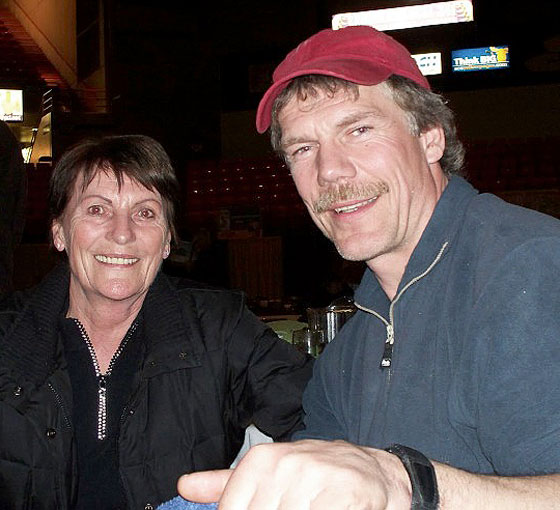
PROUD MOM - Whitehorse musher William Kleedehn has his mother in Anchorage for the start of the Iditarod. They're seen at the musher's start banquet. Photos by JOHN SCHANDELMEIER
Photo by Photo Submitted
PROUD MOM - Whitehorse musher William Kleedehn has his mother in Anchorage for the start of the Iditarod. They're seen at the musher's start banquet. Photos by JOHN SCHANDELMEIER
ANCHORAGE - The parking lot is full at the Millenium Hotel. Ninety-six mushers, and nearly as many race personnel, are here for the mushers' meeting of Iditarod 36, which will start Saturday.
John Schandelmeier, a two-time Yukon Quest champion, will be reporting periodically to Star readers from the trail of the 1,000-mile Iditarod Trail Sled Dog Race.
Along with four Yukon mushers, Zoya DeNure will be on the trail with her husband, Schandelmeier, as handler.
ANCHORAGE - The parking lot is full at the Millenium Hotel. Ninety-six mushers, and nearly as many race personnel, are here for the mushers' meeting of Iditarod 36, which will start Saturday.
The hotel lobby swarms with media personnel and race fans. The place is lit with digital flash as favourite mushers arrive.
For the most part, the drivers duck their heads and hurry into the protection of the meeting room and the comfort of their own.
This is the Iditarod - today, hoop-la and cameras, but in just three more days, it will be the dogs and the challenges of the trail ahead; not so different than any other dog race.
Four Yukoners have signed up for the challenge of the Iditarod: Gerry Willomitzer, Hans Gatt, William Kleedehn and Sebastian Schnuelle.
Gerry, Hans and Sebastian are veterans of this race; William is a rookie. A rookie to this race maybe, but he is an 11-time Yukon Quest veteran who has finished as high as second more than once.
William has been a Canadian for over 20 years. He didn't come here from Germany to race dogs; that just happened, he says.
He started with a few sprint dogs that he used for recreational trips; a friend encouraged him to enter a race, and race he has. The Iditarod will be a new experience for him.
The preparation for this race is far different than that of the Yukon Quest; there are mandatory rookie meetings in December, comprehensive veterinary checks a month later, and complicated food drops in early February.
The food drop alone is daunting; 20 checkpoints rather than the eight that comprise the Quest. The Iditarod requires a minimum of 30 kilograms of food and gear at every checkpoint, whether the driver plans to stop there or not.
Most teams end up sending almost 1,000 kilograms of dogfood and supplies to the various checkpoints along the way.
The Iditarod is expensive; Hans says he can run the Quest for $5,000, double that for this race. The entry fee is $3,000 US, food drops are about $1,100 -
dogs need to return from Nome - the list goes on.
The Canadians also must travel the nearly 1,500-mile, round-trip to Anchorage at least three times.
Sebastion Schnuelle spent most of his winter in Paxson, Alaska.
"Easier for me, I am only a five-hour drive from Anchorage, all of the preliminary races are right around me; there is not the time with travel," Sebastian said in an interview this week.
There is early snow in Paxson, long dog trails and extreme conditions. Two other Iditarod teams train here: Rich Corcoran of Valdez, Alaska, went there to train and my wife, Zoya DeNure, also used these trails.
Corcoran and DeNure are both true rookies; 300 miles has been their longest run.
The Iditarod requires a 200-mile and a 300-mile qualifying race, the same as the Yukon Quest.
Quest veteran Gerry also spends a part of his winter in Alaska; he prefers the trails further south, nearer to Anchorage.
The shorter travel times and the availability of races are also a concern. He has Iditarod experience; 2007 was his rookie year.
"I learned last year; this year, I maybe I can race a bit," he said. "I think you need to do this race a few times to acquire knowledge. There are many real good dog teams in this race that have a lot more experience than I do."
Hans, a three-time Quest champion, is one of those with such experience.
"I have been doing both races; this year, I am concentrating on the Iditarod."
Will he be happy with a top 15 finish?
"No. I want top five."
We'll see - that's why they call it a "race".
One of the most coveted awards of the Iditarod is the rookie award.
The top rookie receives a monetary prize, but more than that, it is a measure of respect in the dog world; this racer is up and coming.
The buzz at the Milleneum was about William Kleedehn.
Is he a shoo-in for the lead rookie?
Maybe. But that is not necessarily William's goal: "I want to have a positive experience.
I need to concentrate on my race and not those of others."
He has a very nice dog team. They are mostly three- and four-year-olds, with only one dog over six.
William always runs a fast team and is extremely focused while on the trail, whether training or racing. He seemed a bit more laid-back to me in the Iditarod banquet room.
"I am going to take care of them and in Nome they will be where they deserve to be."
I will also be in Nome, waiting for the four Canadians I have spent so many hours on the Yukon Quest trail with.
Today, the mushers rest and pace.
Saturday is show-time at the ceremonial start.
Sunday, they race, and they will find the trail as familiar as they all are; dogs and driver together.
By John Schandelmeier
In order to encourage thoughtful and responsible discussion, website comments will not be visible until a moderator approves them. Please add comments judiciously and refrain from maligning any individual or institution. Read about our user comment and privacy policies.
Your name and email address are required before your comment is posted. Otherwise, your comment will not be posted.
Be the first to comment