Photo by Whitehorse Star
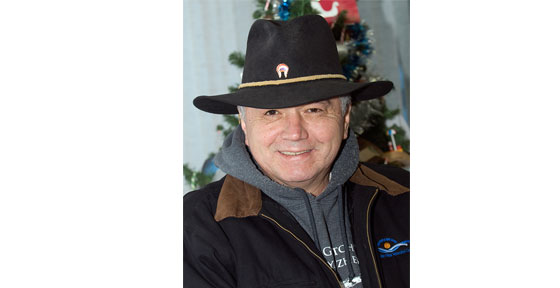
Pictured above: Carl Sydney
Photo by Whitehorse Star
Pictured above: Carl Sydney
First nations say the Department of Fisheries and Oceans' (DFO) narrow interpretation of the Umbrella Final Agreement is preventing the Yukon's Salmon Sub-Committee from doing its job.
First nations say the Department of Fisheries and Oceans' (DFO) narrow interpretation of the Umbrella Final Agreement is preventing the Yukon's Salmon Sub-Committee from doing its job.
At the heart of the looming dispute are meetings between DFO and first nations without the sub-committee's presence, said chair Carl Sydney. And for the first time since the sub-committee's inception, the DFO wants to vet its funding and budget.
"It looks as much that we're trying to be pushed aside," Sydney said at last week's Council of Yukon First Nations' (CYFN's) annual general assembly.
There, delegates from the CYFN's 14 member nations passed a resolution urging Gail Shea, the DFO minister, to instruct department staff to respect the role of the Salmon Sub-Committee.
The resolution goes on to say Yukon first nations will raise the issue of the territory's dwindling salmon stock and its effect on first nations at the Yukon River Panel.
Sydney has taken the protest one step further by writing to American President Barack Obama, highlighting the salmon bycatch courtesy of the pollock industry operating off the Alaskan coast, the massive Alaskan subsistence fishery, and their impacts on Yukon salmon populations.
In 2007, more than 120,000 chinook salmon were caught up in the nets of boats mining the high seas for pollock.
Despite a dramatic decrease in that figure, which fell to 20,000 in 2008, Alaska's subsistence fishery's estimated 50,000 annual catch continued to strain chinook salmon angling to make it to the Canadian side of the Yukon River to spawn.
Meanwhile, because the chinook salmon run - counted at the Yukon-Alaska border, fell well below the norm, DFO closed the commercial and sport salmon fishery on the Yukon River, requested a 50-per-cent reduction in aboriginal salmon harvest and got compliance from all but one first nation.
According to the CYFN resolution, DFO officials ruffled first nations' feathers at a May 27, 2009 meeting with aboriginal governments. With the Salmon Sub-Committee absent, DFO officials delivered news that federal funding for the committee would now be monitored by Fisheries and Oceans.
"(The Salmon Sub-Committee) receives annual funding from the federal government. But it is not part of DFO or (any) federal department. Therefore, it is not appropriate for the DFO to manage or control the operation of the sub-committee as proposed by your officials," reads a June 16, 2009 letter to Shea from the Ta'an Kwach'an Council.
Sydney said DFO's decision to implement similar conservation efforts as the year previous fell in line with sub-committee's wishes, but that's not the point.
"We're not upset at the catch and the amount (first nations) are allowed to take. We're upset with DFO and how they've been behaving," Sydney told the Star this week.
"And (DFO's) news on Friday: 'We've also increased the catch for the first nations and they should be happy.' Yeah, right. That's not the issue. The issue
is what's happening and the fact I had to become aware of some of this stuff through the grapevine."
Like Sydney, Sandy Johnston, DFO's chief management biologist for the Yukon's transboundary region, believes there are ways to improve relations between the sub-committee and the federal ministry; some of which are contained in a recent review of the Umbrella Final Agreement (UFA).
However, Sydney said there has been no move to act on the review, while Johnston said recommendations for the Yukon River salmon stocks, which emanated from the sub-committee, got the go-ahead from first nations.
"I'm not sure (why first nations are not satisfied)," Johnston said. "Going into 2009, it was the same management plan as 2008; it got the full endorsement of the salmon committee so there was nothing to make me believe first nations would believe otherwise."
Johnston added that first nations' needs always take precedence when cuts in the fishery are even contemplated.
"Whenever there's restrictions required, it's precluded by restrictions in the sport and commercial fishery and for the Yukon River those are at zero," said Johnston. "And the last to be affected is the first nation fishery."
A better than expected salmon run on the Yukon River this year could increase the first nations' quota to 6,000 fish, 3/4 of their average annual take, Johnston noted.
As for not including Sydney and the sub-committee in meetings with first nations, Johnston said DFO is following the letter of the final agreement.
"DFO has a fiduciary responsibility to meet with first nations directly, so the Salmon Sub-Committee isn't invited to every meeting," he said. "It's not just our doing but it's also been at the request of first nations."
According to the final agreement, the Salmon Sub-Committee of the Yukon Fish and Wildlife Management Board, "shall be established as the main instrument of salmon management in the Yukon."
Its 10 members, appointed by DFO, the management board and first nations, are charged with making recommendations to the DFO minister "on all matters related to salmon, their habitats and management, including legislation, research, policies and programs."
But problems run deeper than cutting the Salmon Sub-Committee out of the loop, Sydney said.
"We operated all last year with six members. We're a 10-member committee and it's been 18 months since the first nations made their nominations," said Sydney, who described short-staffed operations as a "headache".
"Those nominations are just sitting on the (DFO) minister's desk and the minister doesn't seem to do bugger all about it."According to a DFO spokesman in Ottawa, Shea, "is consulting stakeholders to make those appointments."
The process is near completion and announcements are expected shortly.
But this assurance offers cold comfort to first nations leaders who feel DFO has overstepped its bounds.
At the CYFN assembly, Ruth Massie, Ta'an Kwach'an chief, spoke of DFO's apparent misunderstanding of the Umbrella Final Agreement and the importance of the sub-committee in deliberations on salmon.
"It appears they're intepreting the UFA in a very narrow manner," Massie said. "... furthermore, we need to decide which actions we can take to preserve our salmon."
In order to encourage thoughtful and responsible discussion, website comments will not be visible until a moderator approves them. Please add comments judiciously and refrain from maligning any individual or institution. Read about our user comment and privacy policies.
Your name and email address are required before your comment is posted. Otherwise, your comment will not be posted.
Comments (1)
Up 0 Down 0
Josey Wales on Jul 23, 2009 at 11:31 am
...or perhaps "FN's" are interpreting the UFA in a very excessively wide, entitled & elitisted manner...as per!