Photo by Vince Fedoroff
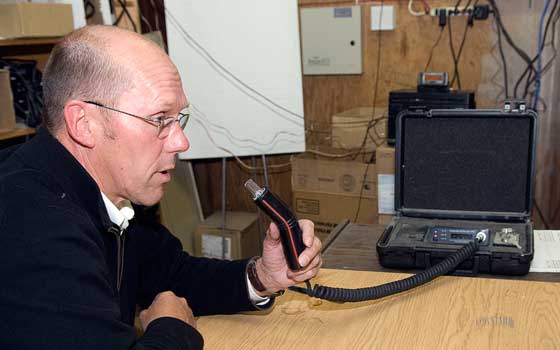
KEEPING INTOXICATED DRIVERS MOTIONLESS - Ken Baxendale, the manager of NAPA Auto Parts in Whitehorse, explains the alcohol ignition interlock system Monday afternoon.
Photo by Vince Fedoroff
KEEPING INTOXICATED DRIVERS MOTIONLESS - Ken Baxendale, the manager of NAPA Auto Parts in Whitehorse, explains the alcohol ignition interlock system Monday afternoon.
Getting busted for drinking and driving used to mean losing your licence for a year or more, a consequence that would keep many Yukoners from getting to work or even the grocery store.
Getting busted for drinking and driving used to mean losing your licence for a year or more, a consequence that would keep many Yukoners from getting to work or even the grocery store.
But since 2002, the Yukon's Driver Control Board has been trying to get people back on the road with the help of the Ignition Interlock Program (IIP).
Last week, it relaxed the program's rules with the aim of getting more people back behind the wheel.
"It's a great learning tool," board chair Tom Fairman says of the IIP, "and we're trying to get more people on the interlock system."
The program permits people who have lost their licences due to an impaired driving conviction to start driving again, as long as they can prove they haven't been drinking before they get behind the wheel.
The interlock device (comprised of a small black box, a breath-sampling apparatus and an ignition lock) is installed in a prohibited driver's vehicle. It requires the driver to give a breath sample every time he or she starts the vehicle, and then at random times while driving.
The system has a two-fold purpose, Fairman says: to get people who are barred from driving because of drunk driving convictions back on the road with an assurance they won't do so under the influence, and to enlighten them about what exactly "zero tolerance" means.
"It takes a while to get used to," says Ken Baxendale, manager at NAPA Auto Parts, the company which installs and maintains the devices.
It is not a matter of simply blowing into the machine, he explains.
The driver must blow forcefully into the mouthpiece, then hum while continuing to blow. (A digital screen flashes commands such as "blow harder" or "blow softer" if the user isn't doing it right.) This is to ensure that the driver isn't using something other than his lungs to blow air into the device, or having a child do the job.
"A can of compressed air can't hum," Baxendale says. "And according to ACS (the company that makes and distributes the device), a child of 12 or 13 would have trouble blowing with the required force."
Once the car or truck has been successfully started, the driver is still on the hook. The device randomly asks for a fresh sample while the vehicle is in motion.
"And it is random," Baxendale says.
If the driver doesn't provide another blow and hum within three minutes, an alarm goes off under the hood and the car must be turned off in order to silence it.
Both Fairman and Baxendale agree the most valuable aspect of the IIP is that it teaches people that "just one drink" is still over the limit when they are under a driving restriction.
A vehicle with the interlock installed won't start if it detects a blood alcohol level of 0.02 or more.
"Talking to people in the first two weeks, they get a lot of fails," Fairman says, because it takes them a while to realize just what zero tolerance means.
The device is extremely sensitive and will pick up the traces of alcohol left by mouthwash, toothpaste and even cough drops.
More importantly, says Fairman, it will detect alcohol left over from the night before.
"A lot of people go to the bar, they leave at one or two in the morning, leaving their vehicle behind, and when they come back for it in the morning, their car won't start."
He says many people who drink regularly don't realize they may still be impaired the morning after, and learning that is an important step to understanding how alcohol affects their life.
"People say they don't have a problem with alcohol, but they've gone to court and been fined $1,000 and prohibited from driving - that shows they have a problem with alcohol."
Anyone who is under a driving prohibition because of an impaired driving conviction is eligible for the program. It used to be that a person would have to get a judge's permission to apply, but now they can apply directly to the driver control board after a mandatory wait period.
First-time offenders have to wait three months before they can get on the program. After that, they have to spend the remaining nine months of their probation using the system, at the end of which they get back their full driving privileges as long as they have gone six months without any fails.
As far as criteria for successful applicants go, Fairman says a willingness to enter the program, and pay for it, is usually enough.
Anyone convicted of drunk driving can apply to the program, but people who want in have to foot the bill themselves, and the cost is not insignificant.
Installation of the device costs $200. It then costs $4.10 a day to monitor and maintain, and finally $50 to remove, all of which is done at NAPA.
The program receives no government funding so cost is a very real obstacle for many.
"We generally try to tailor it to a person's budget," Baxendale says, explaining that the user must pay in advance for up to 68 days of monitoring, which would cost $278.80 plus tax.
"The full amount of time is sometimes outside of people's monthly budget, so we don't hold them to a particular time period."
But as Fairman points out, the cost of the system is the same as the cost of a drink a day.
"That's one of the compromises the person has to be willing to make," he says.
Not everyone is a fan of the program. Only a tiny percentage of people convicted of drunk driving actually use the system, and just 79 units have been installed in the last six years.
Whitehorse defence lawyer Malcolm Campbell describes impaired driving as "usually a victimless crime."
He says strict driving prohibitions for people convicted of impaired driving are all well and good in large cities where people have access to public transit, but not having a driver's licence in the Yukon can mean unemployment and an inability to access necessary services.
Fairman disagrees wholeheartedly with the victimless crime characterization.
"Drunk driving is still the number one cause of criminal death in Canada," he points out, and all efforts should be made to prevent it.
Campbell suggests, somewhat rhetorically, that if the government is really serious about stopping drunk drivers, it should make the interlock device standard in all vehicles. That may sound like a far-fetched solution, but it may not be.
In Sweden, there are more than 40,000 interlock devices installed in taxis, public buses, train cars, transport trucks and ferries, according to ACS spokesman Ian Marples.
"They see interlock as one more element in keeping their investment safe," he said of business owners who choose to have it in their vehicles.
Currently, the system is not available in Canada for commercial vehicles, but Marples says that is something his company is looking toward.
Future considerations aside, the interlock system offers two major hurdles to offenders who want to get back on the road.
One is the price tag, which, Justice of the Peace Dean Cameron says, "is not always made very clear (to the public). I do think that some people can't afford it."
He does add, however, that the money spent could likely be written off as a work expense.
The other obstacle is the inconvenience, bearable for a period of months, but not necessarily for years.
Long-term users often get frustrated with the constant blowing and beeping and end up giving up the system, along with their licences.
"It translates into a level of inconvenience, that someone using it voluntarily probably wouldn't put up with," Marples says of the highly sensitive devices available here. The ones sold to transport companies in Europe are not set to a zero-tolerance level, he notes.
"I only have one person who has used it for more than two years," Baxendale says, although people with more than a couple of driving offences on their records are required to use the device for five years and beyond, if they want to get their licence back.
In order to encourage thoughtful and responsible discussion, website comments will not be visible until a moderator approves them. Please add comments judiciously and refrain from maligning any individual or institution. Read about our user comment and privacy policies.
Your name and email address are required before your comment is posted. Otherwise, your comment will not be posted.
Comments (3)
Up 0 Down 0
Arn Anderson on Feb 5, 2009 at 6:43 am
There are more crappy drivers than drunk drivers. Most of the drunk drivers are at night during the weekends. How many accidents happen on those nights? Hardly none, but all the stupid drivers during the day lots of accidents. I see no enforcement of stupid drivers by any law enforcement agency especially the by the bylaw. Ive seen countless times where people run red lights, turn on no turning lanes, go down a 50 zone at slower than 25, just plane idiocy in front of the bylaw and some RCMP.
I think its time to start evaluating drivers license every time it needs to get renewed, but lets focus on drinking and driving which hardly accounts for accidents in the Yukon.
Up 0 Down 0
Wayne Campbell on Jan 30, 2009 at 12:22 pm
I'm sorprised Mr. Fairman allowed his name to be used. The Driver Control Board is usually ultr-secretive. It's impossible to find any information about them available publicly.
Why pay any attention to Mr. Baxendale? He has a monetary motive to promote the IIP.
Up 0 Down 0
Kevin Taylor on Jan 30, 2009 at 11:32 am
Okay, let me get this straight. In order to use this system you have to give a breath sample and if no is alcohol present, the vehicle will start.
Once IN MOTION (at this time the person behind the wheel is, or should be concentrating on driving), the system at any given time will ask for a breath sample while in motion, while the driver is suppose to be paying attention to the road and his surroundings he/she now has to give another breath sample.
Hmmm, wouldn't this be like answering the cell phone while driving? Isn't this going to take the driver's mind off of what he/she is doing to give a breath sample?
Is the driver going to pull over to give that sample? I tend to think not, how many pull over to answer a phone call?
Most do not pull over for a phone call and some jurdistictions are in the process of banning cell phone use in the vehicle while driving, why?
Because it takes away the driver's attention and can cause an accident that's why.
So, other than the ability to get to work or to get to the grocery store does this really make our roads any safer?
Just my thoughts, safety first!