Photo by Whitehorse Star
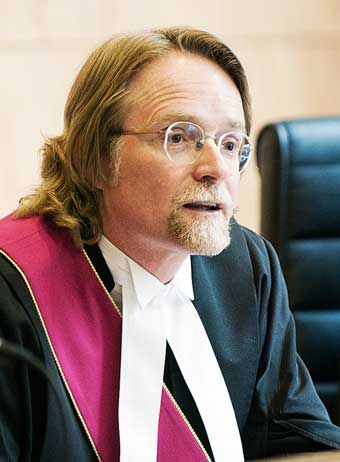
Justice Leigh Gower
Photo by Whitehorse Star
Justice Leigh Gower
The federal government's state of mind is in question, Justice Leigh Gower of the Yukon Supreme Court found in a 26-page decision issued last Friday.
The federal government's state of mind is in question, Justice Leigh Gower of the Yukon Supreme Court found in a 26-page decision issued last Friday.
The judge ruled on a complex legal argument that the Ross River Dena Council is also entitled to a federal report documenting the history of the Kaska people, given Ottawa's statement that it has "no knowledge" of the aboriginal claims by the Kaska people in the Yukon.
Canada was ordered to provide the document to the Ross River Dena Council by 4 p.m. today.
Gower's decision comes as the most recent in a series of court appearances between the two parties over the last couple of years, as they move toward the eventual main trial.
The Ross River Dena Council is suing Ottawa, arguing it breached a constitutional obligation to reach a fair and negotiated settlement with the Ross River Kaska before assuming ownership over the land and resources that make up the council's traditional territory.
The Ross River Dena Council will be in court again next week on another preliminary matter to challenge the federal government's assertion that it has "no knowledge" of the Kaskas' claim to aboriginal rights and title in the Yukon.
In a court appearance in early December, Whitehorse lawyer Steve Walsh sought an order from Gower forcing Canada to turn over the report it commissioned in 1982 to verify aboriginal claims by the Kaska in northern B.C.
Based on that report, the federal government agreed in 1983 to enter into negotiations with the Kaska in northern B.C.
Suzzane Duncan of the local Crown's office argued the federal government didn't have to turn over the report, for a number of reasons.
She argued, for instance, the contents of the document were protected by lawyer-client confidentiality between the federal Department of Justice and the federal Department of Indian and Northern Affairs.
Even if the court found it wasn't protected, the 1982 report was not relevant because it focuses on the aboriginal claims filed by the Kaska in northern B.C., Duncan argued.
Walsh, however, countered that the document might be relevant because it examines the history of the Kaska people, and does not qualify for protection under lawyer-client confidentiality.
Gower ruled the '82 report was not protected by confidentiality provisions, citing reasons in several rulings from higher courts, including the Supreme Court of Canada.
The document, which he read as part of his deliberations, does make reference to the Kaska in the Yukon, he pointed out in his decision.
Furthermore, Gower went on to find, even if the document was protected by client-lawyer privilege, Ottawa surrendered the right to that protection when it claimed it had "no knowledge" of aboriginal claims by Kaska living in the Yukon.
Under the law, Walsh argued, when a party uses its state of mind - in this case, "no knowledge" - in its statements to the court, the opposing party has the right to examine that state of mind.
Walsh argued the superior courts have ruled when documents may have relevance, either to support or destroy a case, it is of the utmost importance they be allowed as
evidence, for the sake of fairness.
When Ottawa claimed "no knowledge" of the aboriginal claims of the Kaska living in the Yukon, it gave up any right it had to keep the 1982 report confidential, because the document "may" be pertinent in examining Canada's state of mind, Walsh argued.
Gower agreed.
In his decision, the justice wrote that had Canada acknowledged the claims of the Ross River Kaska, and then simply challenged the validity of those claims, it would not have waived the client-lawyer privilege, if it did exist.
By indicating it had "no knowledge" whatsoever of claims to aboriginal rights and title by Kaska in the Yukon, the Ross River Dena Council now has the right to see the information that may be pertinent in testing that statement, Gower indicated.
"... Here, counsel for RRDC submits that, in pleading that is has 'no knowledge' of whether the RRDC and its members are part of the Kaska tribe of Indians, or whether the Kaska or the Kaska Nation is one of the aboriginal peoples of Canada, and whether and where the Kaska's traditional territory exists in the Yukon, Canada has made an affirmative pleading with respect to its state of mind," Gower writes in his decision.
"Accordingly, the RRDC ought to be able to make discovery of facts that relate to Canada's state of mind and fairness dictates that any privilege associated with such facts has been displaced."
The justice ordered the federal government to pay the costs of the Dena council of this most recent challenge, if Ross River wins the main event some time down the road.
In an interview Tuesday, Walsh said the council's intent next week is to simply prevent the federal government from hiding behind a falsehood.
"You cannot plead something that you know is not to be true," he said. "There is just no basis for them to claim they have 'no knowledge.'"
The Ross River Dena Council will ask the court to throw out sections of the federal government's statement of defence where it claims "no knowledge" of the Kaska's claims to aboriginal rights and title, Walsh explained.
The 1982 report, he noted, is only a piece of the evidence the Dena council plans to introduce to show Canada does have knowledge of the Kaskas' claims in the Yukon.
Walsh pointed out, for instance, the federal government has included maps on its website showing and explaining the traditional territory of the Kaska Nation and its connection
to Ross River.
The Ross River Dena Council maintains the federal government never had a legal right to assume ownership and management over the land and resources that make up the traditional territory of the Ross River Kaska, because there was no negotiated settlement.
Ottawa, the council argues, failed in its obligation under the Constitution to negotiate a fair settlement with honour, and instead walked away from the negotiating table seven years ago.
The Kaska, the suit maintains, are entitled to the benefits Canada received from resources taken from Kaska land, including the benefits the federal government received from projects like the Faro lead-zinc mine, for instance.
Ottawa attempted in late 2007 to have the Ross River case thrown out, arguing it was groundless, bordered on ridiculous and was an abuse of the court process.
Gower, on the other hand, not only refused to throw out the lawsuit, but went on to suggest it could amount to one of most important constitutional cases in the Yukon's history.
Eleven of the Yukon's 14 first nations have finalized land claim and self-government agreements, according to the guidelines set out in the Umbrella Final Agreement.
The Kaska of the Ross River Dena Council and the Liard First Nation of Watson Lake have been fundamentally opposed to conditions set out in the umbrella agreement since the Kaska voted against it in 1993.
Walsh said the Kaska have indicated to Ottawa on numerous occasions that they are willing to negotiate a settlement, but not under the Umbrella Final Agreement.
"There is no doubt my client would prefer to be negotiating rather than litigating, and they have expressed that to Canada repeatedly, in writing," he said. "This is not a situation where there is no negotiations because we are in court litigating.
"It is the other way around; we are in court litigating because we have no table to go to."
In order to encourage thoughtful and responsible discussion, website comments will not be visible until a moderator approves them. Please add comments judiciously and refrain from maligning any individual or institution. Read about our user comment and privacy policies.
Your name and email address are required before your comment is posted. Otherwise, your comment will not be posted.
Comments (2)
Up 0 Down 0
Arn Anderson on Jan 29, 2009 at 9:53 am
By the time they are done with all these legal procedings the Kaska nation will be left with five dollars to spend on its self govt while the lawyers will overloaded with money from their new found wealth in First Nation legal matters.
Up 0 Down 0
John Lome on Jan 28, 2009 at 4:44 pm
It sounds like the old "the dog ate my homework" scam. Even the Territorial Gov.does ,sort of, better than that.
Did these people actually graduate kindergarten, or were they moved onward because they required more than "child portions"?