Ross River bridge to be demolished
The Ross River suspension bridge will be demolished, the Yukon government announced today.
By Ainslie Cruickshank on October 2, 2013
The Ross River suspension bridge will be demolished, the Yukon government announced today.
There is no indication at this point when the demolition will occur.
"Right now we're dealing with the public safety concern first and ... over the next few days we'll have a better idea of when we'll be able to demolish the bridge,” Jennifer Macgillivray, the director of infrastructure development with Community Services, said today.
"It would be ideal to carry out the demolition work off the ice, but if we can demolish it safer sooner than we'll look into that.”
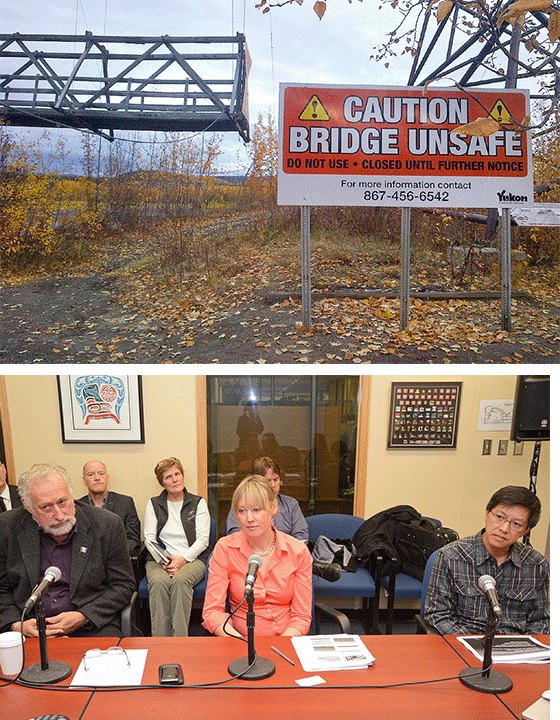
Just shy of 70 years old, the pedestrian bridge has technically been closed to the public due to safety concerns since August 2012.
But there's anecdotal evidence the bridge was being used up until this past weekend when the government was told by a contracted structural engineer that it was at imminent risk of collapse.
As a result, further efforts were made to keep community members off the dangerous structure. The stairs were removed and better barriers were added to the towers, joining signage already present at the site.
The ferry, which runs downstream from the bridge, was closed for a day and is now running at a reduced schedule and under strict safety guidelines, as reported yesterday by the Star.
Jerry Lum, a structural engineer for the North Vancouver-based David Nairne and Associates Ltd., gave a technical briefing to media today outlining the detailed assessment report of the bridge he provided to the government over the weekend.
Lum's report finds that the suspension bridge has "exceeded” its safe life span, it is in "poor overall structural condition,” it's "severely over-stressed,” critical aspects of the structure are "deteriorating rapidly,” and the "north tower head beam (is) at the point of collapse.”
His conclusion: "It is no longer practical from a structural and construction safety perspective to repair and salvage the bridge.”
Lum explained that the bridge was constructed in 1944 to carry an oil pipeline to supply the war effort. It was constructed quickly and as a temporary structure, he said. As such it lacks many details that are normal practice today, he added, noting it is not painted and many of the fasteners are not galvanized.
"I do not think the U.S. Army had intended the bridge to be used as a pedestrian bridge for 70 years,” he said.
Lum noted that the bridge was originally built to hold a pipeline, an estimated weight of 50,000 lbs.
When it was converted to a pedestrian bridge after the Second World War, new timber decking was added, estimated to weigh about 60,000 lbs. The weight of pedestrians or snow loading according to the bridge code is estimated at 120,000 lbs. That's a total estimated weight of 180,000 lbs. – 130,000 lbs. more than it was originally built to hold.
Lum briefly went through the bridge's history of assessments and repairs, noting that a 1984 report by the government found "...the bridge elements are severely over-stressed under pedestrian loads...” That report also included a cost estimate for the demolition of the bridge.
Since 2005 there's been a series of repairs to the bridge, Lum noted.
"Usually when you have a cluster of repairs at a certain point in the lifespan of a structure, that tells me it's near the end of its life,” he said.
"And of course when you have an older structure you have to make a decision when it is practical to keep repairing it or whether it's time for the structure to be removed. And this is the case here where I believe the bridge should be removed.”
Just a few months ago in June, Community Services announced the bridge would undergo further assessment and be repaired. The department estimated it would cost about $1.1 million.
When asked if opting to repair the bridge earlier this summer was, in his expert opinion, the right decision, Lum said, "Yes, every effort was being made to repair the bridge and extend the life. These repairs were intended to be short term repairs and we were anticipating that the repairs would have to be monitored every year to see if anything else was going to deteriorate.”
Responding to questions from the media, Macgillivray explained why the decision was not made to demolish the bridge in say 2005.
"The damage has increased in severity since then, so at that point the bridge wasn't at this stage structurally. We know the bridge is important to the community and the repairs that we did enabled the bridge to be used for a few more years,” she said.
As it stands, various aspects of the bridge are severely compromised, Lum explained, sharing photos from his report.
Posts from the bridge are bearing directly on the ground with no foundation, parts of the guard rail are missing or loose, there are broken or damaged connections in the deck sway frame, the bridge itself is twisted, and there's a gap between the landing and bridge deck. The decking is worn, the bridge deck sways – quite significantly in the wind – suspension anchors are flooded, there are cracks in the diagonal bracing, and the sway cable anchors are undersized and deformed.
The leaning and severely cracked head beam of the north tower appears to be among the most pressing concerns. Since 2009, the lean has increased from four to 12 degrees.
In a Sept. 28 memo Lum said the beam could collapse at any point without warning.
The government has posted two videos showing damage to the bridge on Youtube. These can also be viewed on the Star's Facebook page.
Ben Yu Schott, the director of communications for Community Services, said the community of Ross River has been kept up to date on the situation, noting a meeting with the chief and council took place yesterday.
As long as the risk remains manageable, the ferry will continue to run on a reduced schedule, following established safety guidelines, until Oct. 10, when it was set to close for the season.
Vehicles will continue to be transported on the ferry, while members of the public will be taken across by speedboat.
Mike Johnson, the deputy minister of Highways and Public Works, said one outfitter had 27 horses on the north side of the river that needed to cross. The outfitter was scheduled to bring eight across earlier today. The horses will cross in the trailer on the ferry while the outfitter will be taken across via the speedboat, Johnson said.
For community members who live permanently on the north side, Macgillivray said they will have to make arrangements, including stocking up on supplies, for the period between Oct. 10, when the ferry stops running, and freeze-up.
"The community of Dawson faces a similar situation this time of year and I think that there just needs to be some preparations made in order for those people to not use the bridge. It was the same situation last year,” she said.
Be the first to comment